Bucharest Stock Exchange (Bursa de Valori București)
Bucharest, Romania · Established 1882
This site requires authorization to access.
To request access, contact
william.goetzmann@yale.edu
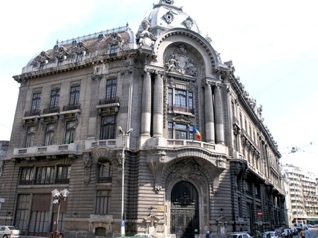
The Palace of the Bucharest Stock Exchange (Palatul Bursei) stands at the intersection of Strada Doamnei and Strada Ion Ghica as one of the finest Beaux-Arts edifices of early twentieth-century Bucharest. Authorized by Law 863 of 25 February 1906, the project advanced through an international architectural competition held in early 1907, attracting fourteen submissions from Romanian, French, German, and Austrian firms. The jury awarded first prize—8,000 lei in gold—to the project submitted under the motto “JUS” by the Romanian architect Ștefan Burcuș. Prince Ferdinand and Princess Maria laid the cornerstone on 11 May 1908, and King Carol I presided over the solemn inauguration on 27 May 1911, at a total construction cost of approximately 800,000 lei in gold. The Italian contractors Domenico Costa and Luigi Farabosco executed the works under the structural supervision of the pioneering engineer Gogu Constantinescu, who employed reinforced concrete floors and special brick walls to ensure seismic stability and fire resistance—techniques documented by Petrescu et al. in the American Journal of Engineering and Applied Sciences (2017). The palace rises over two principal stories, an attic, a mansarded roof, and a basement, with a constructed surface of 1,957 square meters. Its monumental facade progresses from rusticated bossage on the lower registers through Ionic pilasters and capitals on the upper stories to delicate wrought-iron balcony balustrades, a compositional gradation that period critics praised as “a monument of simple and beautiful majesty, with a grandiose, classical and lively facade.” A curved corner volume crowned by a dome anchors the streetscape. After housing the National Library of Romania from 1955 to 2008, the building was returned to the Chamber of Commerce and Industry of Bucharest.
The decorative program of the Palatul Bursei synthesizes architectural sculpture, allegorical relief, and painterly interior finishes in the manner characteristic of Bucharest’s Belle Époque institutional buildings. The facade ornaments were executed by the German-born sculptor Emil Wilhelm Becker, who declared in a May 1910 interview his responsibility for “the general ornamentation of the facade of the new Palace of the Chamber of Commerce.” Becker’s most prominent contribution is the semicircular pediment above the main entrance, centered on a lion’s-head escutcheon flanked by two allegorical figures rendered at natural scale: on the left, Industry, a draped female figure resting her hand upon a hammer; on the right, Commerce, represented as the god Mercury bearing the caduceus in his left hand and an anchor in his right. The roof ornaments were separately modeled by the sculptor Alexandru Dimitriu, contributing to the richly layered silhouette of dormers, round gables, and interrupted cornices visible from the street. Inside, the interiors feature partially gilt, polychrome stucco on walls and ceilings, with marble flooring in hallways and on the octagonal honor staircase displaying geometric patterns in multiple colors. The former council hall preserves ceiling paintings and four panels above its doors executed in the manner of François Boucher—pastoral and mythological compositions in the rococo vein that reflect the francophone decorative taste prevalent among Bucharest’s commercial elite. The ellipsoidal trading hall, the former Chamber session room, and the grand vestibule are described in period accounts as “executed with great mastery,” their spatial drama enhanced by the interplay of natural light from mansard skylights and the ornamental ironwork of upper balconies.
The Palatul Bursei occupies a pivotal site in the historic commercial core of Bucharest, a city whose transformation into a modern European capital accelerated dramatically after the union of the Romanian Principalities in 1859 and the proclamation of the Kingdom in 1881. Under King Carol I, the government recruited French architects to redesign the capital along Haussmannian lines, widening boulevards and erecting monumental public buildings that earned Bucharest the sobriquet “Little Paris of the East,” as described in Keith Hitchins’s A Concise History of Romania (Cambridge, 2014). The principal axis of this transformation was Calea Victoriei, renamed in 1878 to commemorate Romania’s victory in the War of Independence against the Ottoman Empire. Along this avenue and its immediate environs rose the institutions of the new Romanian state’s financial infrastructure: the National Bank of Romania palace (1884–1890), designed by Cassien Bernard and Albert Galleron, both former students of Charles Garnier; and the CEC Palace (1897–1900), the headquarters of Romania’s oldest savings institution, designed by the French architect Paul Gottereau in an eclectic Baroque-Renaissance idiom. The Stock Exchange Palace, located just east of Calea Victoriei on Strada Doamnei, completed this institutional triangle. As John R. Lampe and Marvin R. Jackson observed in Balkan Economic History, 1550–1950 (Indiana University Press, 1982), Romania enjoyed the largest industrial sector and deepest domestic market in the Balkan region, and Bucharest’s Belle Époque streetscape expressed this economic ambition architecturally.
The Bucharest Stock Exchange was established by royal decree of King Carol I in 1881, with its inaugural trading session held on 1 December 1882 in the Bucharest Chamber of Commerce Palace. The exchange’s creation reflected the industrialization program of the National Liberal Party under Prime Minister Ion C. Brătianu, whose protectionist tariff policies of the 1880s sought to channel agricultural export earnings into domestic manufacturing and infrastructure, as Keith Hitchins detailed in Rumania, 1866–1947 (Oxford University Press, 1994). Initially modeled on the French monopolistic bourse system, the exchange was reformed in 1904 when the Ministry of Finance introduced regulations shifting toward a more liberal Austrian-style framework permitting direct transactions among members of the Stock Exchange Corporation. As Oosterlinck and Ureche-Rangau demonstrated in “Interwar Romanian Sovereign Bonds” (Financial History Review, vol. 19, 2012), international diplomacy significantly influenced Romanian debt valuation during this period. At the time of its closure, 93 companies listed shares and 77 fixed-income securities were traded. The communist government’s Law No. 119 of 11 June 1948 nationalized over 1,060 enterprises and shuttered the exchange. The Bucharest Stock Exchange reopened on 20 November 1995 under Law No. 52/1994, notably later than the Budapest (1990), Warsaw (1991), and Prague (1993) exchanges, reflecting Romania’s hesitant post-Ceaușescu transition. By 2005, the BVB had absorbed RASDAQ and converted to a joint-stock company; in 2010 it listed its own shares.
From its 1882 founding, the Bucharest Stock Exchange operated as a mixed bourse for both commodities and securities, reflecting Romania’s position as one of southeastern Europe’s most resource-rich economies. Government bonds and municipal bonds dominated early listings, financing the railway network that expanded from roughly 1,360 kilometers in 1880 to over 3,000 by the early 1900s, as documented by Lampe and Jackson in Balkan Economic History (1982). Shares of the Banca Națională a României, established in 1880 as the state’s central bank with a monopoly on currency issuance, were among the exchange’s foundational listings. Romania’s cereal trade—wheat, maize, and barley shipped via the Danube ports of Brăila and Galați to Western European markets—generated the commercial revenues that underpinned early securities activity. The Russo-Turkish Treaty of Adrianople (1829) had granted the Romanian Principalities full freedom of Danubian commerce, and by the late nineteenth century Romania was widely known as “Europe’s granary.” Petroleum transformed the exchange’s character after 1900. Romania was the site of the world’s first recorded systematic oil refinery near Ploiești in 1857, and production surged from 250,000 tons in 1900 to 1.9 million in 1913 and 8.7 million by 1936, making the country the fourth- to sixth-largest oil producer worldwide during the interwar period. Major petroleum companies traded on the exchange included Steaua Română, reorganized by Deutsche Bank in 1903 into Europe’s largest refinery processing 400,000 tons annually, and Astra Română, founded by Royal Dutch Shell in 1908–1911. At closure in 1948, the exchange listed securities across banking, petroleum, mining, insurance, and transportation sectors.