Bourse at Bruges
Bruges, Belgium · Established 1285

This site requires authorization to access.
To request access, contact
william.goetzmann@yale.edu
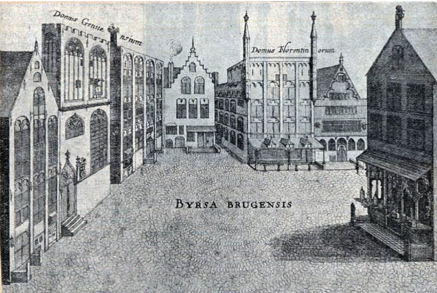
The Huis ter Beurze at Vlamingstraat 35 in Bruges stands on one of the most consequential sites in the history of global finance. The Van der Beurze family operated an inn here from at least 1285, when Robert van der Beurze established the hostelry. The small square in front — the Beursplein (now Oude Beursplein) — became the customary open-air gathering place where foreign merchants negotiated deals, exchanged currencies, and settled accounts. The family coat of arms displayed three purses (Flemish: buerzen, from Latin bursa), and the name of their establishment gave rise to one of the most enduring words in global finance: bourse in French, Borse in German, bolsa in Spanish and Portuguese, borsa in Italian, birzha in Russian, and bors in Danish and Norwegian. Around the Beursplein, a cluster of foreign 'nation houses' arose: the Venetian consulate occupied a building adjacent to the Ter Beurze inn from 1397, while the Genoese built their Saaihalle loggia with large Gothic windows in 1399, and the Florentine house stood across the square. The current building was rebuilt by Jacob van der Buerse in the fifteenth century. Its facade was remodeled in the neoclassical style during the eighteenth century, but in 1947 it was restored to its medieval Gothic appearance based on a seventeenth-century engraving by Antonius Sanderus in his Flandria Illustrata (1641).
The artistic heritage of the Bruges exchange district is inseparable from the extraordinary flowering of Flemish painting that the city's commercial wealth sustained. Jan van Eyck, who settled in Bruges around 1430, received many of his most important commissions from the cosmopolitan merchant community — Italian bankers and traders such as the Arnolfini, the Giustiniani, and the Lomellini — whose portraits he rendered with unprecedented naturalistic detail. His successor Petrus Christus, the leading painter in Bruges from the 1440s to the 1470s, painted A Goldsmith in His Shop (1449, now in the Metropolitan Museum of Art), depicting a red-clad goldsmith weighing a ring on his scales for a well-dressed couple — a vivid window into the luxury commerce that thrived in the city's mercantile quarter. Hans Memling, who became one of the wealthiest citizens of Bruges by 1480, painted portraits of prominent merchants including Tommaso Portinari, the Florentine manager of the Medici bank's Bruges branch, and his wife Maria Baroncelli, capturing the faces of the very bankers who conducted business steps from the Beursplein. The architectural record of the exchange district itself was preserved by Antonius Sanderus, whose engraving of the Huis ter Beurze in Flandria Illustrata (1641) became the basis for the building's twentieth-century restoration.
In the thirteenth through fifteenth centuries, Bruges was the commercial capital of northern Europe, a city of perhaps 46,000 inhabitants at its peak around 1350, making it one of the largest cities north of the Alps. The city owed its rise to the Zwin, a tidal inlet formed by a storm surge in 1134 that broke through the Flemish coast and created a navigable channel reaching some fifteen kilometers inland, giving the landlocked city access to the North Sea. A network of canals (reien), dams, and sluices connected Bruges to a chain of outport towns along the Zwin — Damme, Monnikerede, Hoeke, Mude, and Sluis — that functioned as a linear suburban extension of the city's harbor system. The medieval Waterhalle, a covered hall built over the Reie river at the Markt, allowed commercial ships to unload goods directly into the city center. Foreign merchant communities established permanent consulates and nation houses in the streets around the Beursplein: the Venetians, Genoese, and Florentines clustered on Vlamingstraat, while the German Hanseatic merchants built their Oosterlingenhuis on nearby Oosterlingenplein in 1481. From the late thirteenth century onward, however, the Zwin suffered progressive silting, and by around 1500 the waterway had become unusable, severing Bruges from the sea. This geographical catastrophe, combined with political conflicts between the city and the Burgundian court, drove merchants to relocate to Antwerp, which inherited Bruges's role as the commercial and financial hub of northwestern Europe.
The origins of the Bruges exchange reach back to at least 1285, when Robert van der Beurze established an inn on Vlamingstraat that became the meeting place for the city's international merchant community. The Van der Beurze family were themselves active as brokers and bankers, and their establishment offered far more than lodging: it provided a neutral ground where traders of different nationalities could negotiate, exchange information, and settle transactions. By the early fourteenth century, the Beursplein had evolved into one of Europe's first organized trading centers. Italian merchant-bankers from Genoa, Florence, and Venice had established permanent offices in Bruges by the late thirteenth century, drawn by the opening of a direct galley route from the Mediterranean through the Strait of Gibraltar to Flanders. They brought with them sophisticated financial instruments — bills of exchange, double-entry bookkeeping, partnership contracts, and maritime insurance — that transformed the commercial practices of northern Europe. The Bruges money market became the nexus where these Italian techniques merged with the established trading networks of the Hanseatic League, which maintained one of its four principal kontors in the city. The city's decline began in the later fifteenth century, driven by the silting of the Zwin, political disputes with the Burgundian dukes, and Bruges's refusal to permit trade in English woolens — a prohibition that Antwerp exploited. By the early sixteenth century, the foreign merchant communities had largely relocated southward, and Antwerp's own bourse, built in 1531, inherited the commercial primacy that Bruges had pioneered.
The Bruges exchange dealt in a remarkable range of commodities, financial instruments, and services that reflected the city's position at the intersection of Europe's principal trade routes. Flemish broadcloth — woven from English wool by artisans considered the finest in Europe — was the foundational commodity, and England's raw wool was the essential import that sustained the industry. From the Mediterranean, Italian galley fleets brought spices (pepper, cinnamon, cloves, ginger), silk, wine, citrus fruits, alum for dyeing, and luxury goods, while Portuguese merchants arrived with pepper and other Eastern spices. Baltic and Hanseatic traders supplied fish, timber, furs, grain, amber, and beeswax. Beyond physical commodities, Bruges was a center of financial innovation. Bills of exchange — promissory notes used as substitutes for cash in long-distance trade — were a primary instrument, pioneered by Italian banking houses including the Medici, the Bardi, and the Peruzzi. Letters of credit facilitated transactions across borders without the physical transport of coin. Maritime insurance contracts, developed initially in Genoa, were traded in Bruges from the late fourteenth century, with the Chamber of Assurance established as early as 1310. Currency exchange was a daily activity, handled by licensed moneychangers (wisselaren). This convergence of commodity trading, banking, insurance, and currency exchange on a single small square made the Beursplein the prototype for every subsequent European bourse.