The Exchange, Bristol (Bristol Exchange)
Bristol, United Kingdom · Established 1741-1743
This site requires authorization to access.
To request access, contact
william.goetzmann@yale.edu
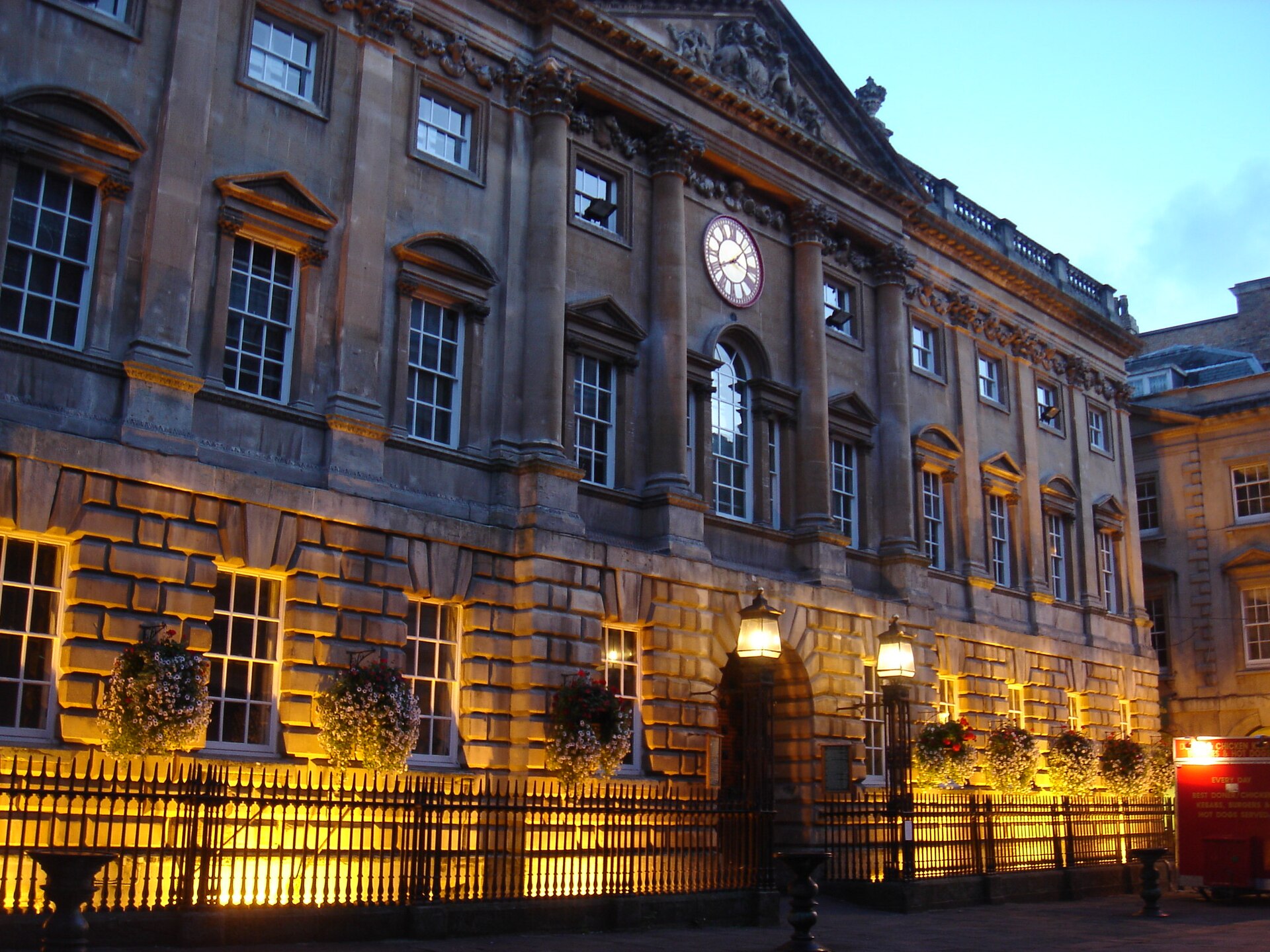
The Exchange on Corn Street was designed by the Bath architect John Wood the Elder and built between 1741 and 1743 for the Corporation of the City of Bristol, opening for trade on 21 September 1743 in the reign of George II. Executed in honey-coloured Bath stone, it is one of the most accomplished provincial public buildings of the English Palladian movement: its principal front presents a giant palace facade, with engaged Corinthian columns rising through the centre and pilasters answering them at the ends, all carried on a rusticated ground storey. As the Historic England statutory listing (NHLE 1298770, Grade I) records, the building is "widely regarded as Wood's outstanding public building... an early and imaginative example of the palace facade based on Palladian principles." Behind the screen front lay an open central court surrounded by a colonnade, flanked by coffee rooms, offices and strong-rooms. Wood himself documented the scheme in his own pamphlet, A Description of the Exchange of Bristol (1743), an unusually full architect's account of an eighteenth-century commercial building. The open court was raised and roofed over in 1872 by Edward Middleton Barry; that roof was lost and replaced by a lower temporary covering after 1945. Tim Mowl and Brian Earnshaw, in John Wood: Architect of Obsession (1988), treat the Exchange as the consummate statement of Wood's mature classical manner outside Bath.
The Exchange's decorative programme is modest in scale but pointed in meaning. The chief artistic interest lies in the carved ornament of the facade, executed by the Bristol mason-sculptor Thomas Paty, who is named in the building accounts as 'Ornament Carver' (the plasterwork being by John Griffin, 'Ornament Plaisterer'). A sculpted frieze of human and animal heads runs across the front, and the carved figures are conventionally read as representing the four continents -- African, American, Asian and European -- an allegory of Bristol's worldwide commerce that, as the Discovering Bristol / PortCities project and Bristol Museums emphasise, also openly advertised the city's deep involvement in the transatlantic slave trade. A Royal Coat of Arms fills the central pediment's tympanum, and cast-iron lion-head knockers ornament the arched doorway. The interior keystones and plaster reliefs are catalogued by Art UK, but the building was conceived as a working merchants' hall rather than a gallery, and its ornament remains subordinate to its civic and commercial purpose.
The Exchange stands on the south side of Corn Street near its junction with Broad Street, in the heart of Bristol's medieval Old City and historic financial quarter. Corn Street was the city's banking and mercantile spine, lined with the Old Bank (founded 1750), insurance offices and later the lavishly Venetian Lloyds Bank, and the Exchange anchored this concentration of commercial institutions. Immediately outside the building stand the four bronze pillar-tables known as 'the Nails', dating from the sixteenth and seventeenth centuries and given by merchants such as Robert Kitchen (d. 1594) and John Barker; four of the original nine were moved here from the earlier arcaded Merchants' Tolzey beside All Saints' Church when that structure was demolished in 1782 and a wing of the Exchange built on its site. The flat-topped nails, used by merchants to count out coin and display samples, are popularly linked to the phrase 'paying on the nail.' Behind and beside the Exchange, occupying its former trading spaces, is St Nicholas Market, which has traded on the site since the nineteenth century and remains one of Bristol's principal covered markets.
Before the Exchange was built, Bristol's merchants conducted business in the open air at the Tolzey, an arcaded walk beside All Saints' Church, where the brass nails stood. By the early eighteenth century this was inadequate to the scale of the city's booming Atlantic trade, and the Corporation resolved on a purpose-built exchange, securing an Act of Parliament and commissioning Wood, fresh from his celebrated work at Queen Square and elsewhere in Bath. Built 1741-43, the Exchange served as a corn and general commercial exchange and merchants' meeting place through the Georgian and Victorian periods; it was as a corn exchange in particular that it continued to function after the 1872 covering of the court. The Exchange is the only surviving purpose-built eighteenth-century exchange building in England -- its great contemporaries, Wood's own Liverpool Exchange (later Town Hall) and the City of London's Royal Exchange, were destroyed or rebuilt -- which gives it a unique standing among the merchant exchanges of the period. It is today owned by Bristol City Council, houses offices and St Nicholas Market, and is protected at the highest level as a Grade I listed building.
The Exchange was built to house the business of merchants who dominated Britain's second city of overseas trade. In the early decades dealings centred on the staples of Bristol's Atlantic and colonial commerce: sugar, tobacco, rum, cocoa and other plantation produce imported through the port, together with the manufactures -- copper and brass wares, glass, gunpowder -- exported in exchange, and crucially the financing of slaving voyages, for Bristol was the leading English slave-trading port of the early eighteenth century, its ships carrying enslaved Africans on the triangular route between Britain, West Africa and the Caribbean. As the Discovering Bristol slavery project notes, the Exchange and the surrounding Corn Street institutions were the financial nerve-centre of this trade. Business was transacted face to face in the colonnaded court and adjoining coffee rooms; bargains were settled in cash literally counted out on the nails outside, and shares in ships and cargoes changed hands among the city's merchant elite. After the abolition of the slave trade and the rise of the grain trade, the building functioned chiefly as a corn exchange, lending it the alternative name by which it is still often known.
Images will be added as the project develops. Photographs by Larry Ng and from research sources.