Bremen Cotton Exchange (Bremer Baumwollbörse)
Bremen, Germany · Established 1872
This site requires authorization to access.
To request access, contact
william.goetzmann@yale.edu
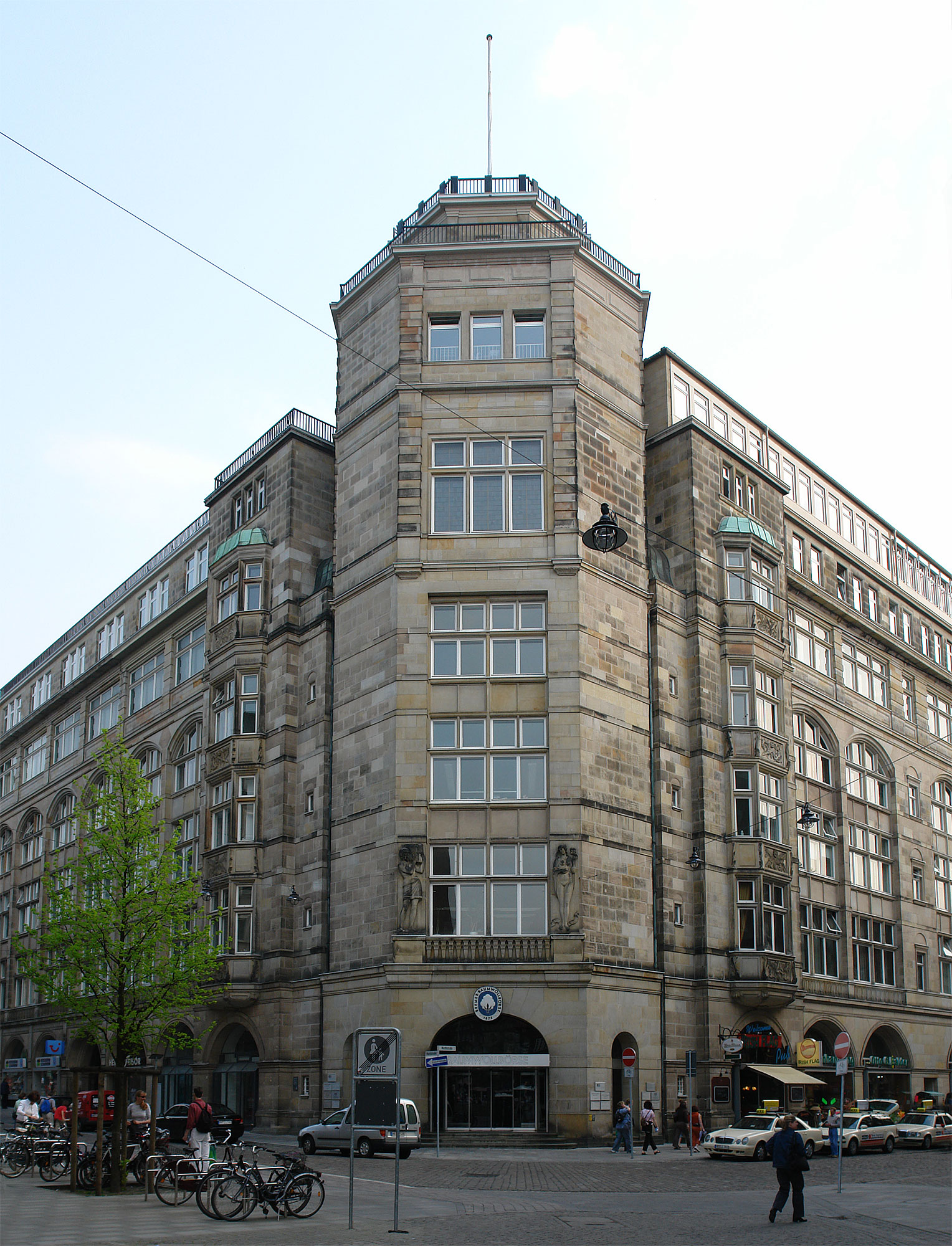
The Bremer Baumwollbörse at Wachtstraße 17–24 stands as one of Bremen’s most significant Gründerzeit commercial buildings. In 1898, the Bremen architect Johann Georg Poppe (1837–1915) won a nationwide design competition against fifty-four rival submissions, as documented by the Bremen Landesamt für Denkmalpflege. Construction began in 1900 and the building was inaugurated in 1902 at a cost of 4.3 million marks. Poppe’s design made it one of Bremen’s first iron-skeleton structures, combining advanced structural engineering with a lavish Neo-Renaissance facade featuring an octagonal corner tower with cupola and double lantern, curved gabled dormers, and corner turrets. The building’s plan was driven by functional requirements: cotton classification rooms occupied the fourth floor, where large north-facing windows provided the glare-free light essential for accurate fiber assessment, as Andreas Wilhelm Cramer described in his official history Bremen Cotton Exchange, 1872/1922 (1922). The original stucco ornamentation proved inadequately weather-resistant, and between 1922 and 1924 architect Otto Blendermann oversaw a complete refacing in Obernkirchener Weser sandstone, simplifying the exterior while adding restrained Expressionist friezes. Allied bombing in 1944 destroyed the rear wing and severely damaged the tower, which was subsequently demolished. Post-war reconstruction, completed by 1950, replaced the original pitched roof with a fifth story and flat-roof penthouse. The approximately 12,000-square-meter building today houses some fifty-five firms, the Faserinstitut Bremen (FIBRE) cotton testing laboratory, and the ICA Bremen quality arbitration center. It was listed as a protected monument in 1993.
The decorative program of the Baumwollbörse reflects the aspirations of Bremen’s cotton merchants to assert their commercial stature through visual splendor. The most celebrated surviving artworks are the lunette mosaics in the entrance vestibule, designed by the Dresden history painter and sculptor Hermann Prell (1854–1922) and executed in 1906 by the Berlin firm Puhl & Wagner, then Germany’s foremost producer of architectural glass mosaic. The left lunette depicts Hermes, the messenger god of commerce, an iconographic choice linking Bremen’s cotton trade to classical traditions of mercantile exchange. The double-armed main staircase, inscribed in an oval plan, features white marble treads and elaborate wrought-iron railings crafted by the Bremen metalworker Justus Leidenberg, documented in the Landesamt für Denkmalpflege conservation files. Stuccoed barrel-vault corridors with dark red-tiled base zones characterize the upper floors. When Blendermann renovated the facade in 1922–1924, the Munich sculptor Friedrich Lommel (1883–1967) contributed new Expressionist frieze panels and parapet reliefs in a moderately expressive formal language that replaced Poppe’s deteriorated Neo-Renaissance ornament. The building also retains one of Germany’s last operational paternoster elevators, now preserved for viewing. Taken together, the interior program—from Prell’s allegorical mosaics to Leidenberg’s ironwork—constitutes a rare surviving ensemble of Wilhelmine commercial decoration, where mythological imagery and fine craftsmanship served to dignify the commodity trade that sustained Bremen’s prosperity.
Bremen’s emergence as continental Europe’s leading cotton port was shaped by its geography on the Weser River and its centuries-old Hanseatic trading networks. The city joined the Hanseatic League in 1260 and for centuries the Schlachte waterfront served as its principal quay. However, progressive silting of the lower Weser threatened Bremen’s maritime viability. In 1827, Mayor Johann Smidt secured a strip of land at the river’s mouth from the Kingdom of Hanover to establish Bremerhaven, providing deep-water access for ocean-going vessels and preserving Bremen’s competitive position against Hamburg. The founding of the Norddeutscher Lloyd shipping line in 1857 by Hermann Henrich Meier and Eduard Crüsemann cemented the Bremen–Bremerhaven axis as a transatlantic gateway. In 1888, Bremen negotiated entry into German customs territory while establishing duty-free zones in the new harbor district. The Europahafen, opened in 1887 at 2,000 meters long and 120 meters wide, became the flagship facility for cotton and colonial goods, achieving annual growth rates of ten to twenty percent. The Baumwollbörse itself occupies a prestigious corner site at the Marktplatz and Wachtstraße, placing the cotton trade at the symbolic heart of the city alongside the UNESCO-listed Town Hall and Roland statue. The twentieth-century decline of maritime traffic led to closure of the Überseehafen in 1991; its 300-hectare footprint was subsequently redeveloped as the Überseestadt, one of Europe’s largest port-regeneration projects.
On October 1, 1872, twelve Bremen cotton merchants founded the Comité für den Baumwollhandel (Committee for the Cotton Trade), the institutional nucleus of the Bremen Cotton Exchange, as Cramer recounts in Bremen Cotton Exchange, 1872/1922. The committee established the Bremer Baumwoll-Usancen (1872, revised 1875), which codified trading terms and quality standards independent of Liverpool—a decisive break, as Karl Boromäus Murr argues in “The Local Face of Global Trade” (Bavarian Studies, 2020), that “secured Bremen’s rise to a new European cotton center.” The exchange received legal capacity from the Bremen Senate in 1889. A transformative moment came in July 1886, when the Verein süddeutscher Baumwollindustrieller (VSBI) and six German spinning associations joined the exchange, with Austrian members following in 1894 and Swiss in 1906. Import volumes surged from 157,630 bales in 1870 to over one million in the early 1890s, surpassing Le Havre in 1886/87 as continental Europe’s largest cotton port, and peaking at 2,870,000 bales in 1911/12. Futures trading was introduced in early 1914 but was immediately disrupted by war; it resumed in 1925 and continued until 1939. World War II devastated both the exchange building and trade networks; operations resumed in 1946 with 250,000 bales from U.S. government stocks and surpassed one million bales again by 1950. The laboratory was established in 1955 and designated by the U.S. Department of Agriculture in 1975. In 2011, the exchange founded the International Cotton Association Bremen (ICA Bremen), now the global center of excellence for cotton testing, arbitration, and laboratory certification.
American upland cotton dominated Bremen’s imports, accounting for roughly seventy-seven percent of German consumption by 1911/12, as Cramer documented. Cotton arrived from the major Gulf and Atlantic ports—New Orleans, Galveston, Mobile, Savannah, and Charleston—transiting through Bremerhaven before reaching spinning mills across Central Europe, as Murr details in his study of Augsburg’s supply chains. Egyptian cotton, divided into long-staple Delta varieties and shorter Upper Egyptian grades, served specialty mills; Indian cotton of shorter staple found use in coarser textile production; and Brazilian cotton added further diversity to the exchange’s trade. Bremen’s classification system was central to its commercial authority. Sworn classers compared fiber samples against standardized reference samples stored in flat boxes representing different quality grades, evaluating staple length (measured in millimeters), color, and fiber strength—a difference of half a millimeter in staple length could mean a ten percent difference in value, Cramer noted. The exchange maintained standards from over forty cotton-producing countries, initially derived from Liverpool but increasingly produced independently. By 1912, the exchange’s arbitration system processed 2,554,000 bales annually. The VSBI’s integration in 1886 brought German spinners from Saxony, Bavaria, Württemberg, and Baden into direct relationship with the exchange, eliminating Liverpool intermediaries. Forward contracts facilitated hedging, and a formal futures market operated from 1914 (with interruptions) until 1971. Today the CIF Bremen price index—covering cost, insurance, and freight—remains a benchmark for cotton pricing across the European continent.
Images will be added as the project develops. Photographs by Larry Ng and from research sources.