Wool Exchange, Bradford
Bradford, United Kingdom · Established 1864
This site requires authorization to access.
To request access, contact
william.goetzmann@yale.edu
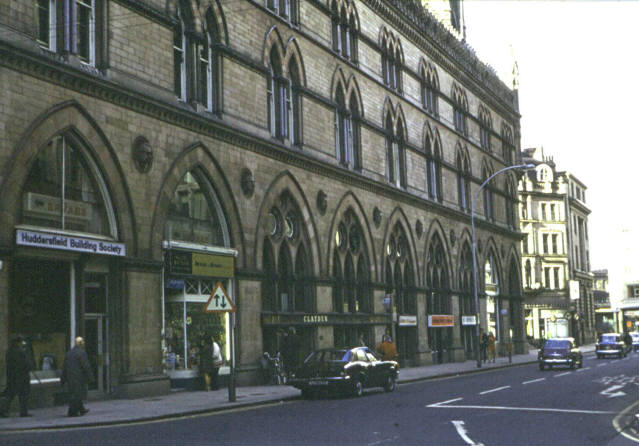
The Wool Exchange was raised between 1864 and 1867 to the designs of the Bradford partnership of Lockwood and Mawson -- Henry Francis Lockwood (1811-1878) with the brothers William and Richard Mawson -- who won an open competition that also drew entries from William Burges and Richard Norman Shaw (Victorian Web, 'Wool Exchange, Bradford, by Lockwood & Mawson'). The building is executed in finely masoned Bradford sandstone of three principal storeys, dressed with red and yellow stone to achieve the structural polychromy that John Ruskin had popularised, and it culminates in a tall clock tower at the north end whose openwork parapet cresting betrays the influence of the Flemish cloth halls of Ypres and Bruges as much as of Venetian Gothic (Historic England, listing NHLE 1132985, Grade I; P. Leach and N. Pevsner, 'Yorkshire West Riding: Leeds, Bradford and the North', 2009). Within, the trading hall is lit through windows of decorative iron tracery and spanned by a lofty hammer-beam roof enriched with wrought ironwork, while polished pink granite columns carrying naturalistically carved foliate capitals march down the floor -- a Gothic vocabulary applied, unusually, to an unambiguously commercial purpose. The contractors were the Bradford firm J. and W. Beanland, and the foundation stone was laid in 1864 by the Prime Minister, Lord Palmerston, a deliberate piece of national theatre that announced the town's economic importance.
The decorative programme is unusually rich for a commercial building and was conceived as a secular iconography of trade. The canopied porch is flanked by statues, carved by James Tolmie, of Bishop Blaize -- the patron saint of woolcombers -- and King Edward III, who by tradition encouraged Flemish weavers to settle in England, pairing the sacred and royal sanction of the wool trade (Victorian Web, Lockwood & Mawson). Around the ground-floor arcade, the spandrels carry portrait medallions of explorers, inventors and statesmen associated with commerce and discovery -- among them Raleigh, Drake, Columbus, Robert Stephenson, James Watt, Joseph-Marie Jacquard (inventor of the figured loom), and the free-trade champions Richard Cobden, Gladstone and Palmerston -- so that the building reads as a Victorian pantheon of enterprise. Inside stands a large statue of Cobden, donor-funded and emblematic of the city's commitment to free trade, and decorative windows incorporate a Star of David motif widely read as an acknowledgement of the German-Jewish 'Bradford merchants' who built much of the export trade (Bradford Civic Society). The carving and ironwork are accomplished, but the art here is documentary rather than fine: it celebrates men and machines of commerce rather than offering an independent aesthetic statement.
The Exchange occupies a prominent island site on Market Street in the centre of Bradford, then the boom town of the West Riding of Yorkshire, and it formed one corner of an architectural ensemble by the same firm that gave the city its Victorian face. Lockwood and Mawson dominated Bradford's building between roughly 1850 and 1875, and the Wool Exchange stands in dialogue with their St George's Hall (1851-53) and their Continental Gothic City Hall (1869-73), as well as their celebrated model village and mills at Saltaire just outside the town (Wikipedia, 'Henry Francis Lockwood'; D. Linstrum, 'West Yorkshire: Architects and Architecture', 1978). Set among the warehouses, banks and counting houses of the merchant quarter, the Exchange was the physical hub of a district built entirely on worsted, its grandeur a calculated assertion that Bradford -- a market town of about 16,000 people in 1800 -- had become one of the wealthiest cities in Europe by the eve of the First World War. The building remains a Grade I landmark; its trading floor now houses a Waterstones bookshop, frequently described as among the most striking interiors of any bookshop in Britain.
The Exchange institutionalised a trade that had outgrown Bradford's earlier Piece Halls. The town had transformed itself within two generations from a rural cloth market into 'Worstedopolis' -- a coinage of the local historian William Cudworth (1888) -- so that by 1841 there were some seventy worsted mills in the borough, processing an estimated two-thirds of the nation's wool (History Through Fiction, 'Worstedopolis'; Bradford District Museums & Galleries). The decision to build a dedicated exchange prompted one of the most famous episodes in Victorian cultural criticism: in April 1864 the committee invited John Ruskin to advise, and he responded with the lecture later published as 'Traffic' in 'The Crown of Wild Olive' (1866), opening with the rebuke, 'I do not care about this Exchange -- because you don't,' and arguing that the merchants' true deity was the 'Goddess of Getting-on' (J. Ruskin, 'Traffic', 1866). The building nonetheless went ahead, opening in 1867 as the regulated meeting place of the worsted trade. Membership was controlled by ticket, normally sponsored by an employer, and the Exchange thrived for a century before the long decline of the British wool industry; it ceased to be used for trading wool in the early 1970s and was listed Grade I in 1963.
What changed hands on the floor was raw and semi-processed wool and worsted yarn -- the fibre, tops and yarns that fed Bradford's spinning and weaving mills and the worsted cloth they produced for world markets. Trading was conducted by verbal contract alone: members met face to face, agreed price, quantity and delivery date, and each party kept his own private note of the bargain, the spoken word carrying the force of contract among ticketed members (Wikipedia, 'Wool Exchange, Bradford'). Quality was underpinned by Bradford's public Conditioning House on Canal Road, which tested the staple length and the dried weight of wool so that moisture-laden lots could not defraud the buyer -- an institutional guarantee that made the local trade trusted internationally. Around the formal floor a fringe of freelance salesmen waited to 'catch a member's eye' and close deals 'off-floor', extending the market beyond its ticketed membership. Through this combination of verbal trust, standardised conditioning and concentrated mercantile expertise, the Bradford Wool Exchange functioned for roughly a century as the effective price-setting centre of the world's worsted trade.
Images will be added as the project develops. Photographs by Larry Ng and from research sources.