Bordeaux Stock Exchange (Place de la Bourse)
Bordeaux, France · Established 1749
This site requires authorization to access.
To request access, contact
william.goetzmann@yale.edu
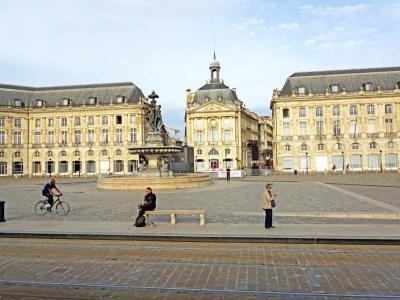
The Place de la Bourse, originally the Place Royale, is one of the finest eighteenth-century architectural ensembles in France and the first great open square in the history of French urbanism. Its creation was set in motion in 1720 when the intendant of Guyenne, Claude Boucher, persuaded the city council to demolish 150 meters of the medieval ramparts along the Garonne, destroying 21 houses and 10 shops to open Bordeaux to its waterfront. Boucher summoned Jacques Gabriel, premier architecte du roi, who designed the square between 1729 and 1733, taking inspiration from Jules Hardouin-Mansart's Place Vendome in Paris. Construction began in August 1735 with the Hotel des Fermes, the southern pavilion housing the Ferme Generale (the royal tax-farming administration), which was completed and occupied by July 1738. Jacques Gabriel died in 1742, and his son Ange-Jacques Gabriel, who succeeded him as royal architect to Louis XV, continued the work. The Palais de la Bourse, the northern pavilion housing the Chamber of Commerce and the commercial court, was completed in 1749. The central pavilion linking the two wings was finished in 1755, the year the square was officially inaugurated. The ensemble forms a grand semicircular composition opening onto the Garonne, framed by harmoniously proportioned facades of local limestone. The elevations follow a consistent scheme: a rusticated ground floor with arcades, an entresol, a piano nobile articulated by giant-order Ionic pilasters, an attic storey, a stone balustrade, and mansard roofs with dormers — a vocabulary of classical restraint that would influence Ange-Jacques Gabriel's later masterwork, the Place de la Concorde in Paris. The terrace extending the square toward the river, built on pine pilings 40 centimeters in diameter, formed a quay 150 meters long and 20 meters wide. At the square's center, the sculptor Jean-Baptiste Lemoyne installed a bronze equestrian statue of Louis XV, inaugurated on 19 August 1743; it was toppled and melted for cannon on 20 August 1792 during the Revolution. The current Fontaine des Trois Graces, designed by the architect Louis Visconti and sculpted by Charles Gumery with a lower basin by Amedee Jouandot, was installed between 1864 and 1869 after Visconti's death in 1853; his son Leon offered the projects to the city in 1854. The Hotel des Fermes, now housing the Musee National des Douanes, contains a remarkable vaulted customs hall measuring 40 meters long by 15 meters wide, supported by 44 pillars carrying 30 ribbed vaults — a space restored to its original clarity in 1982-1983. The facades, roofs, courtyard, and internal fountain of the Hotel des Fermes are classified as Monuments Historiques. In 2006, the landscape architect Michel Corajoud, with fountain-maker Jean-Max Llorca and architect Pierre Gangnet, installed the Miroir d'Eau opposite the square — a shallow reflecting pool of 3,450 square meters that alternates between mirror and mist effects, the largest such installation in the world. In 2007, the entire ensemble was inscribed as part of the UNESCO World Heritage Site "Bordeaux, Port of the Moon," recognized as an outstanding urban and architectural ensemble of the Age of Enlightenment, encompassing 1,810 hectares — the largest urban World Heritage site at the time of inscription. Robert Coustet and Marc Saboya's studies of Bordeaux's architectural heritage, including Bordeaux, le temps de l'histoire: architecture et urbanisme au XIXe siecle (1999), situate the Place de la Bourse within the broader program of classical and neoclassical urbanism that gave the city more protected buildings than any French city except Paris.
The sculptural program of the Place de la Bourse constitutes one of the richest ensembles of eighteenth-century architectural decoration in provincial France. The Flemish-born sculptor Jacques Verberckt (1704-1771), who had trained in Antwerp under his uncle Michiel van der Voort and later worked at Versailles, directed the decorative campaign from 1733. His cousin Michiel van der Voort (1705-1777) was charged with the pediments of the Hotel des Fermes, working between 1733 and 1740 on the allegorical compositions and with a team of six sculptors on the mascarons, brackets, column and pilaster capitals, trophies, and balcony vases. Claude-Clair Francin (1702-1773) completed the central pavilion's pediment and the four pediments of the Bourse between 1748 and 1755, as well as the angled pediments facing the quay, and carved two Bacchus mascarons at the corner of the Rue Saint-Remi. The facade mascarons form an allegorical vocabulary of commerce and empire: Neptune with his trident opens the city to maritime trade; Mercury with his caduceus and purse favors commerce; Minerva with her owl protects the arts; Bacchus crowned with grape vines celebrates the wine trade; and Jupiter's thunderbolts invoke royal authority. The allegory of Time Discovering Truth adorns one pediment, while another depicts the junction of the Garonne and Dordogne rivers — the geographical key to Bordeaux's commercial position. As Erick Noel documented in "Masques noirs, murs blancs" in the volume Figures d'esclaves: presences, paroles, representations (Presses universitaires de Rouen et du Havre, 2012, edited by Eric Saunier), representations of African faces appeared on the central pavilion when Parisian sculptors arrived to complete the decoration between 1748 and 1755, a visual reference to the colonial trade enriching the city. Noel notably observed that Bordeaux's wealthiest slave-trading families — the Gradis and the Raba — chose mythological motifs rather than colonial imagery for their own residences, suggesting a cultural reticence about depicting their commerce directly. The specifications for the Place Royale's sculptural program, as recorded in the building contracts, called for "heads of various divinities," and the resulting array of some 3,000 mascarons across eighteenth-century Bordeaux — studied by Franck Bourguet in "Vigne, vin et mascarons: fortune locale d'un motif decoratif dans le Bordeaux du XVIIIe siecle" — constitutes one of the most extensive surviving ensembles of Baroque-Classical ornamental sculpture in France. The Fontaine des Trois Graces at the square's center, representing the daughters of Zeus — Aglae, Euphrosyne, and Thalie, symbolizing beauty, joy, and fertility — was sculpted in bronze on a white marble pedestal by Charles Gumery to the design of Louis Visconti, with Amedee Jouandot contributing the lower basin with children riding dolphins. The fountain was removed for restoration during tramway construction in 2001 and reinstalled in January 2006. Inside the Palais de la Bourse, the former trading hall retains neoclassical decorative elements reflecting the institution's commercial purpose, though successive renovations over three centuries have altered the original interior scheme.
The Place de la Bourse marks the decisive moment when Bordeaux turned from a walled medieval city toward the Garonne, opening its most magnificent facade to the river that was the source of its wealth. The city occupies the western bank of the Garonne at the point where the river describes a broad crescent — the "Port de la Lune" or Port of the Moon that gave the UNESCO designation its name — at the head of the Gironde estuary, the gateway to Atlantic navigation. This position made Bordeaux a natural entrepot: ocean-going vessels could navigate the tidal estuary to reach the city's quays, while river traffic connected it to the agricultural hinterland of Aquitaine. The intendant Claude Boucher initiated the urban transformation in the 1720s by breaching the medieval walls and commissioning Jacques Gabriel to design the Place Royale; his successor, Louis-Urbain-Aubert de Tourny, intendant from 1743 to 1757, continued the project on a grand scale, beautifying the quays along the Garonne, adding unified facade screens designed by his architect Portier in front of the old quayside buildings, opening broad avenues, and creating the public garden — an Enlightenment program of urban embellishment that transformed Bordeaux into what many contemporaries considered the most beautiful city in France. Immediately north of the Place de la Bourse lies the Chartrons quarter, which from the seventeenth century served as the headquarters of Bordeaux's wine trade. Foreign merchants — English, Irish, Dutch, German, and Danish — were forbidden from establishing operations within the city walls and settled instead in this marshy district downstream, building elegant warehouses along the Quai des Chartrons where they aged and shipped wine. The quarter's stately eighteenth-century facades, with cellars behind running back from the river, testify to the fortunes made by families such as the Johnstons, Bartons, and Lawtons who dominated the claret trade. To the south, the Quai des Salinières and the Quai de la Douane handled the colonial goods — sugar, coffee, indigo — arriving from the Caribbean. The Place de la Bourse itself stands at the heart of this commercial geography, flanked by the customs administration in the Hotel des Fermes and the merchants' institution in the Palais de la Bourse, directly facing the river where hundreds of vessels anchored. Paul Butel, in Les negociants bordelais, l'Europe et les iles au XVIIIe siecle (Aubier, 1974), documented how this waterfront functioned as the nerve center of France's premier Atlantic port, with the Place Royale serving as both the administrative and symbolic nexus of a trading system that linked Aquitaine's vineyards to the sugar plantations of Saint-Domingue, the slave factories of West Africa, and the counting houses of Amsterdam and London.
Bordeaux emerged as France's premier Atlantic trading port in the eighteenth century, a status built upon centuries of commercial tradition dating to the English period (1154-1453) when the claret trade with England established the city's viticultural vocation. The Chambre de Commerce de Bordeaux was founded in 1705 — the third in France after Rouen (1703) and Toulouse (1704) — to advise the crown on matters of trade, tariffs, navigation, insurance, and commercial regulation, as documented in Paul Butel's Histoire de la Chambre de commerce et d'industrie de Bordeaux des origines a nos jours, 1705-1985 (CCI Bordeaux, 1988). The intendant Claude Boucher, appointed in 1720, conceived the Place Royale as both a setting for an equestrian statue of Louis XV and as permanent quarters for the Chamber of Commerce and the Ferme Generale. Construction began in 1735; the Hotel des Fermes was occupied by 1738, and the Palais de la Bourse, housing the Chamber and the commercial court, was completed in 1749. Under Boucher's successor, the Marquis de Tourny (intendant 1743-1757), Bordeaux underwent one of the great urban transformations of the Enlightenment, with the Place Royale as its architectural centerpiece. The eighteenth century saw explosive commercial growth. Bordeaux's Atlantic trade rested on three interlocking circuits: the wine trade with northern Europe (principally England, Ireland, and the Netherlands), the colonial trade with the French Caribbean (especially Saint-Domingue, Martinique, and Guadeloupe), and the slave trade linking all three. As Silvia Marzagalli has shown in her studies of Bordeaux's Atlantic networks — including "Atlantic Trade and Sephardim Merchants in Eighteenth-Century France" (in Bernardini and Fiering, eds., The Jews and the Expansion of Europe to the West, Berghahn, 2001) and Bordeaux et les Etats-Unis, 1776-1815 (Droz, 2015) — the city's merchant community included Sephardic Jewish families such as the Gradis, Huguenot houses, Irish and Scottish wine merchants in the Chartrons, and Dutch and German traders. Eric Saugera's Bordeaux port negrier: chronologie, economie, ideologie, XVIIe-XIXe siecles (Karthala, 1995) established that 508 slave-trading expeditions departed from the Gironde over two centuries, deporting at least 130,000 captives from the coasts of Africa to the French Caribbean — making Bordeaux France's second-largest slave-trading port after Nantes (which conducted 1,744 expeditions). The first recorded Bordeaux slaving voyage dates to 1672; the trade reached its height between 1740 and 1790. The vast profits of the colonial and slave trades financed much of the city's architectural transformation, including the Place Royale itself. The Revolution brought abrupt change: Louis XV's equestrian statue was pulled down in August 1792 and the square was renamed Place de la Liberte, then briefly Place Imperiale under Napoleon (1808), before reverting to Place Royale at the Restoration (1815). In 1848, it received its current designation as Place de la Bourse. The Chambre de Commerce has continuously occupied the Palais de la Bourse since 1749, making it one of the longest-serving institutional buildings in French commercial history. In 1855, the Chamber organized the famous classification of Bordeaux wines for the Exposition Universelle, enlisting the Syndicat des Courtiers to rank the grands crus — a hierarchy that endures to this day.
The Bordeaux Bourse served as the commercial nerve center for one of the most diverse and lucrative trading systems in eighteenth-century Europe. Wine was the foundation: the claret trade with England, dating to the marriage of Eleanor of Aquitaine to Henry II in 1152, had made Bordeaux synonymous with viticulture. By the eighteenth century, English and Irish merchants in the Chartrons quarter — families such as the Bartons, Johnstons, and Lynches — purchased wine from growers, aged it in their cellars along the quays for two to seven years, and shipped it to the British Isles, as Paul Butel documented in Les negociants bordelais, l'Europe et les iles au XVIIIe siecle (Aubier, 1974). Dutch merchants, who had pioneered the sterilization of barrels with sulphur to improve preservation, handled much of the bulk trade in ordinary wines destined for northern Europe. The colonial trade formed the second pillar: sugar, coffee, indigo, cotton, and cacao arrived from the French Caribbean colonies, above all from Saint-Domingue (modern Haiti), where some forty percent of colonists originated from Bordeaux and its hinterland. These tropical commodities were refined, repackaged, and re-exported throughout Europe — Bordeaux became the principal entry point for colonial goods into the French interior and a major re-export hub for the continental market. The third circuit was the slave trade: as Eric Saugera established in Bordeaux port negrier (Karthala, 1995), ships departed the Gironde laden with textiles, weapons, iron bars, brandy, and glass beads, exchanged them for captives on the West African coast, transported the enslaved across the Middle Passage to the Caribbean, and returned to Bordeaux with colonial produce — the notorious triangular trade. Between 1672 and the early nineteenth century, 508 expeditions deported at least 130,000 Africans. The Bourse facilitated all three circuits through the instruments of long-distance commerce: bills of exchange drawn on correspondents in Amsterdam, London, Nantes, and the colonial ports enabled merchants to settle accounts across vast distances and extended payment cycles; marine insurance, underwritten by local firms and later formalized through the Compagnie d'assurances maritimes de Bordeaux, protected against the considerable risks of Atlantic navigation; and the commercial court housed in the Palais de la Bourse adjudicated disputes among merchants with the speed and expertise that royal courts could not provide. The Chambre de Commerce, as Butel documented in his institutional history (1988), exercised authority over trade treaties, tariffs, navigation regulations, and commercial legislation. The Bourse also served as the arena for commodity speculation — the price of sugar, coffee, and wine futures was a matter of daily negotiation among the merchants gathered under its arcades. The 1855 classification of Bordeaux wines, organized by the Chamber for the Exposition Universelle, institutionalized a hierarchy of quality and price that had evolved organically on the Bourse's trading floor over the preceding century.