Colombia Stock Exchange (Bolsa de Valores de Colombia)
Bogotá, Colombia · Established 1928
This site requires authorization to access.
To request access, contact
william.goetzmann@yale.edu
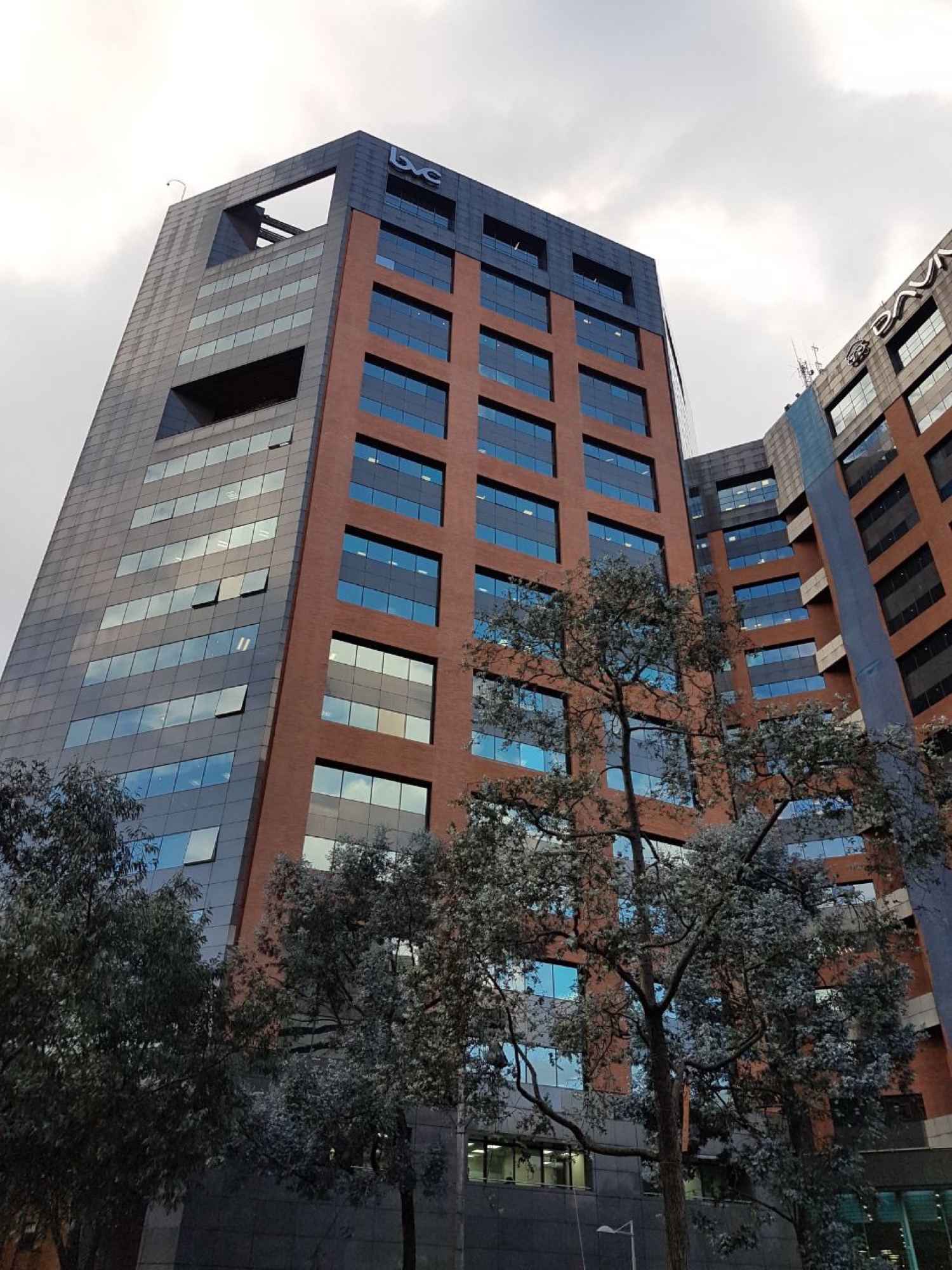
The Bolsa de Bogotá, Colombia’s first stock exchange, was formally established when its bylaws were approved by the Superintendencia Bancaria on March 9, 1929, and the inaugural trading session—the rueda—took place on April 2, 1929. The exchange’s original headquarters occupied a building on Carrera 9 at Calle 14 in the heart of downtown Bogotá, a structure that architectural historians identify as one of the representative Art Deco buildings in the city’s commercial center. As Silvia Arango de Jaramillo documents in Historia de la arquitectura en Colombia (1989), the Art Deco style flourished in Bogotá during the late 1920s and 1930s, adopted principally by banks, insurance companies, and financial institutions along Carrera Séptima and its cross-streets. The Bolsa’s original premises served for approximately thirty-five years, housing the open-outcry trading floor where brokers conducted the corro a viva voz—verbal bidding sessions characteristic of Latin American exchanges through much of the twentieth century. When the Bolsa de Medellín commenced operations on April 3, 1961, it established its own trading hall in the industrial capital of Antioquia, a city whose architectural fabric, as Jesús Abad Colorado and others have chronicled, blended Republican and early modernist styles suited to the textile and manufacturing fortunes that underwrote the region’s capital markets. The Bolsa de Occidente, founded in 1983 in Cali, operated from commercial premises in the Valle del Cauca capital, serving the agro-industrial sector of southwestern Colombia. Following the July 3, 2001 merger that created the Bolsa de Valores de Colombia (BVC), the unified exchange relocated its principal offices to the Edificio Avenida Chile on Carrera 7 No. 71–21, at the intersection of Carrera Séptima and Calle 72 (Avenida Chile), the heart of Bogotá’s modern financial district. This commercial tower, situated amid the cluster of banking headquarters that defines the Calle 72 corridor, represents the transition from the ornamental civic architecture of the early exchange to the glass-and-steel corporate modernism that characterizes twenty-first-century financial infrastructure across Latin America.
Documentation of the decorative programs within Colombia’s historic exchange buildings remains limited in the published literature, reflecting both the modest scale of the original Bolsa de Bogotá and the broader pattern across Latin American exchanges where functional trading spaces took precedence over elaborate artistic commissions. The Art Deco façade of the original Carrera 9 building, consistent with the geometric ornamentation found on Bogotá’s 1930s financial architecture as catalogued by the Instituto Distrital de Patrimonio Cultural in La carrera de la modernidad: Construcción de la Carrera Décima, Bogotá 1945–1960 (2010), likely featured the relief panels and stylized motifs typical of the period. Colombia’s broader artistic engagement with commerce and finance finds expression in the country’s numismatic tradition—gold coinage minted from colonial-era mining wealth, pre-Columbian goldwork preserved in the Museo del Oro, and the ornate banknotes of the early Banco de la República, established in 1923. The Museo del Oro’s collections, as analyzed by Clemencia Plazas and Ana María Falchetti in their studies of Muisca and Quimbaya metallurgy, illustrate how gold functioned simultaneously as currency, artistic medium, and store of value in the Andean highlands long before formal securities markets emerged. The trading floors themselves were utilitarian spaces designed around the corro system: circular or semicircular arrangements where brokers called out bids, a physical layout that shaped the acoustic and spatial character of the room. With the shift to electronic trading platforms following the 2001 merger and the adoption of the X-Stream trading system, the physical trading floor was decommissioned, and the BVC’s contemporary offices in the Edificio Avenida Chile reflect corporate minimalism rather than the civic grandeur associated with older European and North American exchanges.
Bogotá’s emergence as Colombia’s financial center is inseparable from its geography—a highland capital perched at 2,640 meters in the Eastern Cordillera of the Andes, connected to Caribbean ports and Pacific outlets only by difficult mountain routes that historically constrained commerce. The original Bolsa de Bogotá on Carrera 9 and Calle 14 sat within the commercial extension of La Candelaria, the colonial-era historic center where Spanish administrative and ecclesiastical architecture defined the urban fabric. As Alan Gilbert and Peter Ward observe in Housing, the State and the Poor: Policy and Practice in Three Latin American Cities (1985), Bogotá’s commercial life expanded northward along Carrera Séptima during the twentieth century, a centrifugal movement that eventually pulled the financial sector away from the colonial core toward the Calle 72 corridor. The relocation of the BVC to the Avenida Chile district reflects this broader pattern: the intersection of Calle 72 and Carrera Séptima became Bogotá’s premier financial address by the late twentieth century, concentrating banking headquarters, brokerage houses, and corporate offices in a dense commercial node. Colombia’s three historic exchanges also reflected the country’s polycentric economic geography. Medellín, capital of Antioquia in the central Cordillera, developed its exchange to serve the textile mills, cement factories, and coffee-export businesses that made it the country’s industrial powerhouse, as documented in Marco Palacios’s Between Legitimacy and Violence: A History of Colombia (2006). Cali, in the fertile Cauca Valley, anchored the Bolsa de Occidente to agro-industrial capital from sugar, oil palm, and Pacific trade. This triangulation of financial centers—Bogotá as political and banking capital, Medellín as industrial hub, Cali as agricultural gateway—reflects the geographic fragmentation that has shaped Colombian economic life from the colonial period onward, a theme explored extensively in James Robinson and Daron Acemoglu’s analyses of institutional development in the Andean nations.
The history of securities trading in Colombia begins with failed attempts to establish exchanges in Medellín in 1901 and Bogotá in 1903, both undermined by political instability following the War of the Thousand Days (1899–1902). The institutional groundwork was laid by the Kemmerer Mission of 1923—a team of financial advisors led by Princeton economist Edwin Walter Kemmerer—whose recommendations produced Law 25 of 1923, creating the Banco de la República as central bank, and Law 45, establishing the Superintendencia Bancaria to regulate private banks. As Adolfo Meisel Roca and María Teresa Ramírez detail in their research published through the Banco de la República’s Borradores de Economía series, these reforms modernized Colombia’s financial infrastructure and created the regulatory environment in which a formal securities market could operate. The Bolsa de Bogotá was established in 1928 with capital of 20,000 pesos, its first seventeen brokers designated by Banking Superintendent Gonzalo Córdoba, and the inaugural rueda held on April 2, 1929—months before the global crash that would depress commodity prices and strain the young exchange. Coffee was the engine of Colombian capital formation: as Marco Palacios argues in Coffee in Colombia, 1850–1970: An Economic, Social and Political History (Cambridge University Press, 1980), coffee export revenues created the merchant-banking class that demanded formal securities markets and funded government bonds. The Federación Nacional de Cafeteros, founded in 1927, became an institutional anchor linking the agrarian economy to financial intermediation. La Violencia (1948–1958), the brutal partisan conflict that killed an estimated 200,000 Colombians, disrupted economic development but—as Salomón Kalmanovitz demonstrates in Nueva historia económica de Colombia (2010)—paradoxically accelerated capitalist transformation by displacing rural populations into urban industrial employment. The Bolsa de Medellín opened on April 3, 1961, capitalizing on Antioquia’s expanding textile, cement, and manufacturing sectors, while the Bolsa de Occidente commenced operations in 1983 in Cali, serving the Valle del Cauca’s agro-industrial economy. Through the 1990s, President César Gaviria’s apertura económica liberalized trade and foreign investment, stimulating privatization programs that brought state enterprises to market and deepened the capital pool, as analyzed by Augusto de la Torre and Sergio Schmukler in Emerging Capital Markets and Globalization: The Latin American Experience (World Bank and Stanford University Press, 2007). The three exchanges merged on July 3, 2001, creating the Bolsa de Valores de Colombia (BVC). The new entity introduced electronic trading through the X-Stream platform, replacing open-outcry sessions. A formative crisis came in November 2012 when InterBolsa, then Colombia’s largest brokerage controlling roughly 25 percent of market volume, collapsed after defaulting on an $11 million loan—a result of leveraged speculation in textile firm Fabricato’s shares. The Superintendencia Financiera ordered liquidation, affecting over 20,000 investors and prompting sweeping regulatory reforms. As Luis H. Gutiérrez and Carlos Pombo document in their research on corporate governance in Colombia (Universidad de los Andes working papers), the scandal exposed weaknesses in market oversight and concentrated ownership structures that had long characterized Colombian capital markets. In 2011, the BVC joined the Mercado Integrado Latinoamericano (MILA), linking the Colombian, Chilean, and Peruvian exchanges (Mexico joined in 2014) to create a unified cross-border equities trading platform, an initiative analyzed by Forero Lavérde and Vélez Molano in their study of regional integration published in the Latin American Business Review (2016). The Ecopetrol IPO of 2007, raising approximately US$2.8 billion on the BVC, remains the largest public offering in Colombian history and a landmark in the democratization of share ownership in the country.
Securities traded on Colombian exchanges have historically reflected the country’s commodity-dependent economy and the gradual modernization of its financial system. In the early decades of the Bolsa de Bogotá, equities were dominated by shares of commercial banks—including Banco de Bogotá, Banco de Colombia, and Banco Industrial Colombiano—alongside insurance companies and the manufacturing firms that constituted the country’s nascent industrial base. Coffee, the foundational commodity of Colombian capitalism, influenced the market indirectly: coffee export revenues capitalized the banking system and funded government obligations, while the Federación Nacional de Cafeteros issued bonds to finance its stabilization activities, as documented in the economic histories compiled by the Banco de la República’s research division. Government bonds have long constituted the backbone of Colombian fixed-income markets; Titulos de Tesorería (TES), issued by the Ministry of Finance, became the principal sovereign debt instrument from 1990 onward, and today fixed-income trading represents between 85 and 90 percent of BVC’s total volume—a proportion that, as De la Torre and Schmukler (2007) note, reflects the underdeveloped equity culture common across Latin American markets. Mining securities have featured periodically, linked to Colombia’s substantial gold and emerald deposits—the country supplies an estimated 50 to 95 percent of the world’s fine emeralds, as Kesia Revan Giuliani and colleagues document in their study of Colombian emerald mining history published in The Extractive Industries and Society (2015). The apertura of the 1990s brought privatized utility and energy companies to the exchange, including Interconexiones Eléctricas S.A. (ISA) and Empresa de Energía de Bogotá. Ecopetrol’s 2007 IPO transformed the equity market, making shares of the state oil company available to over 480,000 individual Colombian investors. In September 2008, the BVC launched its standardized derivatives market, initially offering futures contracts on a notional basket of TES bonds, subsequently expanding to include futures on individual equities, the COLCAP index, the peso-dollar exchange rate (TRM), and the interbank reference rate (IBR). Through the MILA integration, Colombian investors gained access to equities listed in Chile, Peru, and Mexico, while foreign investors could access BVC-listed securities through cross-border order routing—a structure examined in the Journal of Economics, Finance and Administrative Science by researchers analyzing the integration’s impact on Colombian brokerage firms (2015). The evolution from handwritten transaction slips in the original corro to algorithmic trading on electronic platforms encapsulates more than nine decades of market modernization in a country where financial development has persistently contended with political violence, geographic fragmentation, and concentrated economic power.
Images will be added as the project develops. Photographs by Larry Ng and from research sources.