Malawi Stock Exchange (MSE)
Blantyre, Malawi · Established 1994
This site requires authorization to access.
To request access, contact
william.goetzmann@yale.edu
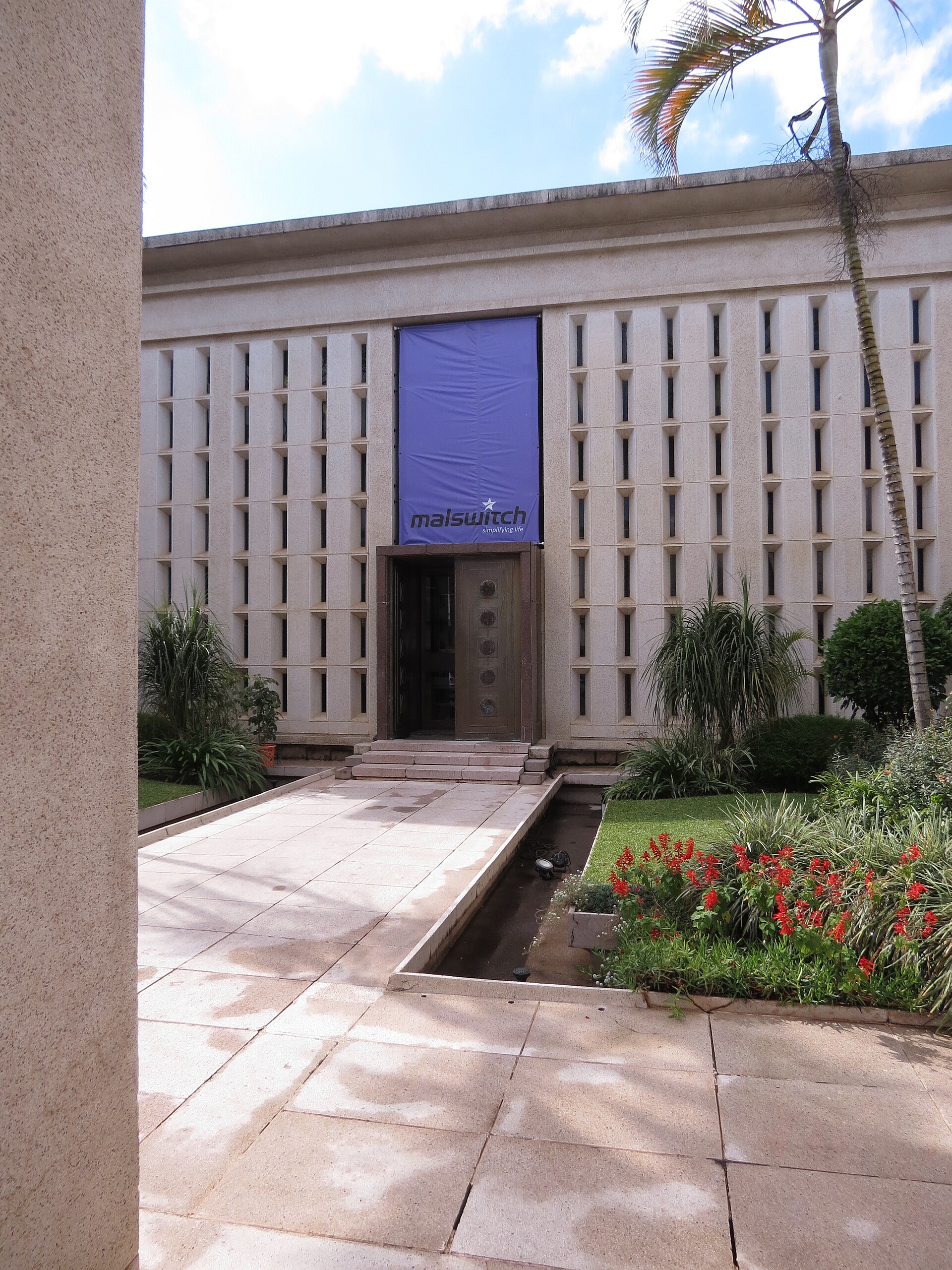
The Malawi Stock Exchange occupies the Old Reserve Bank Building at 14 Victoria Avenue in Blantyre’s Central Business District, a structure originally erected in the mid-1960s to house the Reserve Bank of Malawi when it commenced operations in June 1965. The Reserve Bank’s Blantyre branch was designed by the Zimbabwean architect Mike Clinton, whose regional practice also produced central bank buildings in Harare and the Seychelles, as well as the Mount Soche Hotel in Blantyre itself (Hannah le Roux, “Invented Modernisms: Getting to Grips with Modernity in Three African State Buildings,” Arts, 2022). Clinton’s design followed the idiom prevalent across post-independence sub-Saharan Africa: a rectilinear, multi-storey reinforced-concrete frame with horizontal ribbon windows, flat rooflines, and restrained surface detailing—a functionalist modernism adapted to tropical conditions through deep overhangs and ventilation louvres. When the Reserve Bank relocated its headquarters to Lilongwe in 1981 and later opened a new, purpose-built Blantyre branch on Hanover Avenue in 1998–1999, the original Victoria Avenue building became available for adaptive reuse. The MSE took occupancy, fitting modest office suites and a small trading hall into a structure whose generous floor plates had been designed for banking operations. The building’s utilitarian concrete finish, low decorative profile, and mid-century proportions remain legible beneath subsequent maintenance, placing it within the family of post-colonial institutional architecture catalogued by the SOAS African State Architecture Project.
The decorative programme of the Malawi Stock Exchange is minimal, consistent with its origins as a mid-century central-bank branch and its subsequent conversion into a capital-markets facility on a constrained budget. The Old Reserve Bank Building’s original interiors featured the spare modernist vocabulary typical of Mike Clinton’s institutional commissions: terrazzo or polished-concrete flooring, smooth plaster walls, aluminium-framed glazing, and ceiling-mounted fluorescent lighting with little applied ornament. When the MSE adapted the premises in the mid-1990s, functional signage, institutional logos, and information boards displaying share prices became the primary visual elements of the trading hall. Unlike the grand bourses of Europe or the ornamental banking halls of Johannesburg (Chipkin, “Johannesburg Style: Architecture and Society, 1880s–1960s,” 1993), the MSE’s commercial space was shaped by the pragmatics of a newly established frontier exchange operating on development-bank funding. The exchange’s corporate emblem—featuring the Malawian flag colours and a rising-arrow motif signifying market growth—serves as the dominant decorative element on the building’s façade and interior reception area. Market data displays, initially blackboard and chalk and later electronic ticker boards installed during the 2018 automation project, constitute the principal visual culture of the trading space. This austerity parallels the decorative condition of other small African exchanges that, as Kenny and Moss observe in “Stock Markets in Africa: Emerging Lions or White Elephants?” (World Development, 1998), were established with limited infrastructure budgets as instruments of economic policy rather than civic monuments.
The Malawi Stock Exchange sits on Victoria Avenue, the principal commercial artery of Blantyre, Malawi’s largest city and self-styled “commercial capital.” Victoria Avenue runs through a Central Business District whose colonial-era layout was shaped by three nodes established between 1876 and 1905: the Blantyre Mission founded by Scottish missionaries inspired by David Livingstone, the Mandala trading compound of the African Lakes Corporation (built 1882, now a National Monument and the oldest surviving building in Malawi), and a government-commercial triangle bounded by Haile Selassie Road, Glyn Jones Road, and Hanover Street (UN-Habitat, “Malawi: Blantyre Urban Profile,” 2011). The exchange’s immediate surroundings include the headquarters of the National Bank of Malawi, branches of Standard Bank and FDH Financial Holdings, the Delamere House high-rise—opened by President Hastings Kamuzu Banda as Blantyre’s first tower block—and the Old Boma, the 1887 colonial administrative office that is among the city’s eight designated National Monuments. This compact financial precinct reflects a pattern common to smaller African commercial cities where banking, insurance, brokerage, and exchange functions cluster within a few blocks of colonial-era government buildings. Blantyre’s role as the financial hub persisted even after the political capital moved to Lilongwe in 1975; the Reserve Bank of Malawi maintained a major branch in the city, and the decision to locate the MSE in Blantyre rather than Lilongwe in 1994 affirmed the city’s primacy in private-sector finance (Chirwa and Odhiambo, “Macroeconomic Determinants of Economic Growth: A Review of International Literature,” South East European Journal of Economics and Business, 2010).
The Malawi Stock Exchange traces its origins to the Capital Market Development Act of 1990 and its accompanying Regulations of 1992, legislative instruments that created the legal framework for securities trading in a country transitioning from Hastings Banda’s single-party state to multiparty democracy. The idea was conceived within the Reserve Bank of Malawi and Treasury as part of broader financial-sector reforms supported by the World Bank and IMF structural-adjustment programmes (Chipeta and Mkandawire, “Financial Market Fragmentation and Reforms in Ghana, Malawi, Nigeria, and Tanzania,” World Bank Economic Review, 1996). The MSE was formally established in 1994 and inaugurated in March 1995, but equity trading did not begin until 11 November 1996, when 2,300 Malawian citizens purchased shares in the National Insurance Company (NICO), the country’s largest insurer. The International Finance Corporation and the Dutch development bank FMO provided forty per cent of the US$500,000 start-up cost, while the European Union sponsored public education campaigns. Stockbrokers Malawi Limited, established in 1994 as a subsidiary of the National Bank of Malawi, served as the sole broker and de facto exchange operator in the early years. For its first two decades, trading was conducted by a manual call-over system with minimal daily volume—Charles Chuka, then Reserve Bank Governor, noted in a 2016 address that with only 1,223 trades recorded in 2015, the MSE was the “smallest and least liquid exchange in the SADC region” (BIS Review, 2017). A transformative milestone came in 2018 when the MSE went live with the Capizar Automated Trading System supplied by Pakistan’s InfoTech Group, funded through a US$28.2 million World Bank Financial Sector Technical Assistance Project, which simultaneously introduced a Central Securities Depository operated by the Reserve Bank.
The Malawi Stock Exchange operates three market platforms: the Main Board for established companies, the Alternative Capital Market for small and medium enterprises, and the Debt Market for fixed-income instruments. Prior to the commencement of equity trading in 1996, Stockbrokers Malawi Limited facilitated secondary-market transactions in Government of Malawi Treasury Notes and Local Registered Stock through an over-the-counter facility. When equity trading commenced, the product range was limited to common shares; the first listing, NICO Holdings, was followed by National Bank of Malawi (listed August 2000) and other domestic firms in financial services, agro-industry, telecommunications, and manufacturing. As of 2026, the MSE lists fourteen companies—including Press Corporation, Illovo Sugar (Malawi), Airtel Malawi, FDH Financial Holdings, and the sole foreign listing, Old Mutual, which trades on both the MSE and the Johannesburg Stock Exchange. The Malawi All Share Index (MASI) is the benchmark; it surged 75.56 per cent in the third quarter of 2025, making the MSE Africa’s top-performing exchange that quarter (Daba Finance, 2025). Treasury bonds were added to the Debt Market, with two government bonds listed by 2016. Market capitalization reached approximately MWK 32 trillion (roughly US$1.3 billion at current exchange rates), though daily turnover remains low. Commodities central to Malawi’s export economy—tobacco, tea, and sugar—are not traded on the MSE but underpin the revenues of major listed companies such as Illovo Sugar and the diversified conglomerate Press Corporation, tying the exchange’s performance to global commodity cycles (Kenny and Moss, “Stock Markets in Africa: Emerging Lions or White Elephants?” World Development, 1998).
Images will be added as the project develops. Photographs by Larry Ng and from research sources.