Bilbao Stock Exchange (Bolsa de Bilbao)
Bilbao, Spain · Established 1890
This site requires authorization to access.
To request access, contact
william.goetzmann@yale.edu
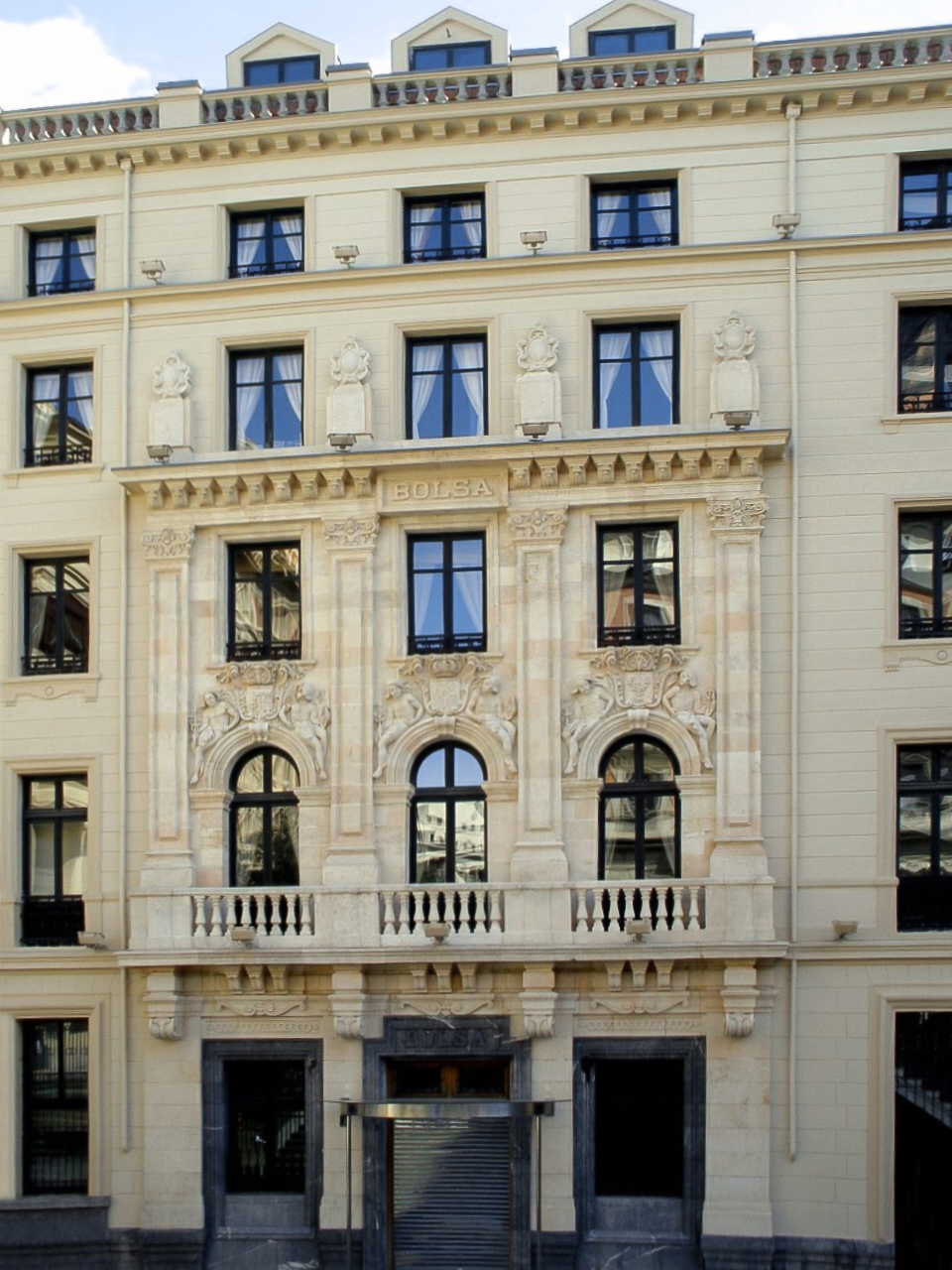
The Bilbao Stock Exchange building, located at Calle José María Olabarri 1 in the Abando district, was designed by architect Enrique Epalza and inaugurated on 29 May 1905. As Elías Mas Serra documents in his monograph Enrique Epalza: Arquitecto para Bilbao (2006), Epalza served as municipal architect and Head of Public Works for the Bilbao City Council during the transition from the nineteenth to the twentieth century. For the exchange he developed what the Open House Bilbao architectural survey describes as a “simple, functional, and elegant” project rendered in a refined eclecticism quite distinct from his modernist Hospital de Basurto (1908). The facade employs ceramic materials including exposed brick and mosaic tile in a treatment approaching neo-Mudéjar, with sloped polychrome roofs and wide eaves characteristic of Epalza’s domestic idiom. The building was sited on the Concordia grounds near the Northern Railway station, at the edge of the new Ensanche district where the financial sector was consolidating. The centerpiece of the interior is the trading hall (corro), crowned by an impressive glass dome that contemporary observers have called “an authentic masterpiece” for its diffusion of natural light into the dealing space. The building underwent significant renovations by Calixto Emiliano Amann in 1921, Manuel Galíndez Zabala in 1942, Ricardo Bastida in 1948 (who raised the building’s elevation), and a final comprehensive renovation by José Jesús del Arenal and Alberto Sanz Fernández de Retana in 1989 that conferred its present appearance. Bastida, who had studied under Domènech i Montaner in Barcelona, brought a modernist sensibility to his interventions, as documented in the Bilbao Fine Arts Museum’s Ricardo Bastida architectural collection.
The decorative program of the Bolsa de Bilbao reflects the restrained eclecticism that Enrique Epalza favored for commercial architecture, prioritizing functional elegance over the exuberant ornamentation typical of contemporaneous exchange buildings in Madrid or Barcelona. The building’s most striking artistic feature is the glass dome over the trading hall, an iron-and-glass structure that floods the corro with natural light, following the tradition of nineteenth-century commercial architecture that treated transparency as both engineering achievement and symbolic gesture toward market openness. The exterior facades incorporate ceramic decorative elements, ornamental brickwork, and mosaic tilework in a treatment that, as architectural historian Elías Mas Serra notes in Bilbao, Arquitectura y Arquitectos (Bilbao City Council, 1985), lends a neo-Mudéjar quality blended with modernist accents recalling Viennese Secessionist design. While the Bolsa de Bilbao’s decorative program was more austere than that of the Madrid Bolsa, the broader Basque financial architecture of the period embraced monumental art. Most notably, the Bilbao-born painter Aurelio Arteta Errasti (1879–1940) executed between 1920 and 1923 a celebrated cycle of twelve frescoes for the Banco de Bilbao’s Madrid headquarters, designed by Ricardo Bastida, depicting the history of the Basque Country and the banking profession through classicist allegories of labor and industry. These murals, now part of the BBVA art collection, represent the finest surviving example of the decorative ambitions that Basque financial institutions brought to their commercial spaces during the early twentieth century.
The Bolsa de Bilbao occupies a strategic position in the Abando district, at the threshold of the Ensanche, Bilbao’s planned urban expansion conceived in 1876 by engineers Pablo de Alzola and Ernesto de Hoffmeyer together with architect Severino de Achucarro after the annexation of the neighboring municipality of Abando. As Jörg Plöger documents in his London School of Economics case study Bilbao City Report (2007), the Ensanche was designed on a rational grid plan with wide avenues and spacious plazas, transforming open land into the modern commercial and financial heart of the city. The exchange building sits near the Concordia railway station and within walking distance of the Gran Vía Don Diego López de Haro, Bilbao’s principal commercial artery, which by the early twentieth century was lined with the headquarters of major financial institutions including Banco de Bilbao (at Gran Vía 12, later redesigned by Pedro Guimón in 1912) and Banco de Vizcaya. The building’s proximity to the Nervión River and the port was no accident: as Anne Power notes in her LSE CASEreport Bilbao City Story (2016), the river estuary was the industrial spine of the metropolitan area, with mining, steel, and shipbuilding operations concentrated along its banks. The exchange thus stood at the intersection of the old mercantile waterfront and the new bourgeois Ensanche, mediating between the physical economy of iron and ships and the paper economy of shares and bonds that financed it.
The Bolsa de Bilbao was constituted on 20 November 1889, when twenty-nine shareholders subscribed an initial capital of 50,000 pesetas divided into 200 bearer shares. A Royal Decree signed by Regent Queen María Cristina de Habsburgo-Lorena on 21 July 1890 formally authorized the establishment of a General Stock Exchange in Bilbao. As Stefan Houpt and Juan Carlos Rojo Cagigal demonstrate in their seminal study “Capital Market Integration in Spain? Introducing the Bilbao Stock Exchange, 1891–1936” (Revista de Historia Económica, vol. 28, no. 3, 2010, pp. 535–573), the first trading session took place on 5 February 1891, with six exchange brokers handling forty listed securities including sixteen public bonds, ten obligation bonds, and fourteen shares. Between 1891 and 1905, trading moved through several provisional locations, including the vestibule of the Teatro Arriaga, the Plaza Nueva, and temporary quarters provided by Banco de Bilbao. The exchange’s founding coincided with Bilbao’s explosive industrial growth: the city’s population surged from 11,000 in 1880 to 80,000 by 1900, driven by iron ore exports to British Bessemer steel producers. The Banco de Bilbao, established in 1857, and the Banco de Vizcaya, founded in 1901, anchored a regional banking system that financed railroads, mines, shipyards, and steel mills. As Houpt and Rojo Cagigal found, the exchange evolved from a public-debt-dominated market into a distinctly industrial exchange tied to regional development, with little evidence of capital market integration with Madrid before the 1920s. Spain’s 1989 stock market reform prompted modernization, and in 2002 the exchange was absorbed into Bolsas y Mercados Españoles (BME), later integrated into the Swiss group SIX.
From its inception, the Bolsa de Bilbao served as the financial clearinghouse for Basque industrialization. The research of Houpt and Rojo Cagigal (“The Origins of the Bilbao Stock Exchange, 1891–1936,” Universidad Carlos III de Madrid Working Paper 10-05, 2010) demonstrates that the exchange rapidly transitioned from a public-debt-dominated market to a specialized industrial bourse. Among the most actively traded securities were shares of Altos Hornos de Vizcaya, formed in 1902 from the merger of Altos Hornos de Bilbao, La Vizcaya, and La Iberia, and for decades the largest company in Spain. Shipping securities figured prominently, notably Naviera Sota y Aznar, incorporated in 1906 by cousins Ramón de la Sota and Eduardo Aznar from twenty-five single-ship companies originally founded in 1889, and Marítima del Nervión. The exchange listed banking stocks including Banco de Vizcaya (founded 1901) and Banco Hispano Americano, as well as hydroelectric shares such as Hidroeléctrica Ibérica (founded in Bilbao in 1901 by Juan Urrutia Zulueta, later merged into Iberdrola) and Hidroeléctrica Española. Railway obligations, particularly those of the Ferrocarril de Santander a Bilbao and the Compañía del Norte, provided fixed-income instruments. As Battilossi and Houpt argued in their conference paper “Risk, Return and Volume in an Emerging Stock Market: The Bilbao Stock Exchange, 1916–1936” (14th International Economic History Congress, Helsinki, 2006), the Bilbao index functioned essentially as an industrial index, reflecting the region’s concentration in iron, steel, shipping, and energy rather than the diversified national market represented by Madrid, making Bilbao Spain’s second financial center with a distinctly regional industrial character.
Images will be added as the project develops. Photographs by Larry Ng and from research sources.