Bern Stock Exchange (Berner Börse)
Bern, Switzerland · Established 1884
This site requires authorization to access.
To request access, contact
william.goetzmann@yale.edu
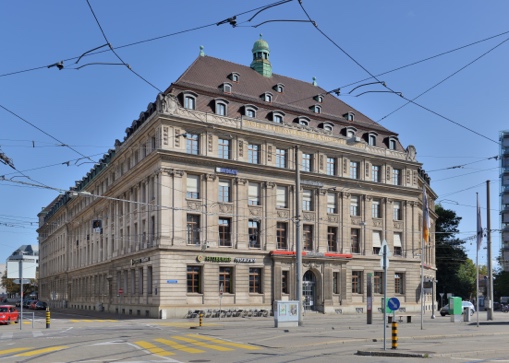
The Berner Börse never occupied a purpose-built exchange palace on the scale of Zurich’s Börsenstrasse edifice or Geneva’s Palais de la Bourse. Instead, the exchange operated within the commercial fabric of Bern’s UNESCO-listed Old City, a dense medieval core of Molasse sandstone buildings that Duke Berchtold V of Zähringen laid out on the Aare peninsula in 1191. From the association’s founding in 1884 until 1961, trading was conducted informally in the offices and meeting rooms of member banks along the Aarbergergasse and neighboring streets, beneath the distinctive covered arcades—the Lauben—that stretch for six kilometers through the Old City, forming one of Europe’s longest sheltered commercial promenades. In 1961, the Berner Börsenverein established a dedicated open-outcry trading floor in the basement of Aarbergergasse 30, a characteristic Bernese sandstone building with ground-floor arcades, upper-story mansard windows, and the greenish-grey local stone façade typical of the post-1575 reconstruction documented by Marcel Gränicher in his study Altstadt von Bern: Die Baugeschichte (1999). The trading floor itself was a modest, functional space—far removed from the grand rings of Frankfurt or Amsterdam—reflecting the regional, cantonal character of the exchange. When open outcry gave way to telephone trading in 1991, the physical trading room was decommissioned, and operations migrated to offices before the exchange became fully electronic in 2002. The BX Swiss website records this transition as the moment when “the company switched from floor to telephone trading due to a lack of volume,” marking the end of the physical marketplace era in Bern.
The decorative program of the Berner Börse was inseparable from the broader ornamental traditions of Bern’s Old City rather than a bespoke commission for a grand exchange hall. The sandstone buildings along Aarbergergasse, where the exchange operated, displayed the carved keystones, wrought-iron balcony railings, and painted façade medallions characteristic of the post-1575 reconstruction era, when the city rapidly rebuilt forty-three structures destroyed in a devastating fire, as documented in the Inventar der neueren Schweizer Architektur (INSA) compiled by the Gesellschaft für Schweizerische Kunstgeschichte. The nearby Ryfflibrunnen fountain on Aarbergergasse, a sixteenth-century polychrome figure of a crossbowman, is listed as a Swiss heritage site of national significance and typifies the public art that framed merchants’ daily passage to the exchange. Within the trading floor at Aarbergergasse 30, the decoration was utilitarian: price boards, ticker displays, and the functional apparatus of a cantonal ring-trading operation. More symbolically resonant was the broader financial architecture surrounding the exchange—the Berner Kantonalbank building on Bundesplatz, originally built as a Gesellschaftshaus in 1867 by architect Johann Caspar Wolff, received a monumental row of oversized Attica statues in 1871, designed by sculptor Robert Dorer and executed by Ludwig Keiser and Heinrich Rudolf Meili, allegorizing commerce, industry, and the liberal arts. These sculptural programs, flanking the nearby Swiss National Bank headquarters inaugurated in 1912 in a Neo-Baroque style by architect Eduard Joos, constituted the visual vocabulary of Bernese financial life—a context of civic monumentality within which the modest Börse quietly conducted its cantonal business.
Bern’s selection as the Bundesstadt—the Swiss federal seat of government—on 28 November 1848 was a deliberate political compromise between German- and French-speaking cantons, as Carl Hilty argued in his Vorlesungen über die Politik der Eidgenossenschaft (1875), chosen for its centrality rather than its economic weight. This political status profoundly shaped the city’s financial geography. The Federal Palace (Bundeshaus), erected in stages between 1852 and 1902, dominated the western end of the Old City’s ridge above the Aare; the Swiss National Bank established its legal headquarters at Bundesplatz 1, inaugurated in 1912; and the Berner Kantonalbank occupied its converted Gesellschaftshaus directly opposite. The Börse’s location on Aarbergergasse placed it within this governmental-financial corridor, just minutes from both the Federal Palace and the National Bank—a proximity that reflected Bern’s dual identity as political capital and financial center. As Henri B. Meier, John E. Marthinsen, Pascal A. Gantenbein, and Samuel S. Weber note in Swiss Finance: Banking, Finance, and Digitalization (Springer, 2023), Bern had been “an important location for renowned private banks, primarily active in international finance” since the eighteenth century, with houses like Marcuard & Cie., founded in 1746 by Johann Rudolf Marcuard, pioneering sovereign debt placement well before the formal exchange existed. The city’s UNESCO World Heritage designation, awarded in 1983 for the medieval Old City’s “exceptionally coherent planning concept,” ensured that the Börse operated within one of Europe’s best-preserved urban landscapes.
Bern’s financial traditions long predated the formal exchange. The Republic of Bern invested state surpluses abroad as early as the seventeenth century, engaging banking houses like Malacrida & Cie. and Samuel Müller & Cie. in London—both of which collapsed in the speculative crisis of 1720 linked to the Mississippi and South Sea bubbles, an episode analyzed by Stefan Altorfer-Ong in his doctoral dissertation The Role of Berne in European Fiscal-Military State Building (Cambridge, 2003). The founding of the Berner Bankervereinigung (Berne Bankers’ Association) on 28 January 1880, by nine banks and fourteen private firms, formalized the city’s over-the-counter securities trade. Four years later, on 10 November 1884, the Berner Börsenverein (Berne Stock Exchange Association) was officially constituted, making it the fifth Swiss exchange after Geneva (1850), Basel (1866), Zurich (1873), and the smaller Lausanne bourse. The exchange operated under cantonal authorization, as all Swiss bourses did until the Federal Stock Exchange Act (BEHG/SESTA) of 1995 transferred regulatory authority to the federal level. Open-outcry trading was conducted in the basement of Aarbergergasse 30 from 1961 to 1991, when declining volumes forced a switch to telephone-based trading. Full electronic trading arrived in 2002 under the rebranded name BX Berne eXchange. Unlike Geneva, Basel, and Zurich—which merged in 1993 to form the SWX Swiss Exchange (later SIX Swiss Exchange)—the Bern exchange maintained its independence. Archival records held at the Graduate Institute Geneva (reference P6.3.15) document the Berner Börsenverein’s operations from 1929 to 1970 in sixty-eight volumes. In 2017, the Financial Market Infrastructure Act (FINMASA) authorized BX Swiss as a fully regulated stock exchange; shortly thereafter, Boerse Stuttgart acquired full ownership, securing the institution’s future as Switzerland’s second official exchange.
The Berner Börse’s traded instruments reflected both its cantonal origins and Bern’s status as the seat of the Swiss Confederation. Government bonds—federal, cantonal, and municipal—formed the backbone of the exchange’s listings from its earliest decades, as the Swiss government and the Canton of Bern issued debt to finance the massive railway infrastructure projects of the late nineteenth century that Henri B. Meier and colleagues describe in Swiss Finance (Springer, 2023) as the catalyst for Swiss equity market development. Cantonal bonds (Kantonalanleihen) and Pfandbriefe—mortgage-backed securities issued under the Pfandbriefgesetz of 1930 through the Pfandbriefzentrale, an institution restricted by law to cantonal banks—also featured prominently. Equities of regional firms, insurance companies, and local industrial enterprises rounded out the listings, though the exchange always remained modest in comparison with Zurich. As the Pictet long-term study of Swiss equities and bonds (published annually since 1988) documents, Swiss bond and equity markets delivered stable real returns over the twentieth century—averaging 4.0 percent annually for bonds and 7.7 percent for equities in nominal terms since 1926. In its modern incarnation as BX Swiss, the exchange lists stocks, bonds, exchange-traded funds, structured products, and cryptocurrency exchange-traded products (ETPs), serving as the primary listing venue for twenty-one Swiss companies, many of them small and medium-sized enterprises. The Moneyland.ch guide to BX Swiss notes that most major Swiss stocks carry secondary listings on the exchange, providing an alternative trading venue to SIX Swiss Exchange.