Berlin Stock Exchange
Berlin, Germany · Established 1685

This site requires authorization to access.
To request access, contact
william.goetzmann@yale.edu
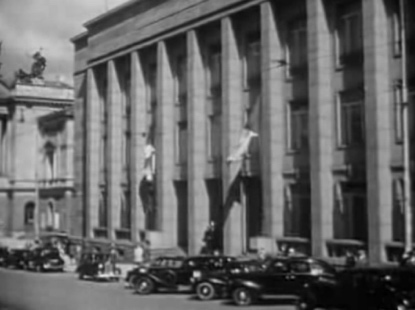
The earliest exchange sessions, called Morgensprachen (morning talks), were held informally in a garden house known as the Grotte in the Lustgarten, and sometimes simply under open sky, before the institution moved into its first proper exchange building in 1805. The monumental building that defined the Berliner Börse was designed by Friedrich Hitzig -- a pupil of Karl Friedrich Schinkel -- and constructed between 1859 and 1863 at Burgstraße 25-26 in a Neo-Renaissance style that married Schinkelesque classical restraint with rich Italianate detailing, at a cost of approximately 700,000 Vereinsthaler. Its two vast trading halls were the largest enclosed spaces in all of Berlin at the time, and the complex included an open courtyard called the Sommerbörse (summer exchange) where trading continued outdoors in warm weather; Hitzig published a detailed monograph on the design in the Zeitschrift für Bauwesen (vols. 15-16, 1865-66). Heavily damaged by Allied bombing on 3 February 1945 -- the largest American air raid of the war -- the ruin was demolished after the war by order of the East Berlin Magistrate, and today a bronze commemorative plaque marks the site where the exchange once stood.
Hitzig's Neo-Renaissance facade at Burgstraße featured elaborate stone ornamentation with pilasters, arched windows, and sculptural decoration characteristic of the monumental public architecture of Wilhelmine Berlin, intended to project the economic prestige of the Prussian capital. The building's grandeur made it a subject for artists across media: the Austrian artist Gustav Kalhammer produced a print titled 'Berlin: Stock Exchange (Die Börse)' published by the Wiener Werkstätte in 1911, now in the collection of the Metropolitan Museum of Art (9 x 14 cm), while the German-American etcher Anton Schutz included a detailed 'Berlin Stock Exchange' etching in his celebrated 1930 series 'Stock Exchanges of the World,' now held by the National Gallery of Art in Washington. Historical engravings and photographs from the 1860s through 1900 -- including views from across the Friedrichsbrücke toward Museum Island -- document the building's imposing riverfront presence and its richly articulated facade rising above the Spree.
The Hitzig building at Burgstraße 25-26 occupied a commanding position in Berlin-Mitte on the north bank of the Spree, directly opposite Museum Island and visible from the Friedrichsbrücke, placing the exchange at the symbolic intersection of Prussian culture and commerce. The surrounding streets formed the financial heart of imperial Berlin, close to the Reichsbank and the major banking houses along Behrenstraße and Unter den Linden, and within easy reach of the government quarter along Wilhelmstraße. After the building's wartime destruction and the division of Berlin, the exchange reopened in the western sector -- first in the Logenhaus on Emser Straße, then in a purpose-built facility on Fasanenstraße inaugurated on 18 June 1955, and from 1998 in the striking Ludwig Erhard Haus designed by Nicholas Grimshaw at Fasanenstraße 85 in Charlottenburg, whose fifteen elliptical steel arches rising to 38.6 meters earned it the local nickname 'the Armadillo.'
Founded on 29 June 1685 by an edict of the Great Elector Friedrich Wilhelm of Brandenburg, the Berliner Börse is one of the oldest exchanges in Germany, though it initially served merely as a meeting place for the guilds of chandlers and dressmakers to conduct reciprocal business consultations, with formal securities trading not commencing until 25 February 1739. The exchange grew in tandem with Prussian and then German industrialization: the first railway shares were officially quoted in 1840, and the massive French reparation payments following the Franco-Prussian War of 1871 fueled the speculative Gründerzeit boom in which construction companies and industrial ventures flooded the exchange with new share issues. By the eve of World War I, the Berliner Börse had become the largest exchange in Germany and one of the largest stock, bond, and commodity exchanges in the world, comparable in scale to the London Stock Exchange and the New York Stock Exchange. The Weimar-era hyperinflation of 1921-23 convulsed the market, the Nazi regime imposed price floors that effectively froze trading by January 1943, and Allied bombing devastated the Burgstraße building on 3 February 1945; after the war, trading resumed in West Berlin on 19 July 1950, and following German reunification in 1990 the exchange was reconstituted as a unified institution that continues to operate today.
In its earliest decades the exchange facilitated informal commodity dealing and mercantile consultations among Berlin's guild traders, but by the mid-eighteenth century it had evolved into a marketplace for securities, with the first formal securities transactions recorded on 25 February 1739 and Prussian government bonds (Staatsanleihen) becoming a mainstay of trade. During the Second Industrial Revolution, the Berlin exchange became a critical engine for financing new technology: research analyzing 474 IPOs between 1892 and 1913 has shown that innovative firms in successive waves -- railways (1877-86), synthetic dyes (1887-96), chemicals (1897-1902), and electrical engineering (1903-18) -- raised capital on favorable terms, with particularly low underpricing and strong long-run performance. At its imperial-era peak the exchange traded stocks, corporate and government bonds, commodities, and foreign currencies on a scale rivaling London and New York, underwritten by the great Berlin-based universal banks -- Deutsche Bank, Dresdner Bank, and Disconto-Gesellschaft -- that dominated German capital markets. Today the Börse Berlin specializes in the trading of international equities, offering approximately 15,000 stocks from issuers in more than 80 countries alongside bonds, ETFs, warrants, and exchange-traded commodities.