Bryggen — Hanseatic Kontor of Bergen (Tyskebryggen)
Bergen, Norway · Established Kontor established c. 1350; surviving timber buildings rebuilt after the 1702 fire
This site requires authorization to access.
To request access, contact
william.goetzmann@yale.edu
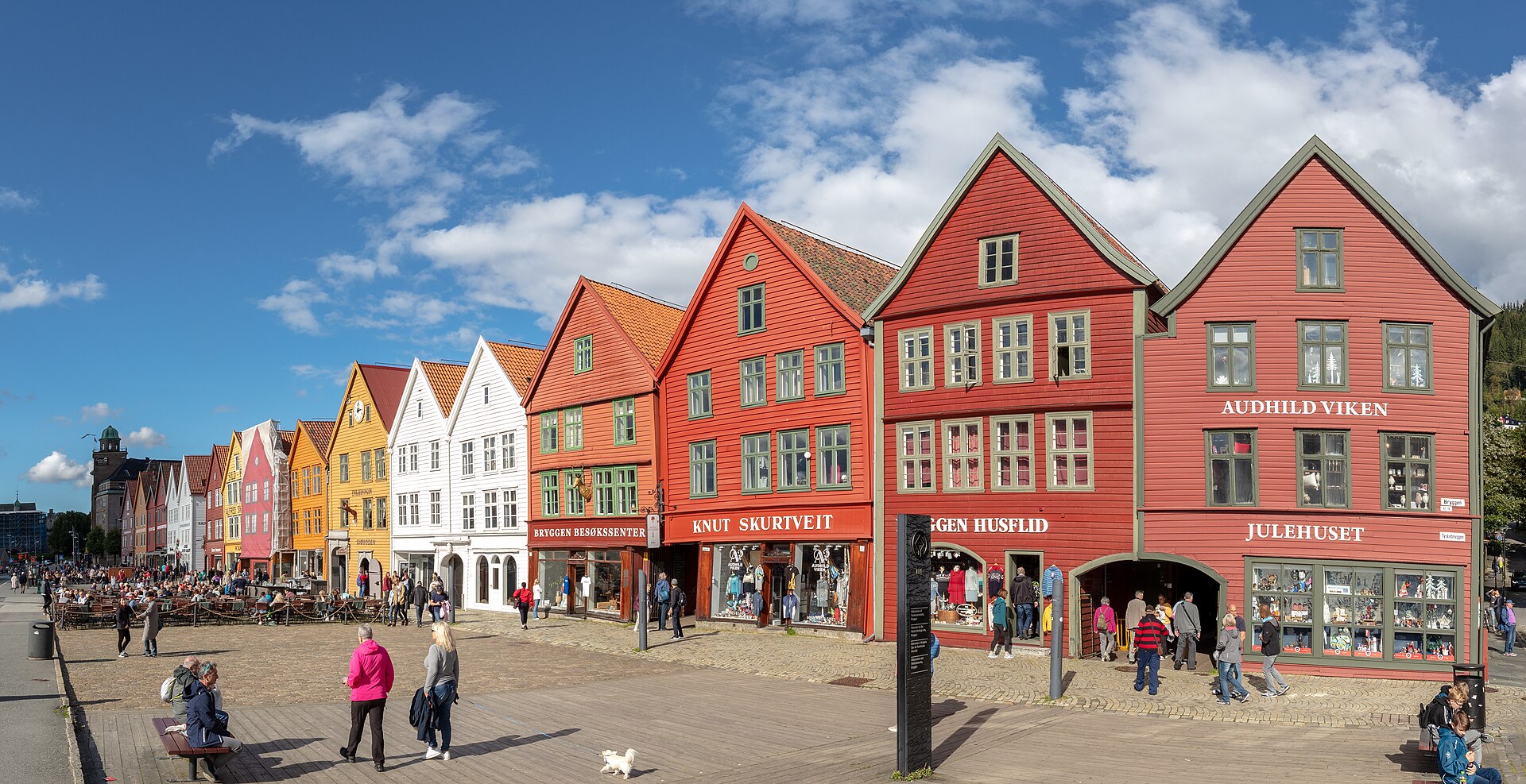
Bryggen is not a single monumental structure but a tightly packed quarter of narrow, gable-fronted timber tenements ranged in parallel rows along the eastern shore of the Vågen harbour, the only one of the Hanseatic League's four great overseas Kontors whose buildings survive. The present ensemble of roughly 60 buildings dates from the reconstruction that followed the catastrophic fire of 1702, which, as the UNESCO nomination notes, reduced the medieval town to ashes; yet because each tenement (gård) was rebuilt on its own fire-cleared stone foundations and to the same plot boundaries it had occupied since the twelfth century, the post-1702 wharf preserves a medieval urban morphology almost unchanged (UNESCO World Heritage Centre, 'Bryggen', inscribed 1979, criterion iii). The construction combines two techniques described in Knut Helle's standard monograph 'Bryggen: The Hanseatic Settlement in Bergen' (Det Hanseatiske Museums skrifter): solid horizontal log-building (laft) for the load-bearing storerooms and a lighter column-and-beam frame, clad in horizontal weatherboarding, for the jettied galleries and upper living rooms. Each gård is a deep, double-loaded block running back from a quay, crane and gabled façade on the water to a kitchen and the communal assembly rooms at the rear, with narrow passages threading between the rows. Fifteenth-century stone cellars survive beneath several tenements, and the single best-preserved house, Finnegården of 1704, retains its original interior and now serves as the Hanseatic Museum (Hanseatic Museum and Schøtstuene; Riksantikvaren, 'Bryggen in Bergen').
Bryggen's artistic interest lies less in fine art than in the vernacular fabric and fittings of a working merchant colony, and the entry is honest in treating this category as modest. The chief decorative survivals are the carved and painted woodwork of the Schøtstuene, the heated assembly and dining rooms where, because open fire was forbidden in the warehouse tenements themselves, the German journeymen gathered, ate and conducted communal business; their painted panels, benches and merchant marks form the principal ornamental ensemble of the quarter (Hanseatic Museum and Schøtstuene, Museum Vest). Far more important than any conventional artwork is the extraordinary corpus of medieval material culture recovered beneath the wharf: the Bryggen inscriptions, some 670 runic texts incised on wood and bone and uncovered after the 1955 fire, range from business memoranda and ownership tags to poetry, prayers and ribald verse, and have been called the most important runic find of the twentieth century ('Bryggen inscriptions', recovered from 1955). Together with imported ceramics from across Europe and the Middle East, these objects, now displayed in Bryggens Museum, constitute the visual and documentary record of the colony far more than any painted decoration.
The quarter occupies the historic core of Bergen, founded before 1070 and long the largest town in medieval Norway, lining the sheltered eastern quay of the Vågen inlet that gave the port its strategic command of the North Sea and Baltic sea routes (Knut Helle, 'Bergen bys historie', vol. 1). Bryggen, literally 'the wharf', was from the thirteenth century the commercial waterfront of the whole town, and after the Hanseatic merchants took up year-round residence it became known as Tyskebryggen, the 'German Wharf' — effectively a foreign enclave of perhaps a thousand German men at its peak around 1400–1600, governed by its own aldermen and law yet wedged into the centre of a Norwegian city (Mike Burkhardt, 'The German Hanse and Bergen', Scandinavian Economic History Review, 2010). It was, as Riksantikvaren observes, the only Hanseatic trading city outside the League's German heartland where the original built structure still stands in the urban core. Today the surviving rows face the modern harbour front and the Bryggens Museum and Mariakirken (St Mary's Church) immediately behind, and the protected wharf with its archaeological deposits forms a national treasure ringed by a UNESCO buffer zone.
Bergen was a major North Atlantic emporium long before the Germans arrived, but Hanseatic merchants began wintering on the wharf from the mid-thirteenth century, and the League formally constituted its Bergen Kontor — one of only four, alongside the Steelyard in London, Bruges and the Peterhof at Novgorod — around 1350 (World History Encyclopedia, 'Bergen'; UNESCO, 'Bryggen'). The Kontor was a self-governing corporation of unmarried German merchants and journeymen, organised by tenement and presided over by aldermen who exercised internal jurisdiction and represented the colony to the League and to the Norwegian Crown (Mike Burkhardt, Scandinavian Economic History Review, 2010). Through royal privileges the Hansa secured a near-monopoly on Bergen's export trade and gradually acquired ownership of the wharf itself. The colony endured repeated fires and growing pressure from Norwegian and Dutch competition, and from the sixteenth century its autonomy waned; the office was finally wound up in the mid-eighteenth century, the last German-run firms giving way to Norwegian owners by the 1760s–1770s. Bryggen was among the very first monuments protected under Norway's Cultural Heritage Act, listed in 1927, and was inscribed on the UNESCO World Heritage List in 1979 (Riksantikvaren, 'Bryggen in Bergen'); most of the buildings are now owned and conserved by the Bryggen Foundation, established in 1962.
Bryggen was the hub of the North Atlantic stockfish trade — air-dried cod (tørrfisk) brought south from the Lofoten and Vesterålen fisheries of northern Norway, which the German merchants bought from Norwegian fishermen and re-exported across Europe as a durable, high-protein staple (World History Encyclopedia, 'Bergen'; UNESCO, 'Bryggen'). The trade ran on a long-credit system that bound northern fishermen to the Kontor: the merchants advanced grain, flour, beer, salt, cloth, wine and manufactured goods — commodities northern Norway could not produce — against future deliveries of fish, the imports flowing in from the Baltic and Rhineland while the stockfish flowed out (Mike Burkhardt, 'The German Hanse and Bergen', Scandinavian Economic History Review, 2010). The deep ground-floor warehouses of each tenement, set directly on the quay with their own cranes, were the physical instruments of this exchange: stockfish was piled, weighed, graded and shipped from them, while grain and trade goods were stored above and behind. For four centuries this single axis — northern fish for southern grain and goods, settled on credit through the German Wharf — made Bergen one of the great commodity markets of medieval and early-modern northern Europe (Knut Helle, 'Bryggen: The Hanseatic Settlement in Bergen').
Images will be added as the project develops. Photographs by Larry Ng and from research sources.