Bergen Exchange (Bergen Børs / Børsbygningen i Bergen)
Bergen, Norway · Established 1813
This site requires authorization to access.
To request access, contact
william.goetzmann@yale.edu
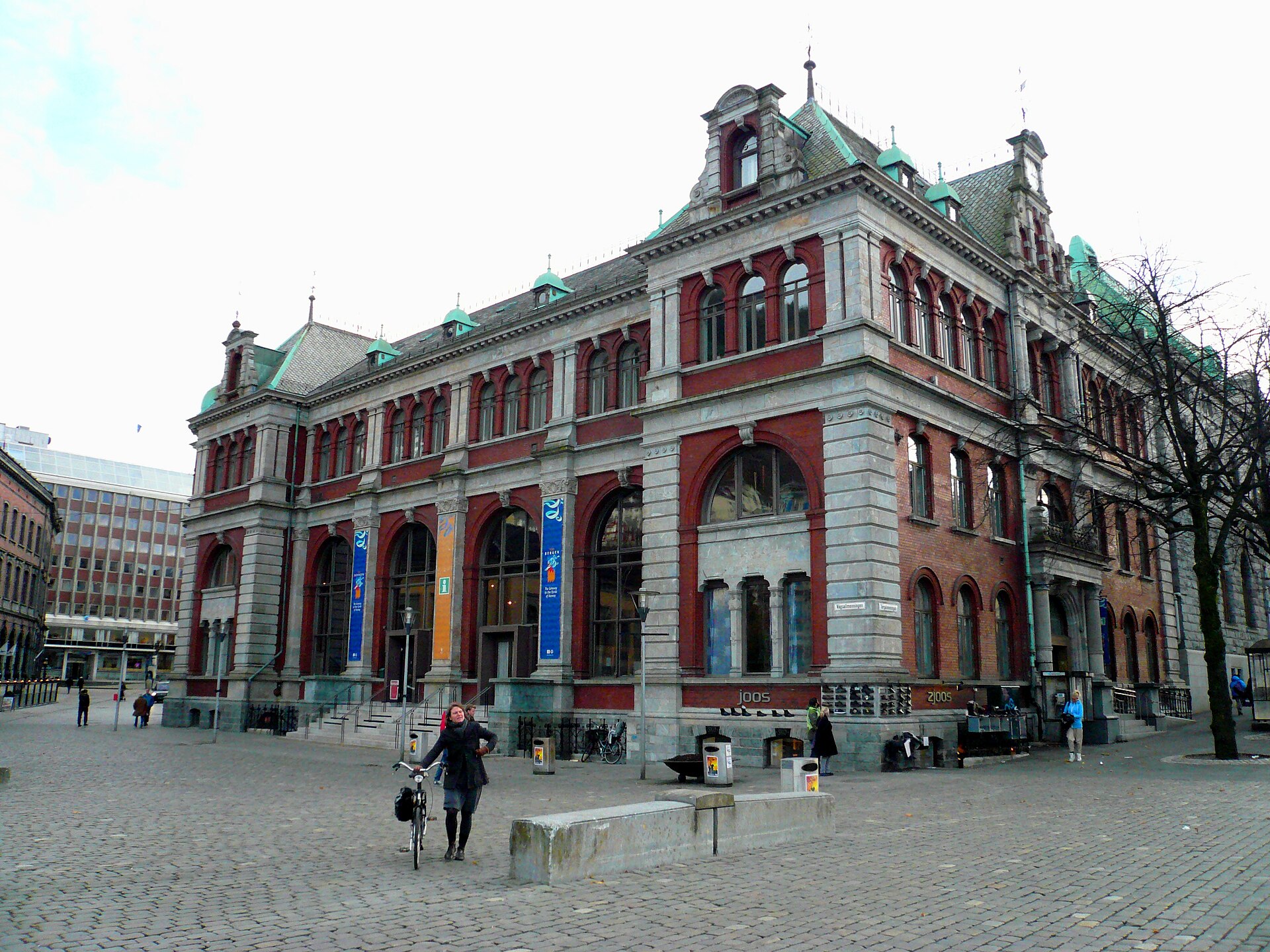
The Bergen exchange building (Børsbygningen) at Vågsallmenningen 1 was raised in two campaigns that left it stylistically doubled over. Excavation of the central market-square site began in 1857, and the first structure was completed in 1861–62 to designs by the German-born architect Frantz Wilhelm Schiertz (1813–1887), a former pupil of the landscape painter J. C. Dahl who had settled in Bergen in 1851 and who also designed the city's town hall (Store norske leksikon, 'Frantz Wilhelm Schiertz'). Schiertz conceived a late-Neoclassical (senklassisistisk) hall originally intended to rise three storeys, but, as the Bergen city archive records, available funds 'ikke strakk til,' so it was built as a more modest two-storey block with a flat roof and a smaller exchange hall than planned (Bergen kommune byarkiv, 'Børsbygningen på Torvet – 150 år'). By the 1870s the premises had become inadequate; the Bergen architect Lars Solberg won a competition and between 1890 and 1893 rebuilt the structure, adding a storey and recladding it in red brick and Norwegian soapstone (kleberstein) beneath steep copper-clad roofs. The result, with its arcaded round-headed windows, corner pavilions, and polychrome masonry, is reckoned 'en av byens viktigste nyrenessansebygninger' — one of Bergen's foremost Neo-Renaissance buildings (Norwegian Wikipedia, 'Børsbygningen i Bergen').
The building's artistic fame rests overwhelmingly on a single interior: the Frescohallen, the former exchange hall measuring roughly 26 by 19 metres, whose ten curved wall panels were decorated between 1921 and 1923 by Axel Revold (1887–1962). Revold had studied under Henri Matisse in Paris from 1908 to 1910 and trained specifically in true fresco technique there in 1919–20, and the Bergen commission — awarded after a national competition announced in 1918 — was the largest given to a Norwegian artist of his day and is regarded as 'one of the principal works in Norwegian fresco painting' and a breakthrough for the al fresco method in Norway (Store norske leksikon, 'Axel Revold'). The murals fuse lessons from Matisse and Cubism in flat, strongly coloured decorative compositions showing the labour that underpinned Bergen's economy — Lofoten fishermen, sailors and porters on the Bryggen wharf, industrial workers and farmers — presenting the city as the hub of a worldwide trade. The cycle is counted among Norway's national art treasures (nasjonale kunstskatter). Beyond the frescoes the building's decorative interest is largely architectural, residing in Solberg's Neo-Renaissance masonry, ironwork, and the hall's restored coffering and floor rather than in a wider collection of art.
The exchange occupies a commanding site on Vågsallmenningen, one of the broad fire-break squares (allmenninger) that open off the inner harbour (Vågen) in the medieval core of Bergen, a short walk from the Hanseatic wharf of Bryggen, a UNESCO World Heritage site. A central, prestigious location 'on Torvet' (the marketplace) had been an explicit condition for building a dedicated exchange in the city, signalling that the institution stood at the commercial heart of western Norway (Bergen kommune byarkiv, 'Børsbygningen på Torvet – 150 år'). Before this purpose-built house existed, the exchange had met in merchants' rooms and in a shed (skur) on the Bryggen wharf, so the move to Vågsallmenningen in 1862 was as much a civic statement as a practical one. The building remains a landmark of the old town's nineteenth-century commercial quarter, ringed by the squares, quays, and merchant houses that had carried Bergen's trade for centuries.
Organised exchange activity in Bergen reached back to 1684, when Jørgen Thormøhlen obtained royal permission to found a børs that soon lapsed, but the continuous institution dates from 1813, when some 180 interested merchants joined to establish a more orderly exchange; it became a public exchange with royal commissioners in 1837 (Bergen byleksikon, 'Bergens Børs'). For most of the nineteenth century the exchange served as the regional commercial nerve-centre of Hordaland, the meeting place where the mercantile community of western Norway gathered. Its activity was gradually overshadowed by the rise of the Christiania (later Oslo) exchange, and Bergens Børs merged with Oslo Børs in 1991, formally ending the independent Bergen exchange (with the wider institution's history running, in the building's accounts, from 1813 to 2000). The building passed to Bergens Privatbank in 1967 and later housed banks, offices, the tourist office, and cultural bodies; in 2017 it reopened, sensitively restored, as the Bergen Børs Hotel, with the cleaned and refurbished Frescohallen serving as a restaurant beneath new guest floors (De Bergenske, 'Bergen Børs Hotel – History and Design').
The Bergen exchange was, in its essence, a commodity and shipping bourse rather than a securities market. Its core business was the quotation of prices and exchange rates for the two staples that had defined Bergen's economy since the Hanseatic era — grain imported into a region that could not feed itself, and fish, above all the dried stockfish (tørrfisk) and salt cod shipped out from northern Norway through Bergen to southern Europe (Bergen byleksikon, 'Bergens Børs'; visitBergen, Hanseatic Museum). To these were added shipping and freight quotations reflecting the city's large merchant fleet, together with foreign-currency rates, while the exchange also maintained journals and newspapers so that merchants could follow national and world markets (Daily Scandinavian, 'The Stock Exchange in Bergen'). The exchange thus formalised, under one roof and a fixed set of posted prices, the grain-for-stockfish trade that Hanseatic merchants had run from Bryggen since the thirteenth century — making the Bergen Børs the institutional successor to one of medieval northern Europe's great commercial systems.
Images will be added as the project develops. Photographs by Larry Ng and from research sources.