Belfast Linen Exchange (White Linen Hall)
Belfast, Northern Ireland · Established 1784
This site requires authorization to access.
To request access, contact
william.goetzmann@yale.edu
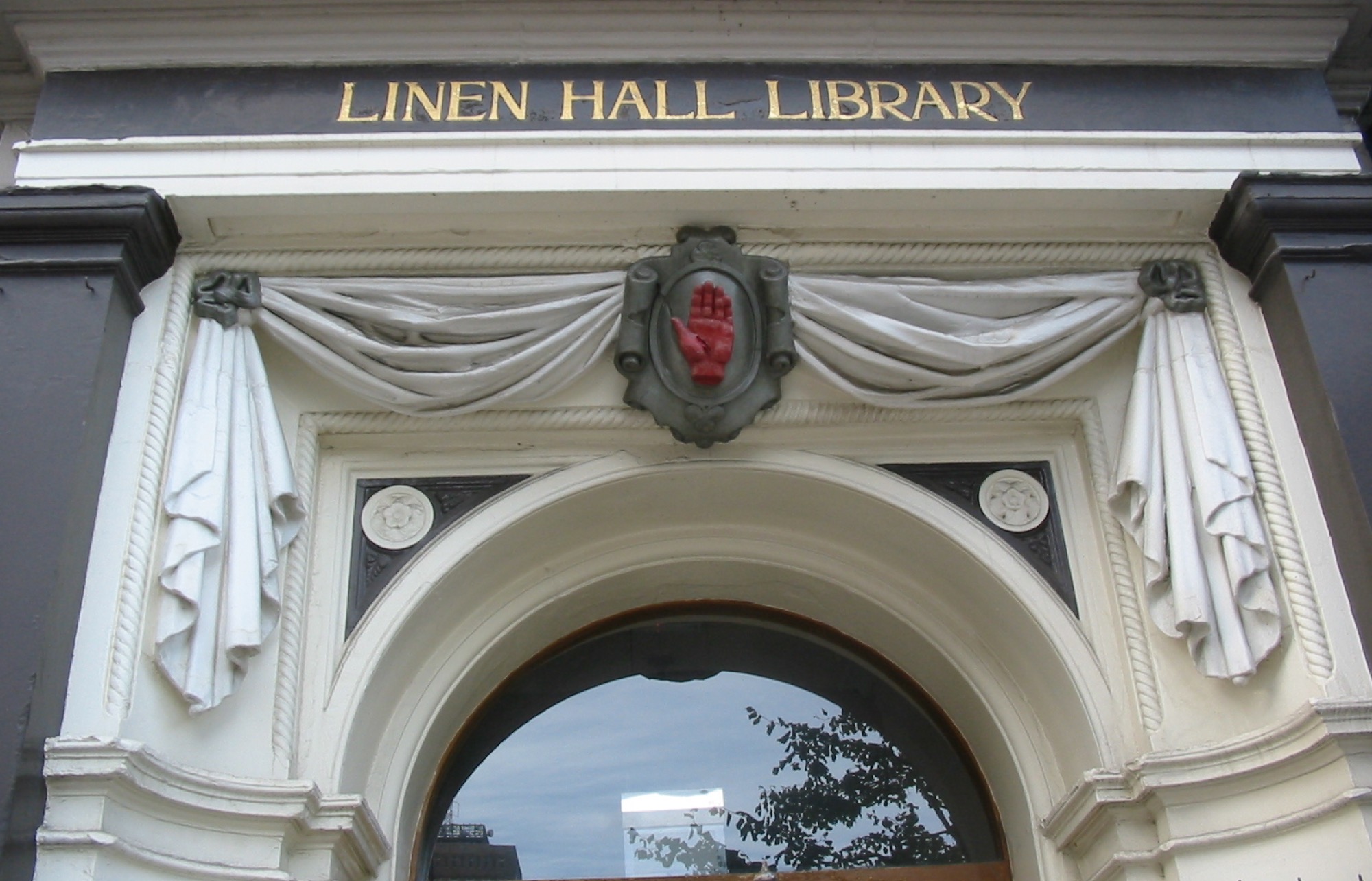
The White Linen Hall, erected between 1783 and 1785 on a four-acre site in what became Donegall Square, was the architectural centerpiece of Belfast’s Georgian commercial expansion. As C.E.B. Brett documented in Roger Mulholland, Architect, of Belfast, 1740–1818 (Ulster Architectural Heritage Society, 1976), the building is attributed to Roger Mulholland, the most distinguished architect working in late eighteenth-century Belfast, who subscribed £100 toward its construction. The Hall was a two-storey quadrangle built at a cost of £10,000 on ground granted by Lord Donegall from the former Castle Meadows. Its principal front elevation rose higher than the other three relatively unadorned facades and was ornamented with pediments, a central tower, and a spire, lending the composition a civic grandeur unusual for a commercial building. The enclosed central courtyard provided the functional heart of the complex, where offices and rooms for the factors—the merchants and agents engaged in linen trading—occupied the interior ranges. An earlier predecessor, the Brown Linen Hall on Donegall Street (dated 1773 over its doorway), had served as the market for unbleached linen but lacked proper shelter—described as a quadrangle open to the elements with only a tumbledown piazza. The White Linen Hall’s superior accommodation represented a deliberate architectural improvement for the bleached-linen trade. In 1802 the Belfast Reading Society, which Mulholland himself had co-founded, took permanent quarters within the Hall, establishing what became the Linen Hall Library. The White Linen Hall was demolished in 1896 after Belfast received city status in 1888, and the site was cleared for Alfred Brumwell Thomas’s grand Baroque Revival Belfast City Hall, completed in 1906.
The decorative program of the White Linen Hall reflected the restrained Georgian aesthetic appropriate to a mercantile institution rather than the ornamental exuberance of later Victorian linen warehouses. The principal elevation, as recorded in contemporary engravings reproduced in Brett’s Buildings of Belfast, 1700–1914 (1985), displayed classical pediments and a central tower with spire—architectural ornament that signaled civic ambition and commercial respectability. The three subsidiary facades remained deliberately plain, their functional austerity reflecting the practical character of a trading hall where the quality of goods, not architectural display, commanded attention. Inside, the factor’s rooms and inspection halls served a fundamentally aesthetic purpose: linen was laid out for visual examination under natural light, where drapers assessed weave, weight, and the evenness of bleaching. The later Victorian linen warehouses that grew up around Donegall Square carried forward the industry’s decorative vocabulary with far greater elaboration. Yorkshire House on Linenhall Street (1862–63), built for Jaffe Brothers, featured sixteen carved portrait roundels by sculptor Thomas Fitzpatrick—including representations of Jacquard, the inventor of the programmable loom—alongside allegorical figures and carved floral motifs. As Katie Larmour has documented, neighboring warehouses displayed carved stone panels inscribed “PURE FLAX,” stylized flax flowers as trade emblems, winged gargoyles, and child figures carrying sheaves of flax and bolts of Irish linen. The pediment sculpture of Belfast City Hall itself, which replaced the White Linen Hall, continued this tradition: Hibernia sits enthroned beside a seated woman at a spinning wheel, while a figure of Industry holds a roll of finished linen.
The White Linen Hall occupied a pivotal position in Belfast’s transformation from a modest market town into Ireland’s largest industrial city. As Olwen Purdue, Georgina Laragy, and Jonathan Jeffrey Wright explored in Urban Spaces in Nineteenth-Century Ireland (Liverpool University Press, 2018)—particularly the chapter “The Donegalls’ Backside: Donegall Place, the White Linen Hall and the Development of Space and Place in Nineteenth-Century Belfast”—the Hall’s construction in the 1780s on the former Castle Meadows anchored an entirely new urban quarter south of the old town center. Donegall Square was laid out around the building, and Donegall Place extended northward to connect the new commercial precinct to the established High Street core. During the late eighteenth and early nineteenth centuries, the balance of commercial power in Belfast shifted decisively southward toward the White Linen Hall. The surrounding streets filled with linen merchants’ townhouses, and after the Mulholland family established the first mechanized linen mill on York Street in the 1820s, warehouses and offices for major firms—William Ewart and Sons, the Richardson brothers, Jaffe Brothers—congregated along Bedford Street and Linenhall Street, forming what became known as the Linen Quarter and later “Linenopolis.” Beyond the built-up area, bleach greens stretched along the Lagan Valley, where webs of brown linen were laid out in long stripes to whiten under sun, wind, and rain. Belfast’s population surged from roughly 25,000 in 1808 to 350,000 by 1901, overtaking Dublin—a demographic explosion driven overwhelmingly by the linen industry and its ancillary trades.
The Belfast Linen Exchange emerged from a centuries-long development of the Irish linen industry that reshaped Ulster’s economy and Britain’s imperial trade. As Conrad Gill demonstrated in The Rise of the Irish Linen Industry (Oxford University Press, 1925), the foundations were laid in the 1690s when the Huguenot refugee Louis Crommelin, appointed by William III as Overseer of the Royal Linen Manufacture of Ireland, established a model manufactory at Lisburn in the Lagan Valley, introducing Continental techniques for producing fine cambric and lawn. The Irish Parliament created the Board of Trustees of the Linen Manufacturers (the Linen Board) in 1711 to foster and regulate the industry, distributing public funds, appointing seal masters to inspect and certify cloth quality, and operating spinning schools across Ulster. Linen exports soared from 750,000 yards in 1710 to 35 million yards by the century’s end, constituting over half of all Irish exports. W.H. Crawford’s research on the domestic linen industry, synthesized in Marilyn Cohen’s edited volume The Warp of Ulster’s Past: Interdisciplinary Perspectives on the Irish Linen Industry, 1700–1920 (St. Martin’s Press, 1997), reveals how the putting-out system functioned: farm families grew flax, women spun yarn, and weavers produced brown cloth sold to drapers at open-air markets. Northern drapers, dissatisfied with Dublin-centered regulation, established the White Linen Hall at Belfast in the 1780s to trade directly with English buyers. The mechanization of spinning after James Kay’s wet-spinning patent of 1825 transformed the industry: by 1871, 78 mills with 43,000 hands operated in Belfast. D.L. Armstrong’s study “Social and Economic Conditions in the Belfast Linen Industry, 1850–1900” (Irish Historical Studies, vol. 7, 1951) documented the city’s industrial peak, when Belfast operated 900,000 spindles, earning its title as the linen capital of the world.
The White Linen Hall was specifically designated for the sale of bleached (“white”) linen, distinguishing it from the older Brown Linen Hall on Donegall Street where unbleached (“brown”) cloth had been traded since 1773. The commodities passing through Belfast’s linen halls encompassed a hierarchy of fabric types differentiated by weave, weight, and finish. Common brown linen—the coarse, unbleached cloth produced on farmstead looms—was the foundation of the trade, purchased by drapers and bleachers who invested six months of capital in the finishing process. The finished white linens ranged from sturdy household cloth to fine specialty fabrics: diaper, introduced to Belfast production by John Holden around 1730; damask, manufactured at Lisburn from 1766 and later at Ardoyne from 1825, employing satin-weave techniques to produce figured patterns of notable excellence; lawn, an exceptionally light and open-structured cloth used principally for ladies’ handkerchiefs, valued at five shillings per yard; and cambric, the finest grade named for Crommelin’s native Cambrai. Beyond finished cloth, the Hall facilitated trade in linen yarn, raw flax, and bleaching materials including potash, buttermilk, and after 1760 diluted sulphuric acid. Quality control was enforced through a system of seal masters appointed by the Linen Board: brown linen seal masters inspected unbleached webs at market and affixed an official seal for a penny per piece, while white seal masters conducted a final inspection at the port of export, certifying cloth with the government’s crown-and-harp insignia alongside the bleacher’s name and county.
Images will be added as the project develops. Photographs by Larry Ng and from research sources.