LSE Data Center (Basildon)
Basildon, UK · Established 2011
This site requires authorization to access.
To request access, contact
william.goetzmann@yale.edu
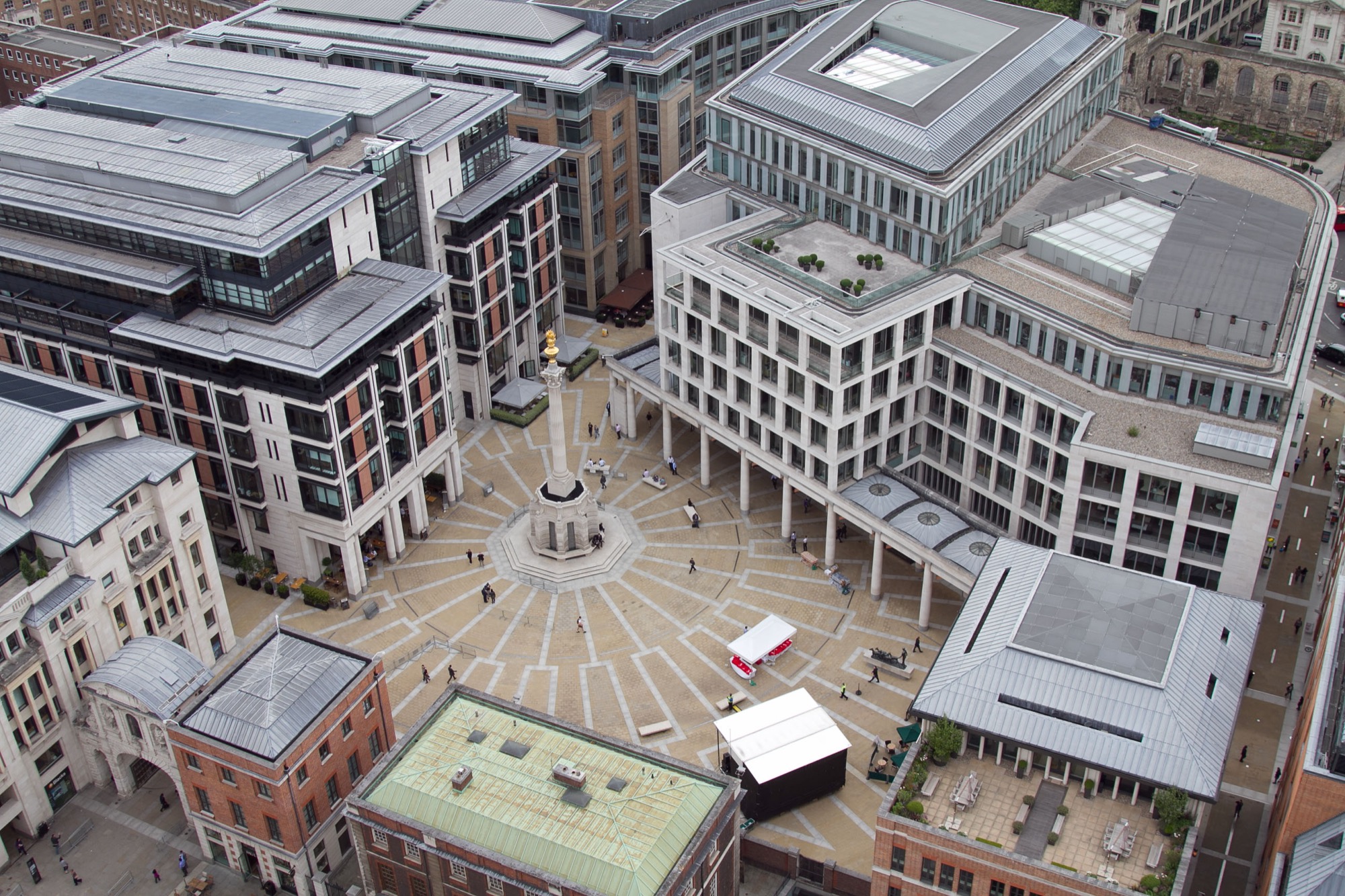
Basildon, Essex, thirty miles east of St Paul’s Cathedral, represents the logical terminus of the London Stock Exchange’s four-century architectural trajectory—from Edward Jerman’s rebuilt Royal Exchange of 1669, commissioned after the Great Fire destroyed Thomas Gresham’s original of 1571, through James Peacock’s Subscription Room at Capel Court in 1802, J.J. Cole’s green-veined marble “Gorgonzola Hall” of 1885, the Llewelyn-Davies twenty-six-storey tower on Old Broad Street opened in 1972, and finally Eric Parry’s Portland stone headquarters at 10 Paternoster Square completed in 2004, to the anonymous industrial sheds that now house the matching engines of modern finance. The physical infrastructure at Basildon centers on ICE’s European Liquidity Centre, a Tier 4 guided data center comprising 30,000 square meters on a 6.5-hectare site, originally opened in May 2010 as the NYSE Euronext facility and retained by Intercontinental Exchange after its 2013 acquisition. The LSE’s own primary matching infrastructure operated from a data center near Liverpool Street in the City of London before migrating in 2022–2023 to a purpose-built facility within Telehouse’s Docklands campus near the River Lea, a move LSEG described as enabling green energy sourcing and cloud migration for internal systems. The Millennium Exchange platform at the heart of this infrastructure was built on technology from MillenniumIT, a Colombo-based firm the LSE acquired in September 2009 for approximately £18 million—one of the most cost-effective technology acquisitions in exchange history, as noted in financial press coverage at the time. MillenniumIT’s Linux-based matching engine replaced TradElect, a £40-million platform developed with Accenture on Microsoft .NET and Windows Server 2003 that had launched in 2007 but suffered catastrophic outages under high trading volumes, including a seven-hour failure that exposed the LSE to competitive threats from Chi-X and other multilateral trading facilities, as Juan Pablo Pardo-Guerra recounts in Automating Finance: Infrastructures, Engineers, and the Making of Electronic Markets (Cambridge University Press, 2019). At launch in February 2011, the Millennium Exchange recorded average order-entry latency of 126 microseconds via its native API—twice as fast as its principal competitors—a figure subsequently reduced further through successive hardware and software upgrades.
The visual culture of the London Stock Exchange in the electronic era is defined by a single masterwork: The Source, a kinetic sculpture by the artist collective Greyworld, commissioned for the eight-storey atrium of the Paternoster Square headquarters when the LSE relocated there in July 2004. The installation consists of 162 cables arranged in a square grid, stretching from the ground floor to the glass roof, with nine spheres mounted on each cable—729 spheres in total—that are free to move independently up and down, driven by real-time market data. At the opening of each trading day, the spheres rise and choreograph themselves into formations; as trades execute across the Millennium Exchange, the spheres respond to the rhythms of buying and selling, creating an ever-shifting three-dimensional representation of market activity that is perhaps the most sophisticated fusion of financial data and kinetic art in any exchange worldwide. The Source stands in deliberate counterpoint to the visual heritage of the old trading floors: the hexagonal dealing booths at Throgmorton Street, where “waiters”—uniformed attendants whose title recalled the coffee-house origins of London securities dealing—summoned brokers with handwritten messages; the green marble columns beneath Cole’s dome at Capel Court; and the banks of television screens that replaced the chalkboards on the Old Broad Street floor after the Big Bang of October 1986, a transformation Pardo-Guerra documents in meticulous detail in Automating Finance (Cambridge, 2019). At Basildon and Docklands, the aesthetic is industrial-sublime: server racks arranged in precise rows within temperature-controlled halls, fiber-optic cables threading through raised floors, and the silent pulse of matching engines processing millions of orders per day. Borsa Italiana, which the LSE acquired in 2007 and housed within the London Stock Exchange Group until its sale to Euronext in 2021, contributed its own visual patrimony: the Palazzo Mezzanotte in Milan’s Piazza degli Affari, designed by Paolo Mezzanotte in 1932, with its monumental Fascist-era travertine facade and the celebrated trading floor where open outcry persisted until 1994. The shift from Palazzo Mezzanotte to Basildon—from carved stone to cooling systems—epitomizes the transformation Donald MacKenzie describes in “Material Signals: A Historical Sociology of High-Frequency Trading” (American Journal of Sociology, vol. 123, no. 6, 2018), where the material infrastructure of markets moves from architecturally legible public spaces to deliberately opaque, security-restricted facilities whose aesthetics serve thermal management rather than civic expression.
Basildon sits along the A127/A13 corridor in south Essex, approximately fifty-three kilometers from central London—a distance strikingly comparable to the twenty-seven miles separating the NYSE’s Mahwah, New Jersey data center from lower Manhattan, as Donald MacKenzie observes in his analysis of the material geography of high-frequency trading. The choice of Essex for London’s electronic trading infrastructure reflects several converging logics: access to long-haul fiber routes running eastward toward transatlantic cable landing points at Bude in Cornwall and Highbridge in Somerset; proximity to the Continent via undersea cables crossing the Channel; sufficient land and power for industrial-scale data center construction unavailable within the congested Square Mile; and the A127 arterial road providing physical access for maintenance and construction. The Hibernia Express transatlantic cable, completed in September 2015 at a cost exceeding $300 million, connects Brean in Somerset to Halifax, Nova Scotia with a tested round-trip latency of under 58.95 milliseconds between Equinix LD4 in Slough and Secaucus, New Jersey—a figure confirmed by Hibernia Networks upon the cable’s entry into service. The London-Frankfurt corridor, Europe’s equivalent of the Chicago-New Jersey microwave route immortalized in Michael Lewis’s Flash Boys (W.W. Norton, 2014), is served by McKay Brothers International, whose microwave network achieved 4.192-millisecond latency on the wireless route between Frankfurt and Basildon, as reported in Traders Magazine. Jump Trading, one of the world’s largest high-frequency firms, independently constructed microwave paths from Houtem, Belgium to both Slough (west of London) and Basildon (east of London), creating redundant ultra-low-latency links documented by the researcher Alexandre Laumonier on his blog “Sniper in Mahwah.” The Slough Trading Estate, home to Equinix’s LD4 campus—where BATS Chi-X Europe (now CBOE Europe) hosted its matching engine—sits twenty-five miles west of the City, forming with Basildon and the Docklands a triangular geography of electronic liquidity that has replaced the coffee houses of Exchange Alley. The City of London’s own physical transformation since the Big Bang of 1986 reflects this dispersal: what began at Jonathan’s Coffee-House on Exchange Alley in the 1690s, migrated to Capel Court in 1802, and occupied Paternoster Square from 2004, now exists as a distributed network whose critical infrastructure is measured not in Portland stone but in microseconds of propagation delay.
The migration of the London Stock Exchange’s trading infrastructure to electronic systems outside the City of London represents the culmination of a transformation that Ranald Michie, in The London Stock Exchange: A History (Oxford University Press, 2001), traces across three centuries of institutional evolution. The first decisive break came on 27 October 1986—the “Big Bang”—when the Thatcher government’s deregulation abolished fixed commissions, eliminated the separation between brokers (who dealt with clients) and jobbers (who made markets), and opened membership to foreign firms for the first time. SEAQ, the Stock Exchange Automated Quotations system designed by Ian McLelland and Peter Buck, went live simultaneously, replacing the informational primacy of the physical trading floor with screen-based quote dissemination, as Pardo-Guerra details in Automating Finance (Cambridge, 2019). SEAQ’s successor, SETS (Stock Exchange Electronic Trading Service), launched in October 1997 as a fully electronic order book for FTSE 100 stocks, fundamentally shifting execution from telephone-mediated dealer markets to algorithmic matching. The next generation, TradElect, developed over four years with Accenture at a cost of £40 million and launched in June 2007, ran on Microsoft Windows Server 2003 with .NET technology and SQL Server 2000; it achieved 10-millisecond trade completion but proved catastrophically unreliable, suffering multiple outages—including a seven-hour failure—when trading volumes spiked. Within two years the LSE resolved to replace it entirely, acquiring MillenniumIT of Colombo, Sri Lanka in September 2009 for £18 million. The MillenniumIT team, led by founder Tony Weeresinghe, delivered a Linux-based matching engine that went live in February 2011 with 126-microsecond average latency—a world record at the time. Meanwhile, the LSE Group expanded through a series of transformative acquisitions: Borsa Italiana in 2007 (sold to Euronext in 2021 as a condition of the Refinitiv deal), FTSE International in 2011, the Frank Russell Company in 2014, and Refinitiv in January 2021 for $27 billion—an all-share transaction that gave LSEG global scale in data, analytics, and index services. Failed merger attempts with Deutsche Börse in 2000, 2005, and 2016–17 (the last blocked by the European Commission over concerns about clearing-house dominance) punctuated this expansion. The competitive landscape was reshaped by MiFID (Markets in Financial Instruments Directive, 2007) and MiFID II (2018), which fragmented European equity trading across multilateral trading facilities including Turquoise (majority-owned by LSEG) and Chi-X Europe (acquired by BATS, now CBOE Europe), reducing primary exchange market share below forty percent of total European equity volume.
The Millennium Exchange platform processes orders for the full range of securities listed on the London Stock Exchange, anchored by the constituents of the FTSE 100 and FTSE 250 indices—the blue-chip and mid-cap benchmarks maintained by FTSE Russell, a subsidiary of LSEG since the 2011 acquisition of FTSE International and the 2014 purchase of the Frank Russell Company. The LSE’s Main Market lists approximately 2,000 companies from over sixty countries, with a combined market capitalization in the trillions of pounds, making it Europe’s largest equity exchange by value. The Alternative Investment Market (AIM), launched on 19 June 1995 as a successor to the Unlisted Securities Market, has become the world’s most successful junior equity market: from ten companies valued collectively at £82.2 million at inception, it grew to approximately 800 companies by the 2020s, regulated through the distinctive Nominated Adviser (“Nomad”) system that substitutes ongoing advisory oversight for the full listing requirements of the Main Market. Beyond equities, the LSE’s electronic infrastructure handles UK government gilts, exchange-traded funds, exchange-traded commodities, covered warrants, global depositary receipts, and international order-book securities from dozens of countries. The competitive environment created by the European Commission’s MiFID directive (2007) and its successor MiFID II (2018) fragmented execution across venues: by the late 2010s, only around forty percent of European equity volume transacted on primary exchanges, with the remainder dispersed across multilateral trading facilities (Turquoise, majority-owned by LSEG; CBOE Europe, successor to Chi-X and BATS Europe), systematic internalisers, periodic auctions, and dark pools subject to MiFID II’s double volume cap of four percent per venue and eight percent aggregate. This fragmentation is Europe’s parallel to the Regulation NMS-driven dispersal of US equity trading that MacKenzie analyzes in “Material Signals” (American Journal of Sociology, 2018). The Millennium Exchange’s sub-millisecond latency was developed precisely to compete in this fragmented landscape, where execution speed determines whether a venue captures or loses order flow to rival platforms operating from Slough, Bergamo, or Frankfurt.
Images will be added as the project develops. Photographs by Larry Ng and from research sources.