Basel Stock Exchange
Basel, Switzerland · Established 1866
This site requires authorization to access.
To request access, contact
william.goetzmann@yale.edu
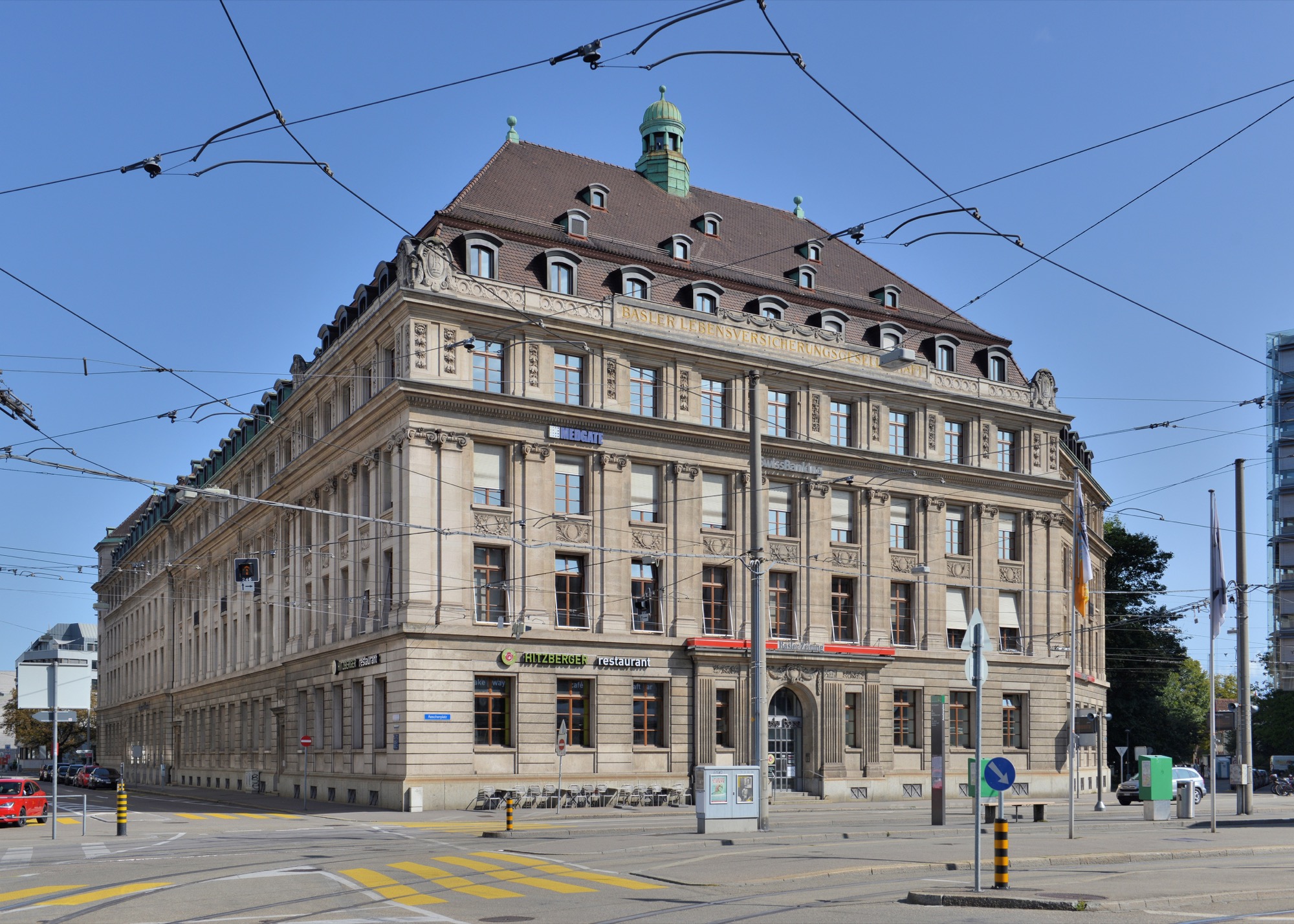
The Basler Börse occupied two successive buildings during its 127-year history. The original exchange premises, established at Aeschenplatz in 1866, were situated in the rapidly developing commercial quarter that emerged after the demolition of Basel’s medieval Aeschentor gate in 1861. Johann Jakob Stehlin the Younger (1826–1894), the dominant Basel architect of the Gründerzeit, had already shaped the surrounding streetscape with stately residential and commercial buildings along the Aeschenvorstadt, as documented in the Christoph Merian Verlag volume Architekten des Klassizismus und Historismus: Bauen in Basel 1780–1880 (2015). The first exchange premises reflected the restrained neoclassical idiom characteristic of mid-nineteenth-century Swiss commercial architecture—dressed sandstone facades, arched windows, and symmetrical proportions suited to the dignity of financial transactions. By the turn of the century, the exchange had outgrown these quarters. In 1905–1906, a new Börsengebäude was erected at Marktgasse 8, in a Neo-Renaissance style that drew on the Historismus vocabulary then prevalent across Swiss and German commercial architecture. The Marktgasse building featured a more imposing street presence, with rusticated stonework on the ground floor, pilastered upper stories, and ornamental cornices typical of the period’s Geschäftshäuser. Photographs preserved in the Basel State Archives (Staatsarchiv Basel-Stadt, PLA 54, 348) document the building’s exterior from roughly 1905 to 1960. The Marktgasse exchange served as the trading venue until 1995, when electronic systems replaced ring trading, and the building was formally closed in 1998. In 2017–2018, the firm Blaser Architekten undertook a sensitive renovation, converting the former exchange into open-plan offices for MIAC AG, a clinical research organization affiliated with the University of Basel, preserving the building’s external character while adapting the interior with glass partitions and a modernized podium within the existing structure.
The decorative program of the Basler Börse, while more restrained than the lavish iconographic schemes of larger continental bourses, reflected Basel’s distinctive identity as a city where commerce, humanism, and the arts intertwined. The Marktgasse building’s facade featured carved stone ornament in the Renaissance Revival tradition—acanthus scrollwork, garland friezes, and classicizing keystones over the arched windows—motifs that signaled commercial respectability within the visual language of Swiss Historismus, as described in Basel’s architectural heritage surveys published by Christoph Merian Verlag. Inside, the trading hall (Handelsraum) was fitted with wood-paneled walls and coffered elements that evoked the mercantile dignity of earlier Basel institutions such as the Safranzunft (Saffron Guild) hall. The original exchange at Aeschenplatz, erected during the period when Basel’s silk ribbon industry dominated Swiss exports, would have drawn on decorative conventions documented in the Schweizerisches Wirtschaftsarchiv (Swiss Economic Archives) at the University of Basel, which preserves extensive material on the visual culture of Basel’s commercial institutions. Basel’s broader tradition of integrating art into civic and commercial buildings—from Hans Holbein the Younger’s facade paintings in the sixteenth century to the Kunsthalle designed by Stehlin the Younger in 1872—provided an aesthetic context in which even financial buildings aspired to cultural seriousness. The exchange’s relatively sober ornamentation reflected the Protestant mercantile culture of Basel, where, as the Historisches Lexikon der Schweiz notes, discretion and solidity in business affairs were valued above ostentatious display. When Blaser Architekten renovated the Marktgasse building in 2017–2018, the existing glass tower element—likely a mid-twentieth-century addition—was retained and adapted, creating a visual dialogue between the building’s historicist shell and its modernized interior.
Basel’s position at the Rhine knee (Rheinknie), where the river bends northward at the junction of Switzerland, France, and Germany, made it one of Europe’s most strategically situated commercial cities. The Mittlere Brücke, opened in 1226 as one of the oldest Rhine crossings between Lake Constance and the North Sea, established Basel as a critical node on the trade routes connecting the Mediterranean world via the Gotthard Pass to northern Europe. The exchange’s two locations—Aeschenplatz and Marktgasse—both lay within the commercial core of Grossbasel, the larger western half of the city that had served as its mercantile center since medieval times. Aeschenplatz anchored the southern approach to the city, where the Aeschenvorstadt connected to the Freie Strasse, Basel’s oldest and most prestigious commercial thoroughfare. The Marktgasse building stood near the Marktplatz, dominated by the red sandstone Rathaus and site of continuous market activity since the eleventh century. Basel’s nineteenth-century economic transformation—from a silk ribbon manufacturing center, which in the 1840s accounted for roughly eighty percent of Swiss exports, to a chemical and pharmaceutical powerhouse—reshaped the urban fabric around the exchange. As Urs Karrer documents in Die chemische Industrie am Rheinknie (Schwabe Verlag, 2005), the dye manufacturers Geigy (founded 1758), CIBA (1884), and Sandoz (1886) established their factories along the Rhine, exploiting local salt deposits and river water, and their growth fed capital through the Börse. The founding of the Bank for International Settlements (BIS) in Basel in 1930—chosen for Switzerland’s neutrality and Basel’s railway connections—further cemented the city’s role as an international financial center, a status reinforced by the Basel Committee on Banking Supervision established in 1974.
The Basler Börse was founded in 1866, making it the second formal securities exchange in Switzerland after Geneva (1850). Its establishment responded to the capital needs of Basel’s industrializing economy, particularly the financing of railway construction—including the Gotthardbahn and the Basel–Zürich line—and the expansion of the region’s banking and manufacturing enterprises. The Historisches Lexikon der Schweiz records that the early period of Swiss exchanges was marked by speculative excess; in Basel, this led to the temporary nationalization of the exchange in 1897, a remarkable episode in the professionalization of Swiss market regulation. Prominent Basel banking houses—including the Basler Handelsbank and the Schweizerischer Bankverein (Swiss Bank Corporation, formally organized as a joint-stock company in 1872)—used the Börse as a primary venue for issuing and trading equities and bonds. The development of the exchange was, as the German-language Wikipedia article on the Basler Börse notes, “eng verknüpft mit dem Aufstieg der chemischen und pharmazeutischen Industrie” (closely linked to the rise of the chemical and pharmaceutical industry). Companies including Ciba, Sandoz, and F. Hoffmann-La Roche (founded 1896) raised capital through Basel’s banks and exchange. During World War I, trading was suspended from summer 1914 to early 1915. After 1945, the post-war chemical boom restored the exchange’s importance, though Zürich increasingly dominated Swiss securities trading. In 1962, Basel and Zürich pioneered exchange television broadcasts. The decisive transformation came in 1993, when the Basler Börse merged with the Zürich and Geneva exchanges to form the Verein Schweizerische Effektenbörse (SWX Swiss Exchange), as documented in the SpringerLink chapter “Swiss Equity Markets” (2023). Ring trading ended on 16 August 1995, replaced by the world’s first fully automated trading, clearing, and settlement system. The Marktgasse building closed in 1998. SWX was renamed SIX Swiss Exchange in 2008.
The Basler Börse served primarily as a market for equities (Aktien) and bonds (Anleihen) issued by the banking, industrial, and chemical firms of northwestern Switzerland. In its early decades, the exchange facilitated the placement of railway securities—shares and bonds financing the construction of the Gotthardbahn and the Basel–Zürich railroad—alongside cantonal government bonds and the obligations of Basel’s private banking houses. As the chemical and pharmaceutical industry grew, the exchange became the natural listing venue for shares in firms such as J.R. Geigy (publicly traded from 1901), CIBA, Sandoz (incorporated as a joint-stock company in 1895), and F. Hoffmann-La Roche, which converted to a limited stock company after World War I. Swiss securities carried distinctive instrument types: Inhaberaktien (bearer shares), Namenaktien (registered shares), and Genussscheine (non-voting equity participation certificates), a structure particularly associated with Roche, whose Genussscheine remained among the most actively traded securities on the SIX Swiss Exchange until their proposed conversion to Partizipationsscheine in 2025. Insurance companies headquartered in Basel—notably the Bâloise (Basler Versicherungsgesellschaft, founded 1863)—were also listed. The Schweizerischer Bankverein (Swiss Bank Corporation), established in Basel in 1872 and listed on multiple Swiss exchanges including Basel, Zürich, Geneva, Lausanne, Berne, Neuchâtel, and St. Gallen, exemplified the cross-listing that characterized the fragmented Swiss market. Trading was conducted à la criée (by open outcry at the ring) until 16 August 1995, when electronic systems replaced floor trading across all Swiss exchanges. The 1993 merger into SWX consolidated what had been a decentralized cantonal system, subject to cantonal value-added taxes, into a unified national market. Today, Basel-headquartered firms including Novartis (formed by the 1996 merger of Ciba-Geigy and Sandoz) and Roche remain among the heaviest-weighted constituents of the Swiss Market Index (SMI) on SIX Swiss Exchange.
Images will be added as the project develops. Photographs by Larry Ng and from research sources.