Barcelona Grain Exchange
Barcelona, Spain · Established 14th century

This site requires authorization to access.
To request access, contact
william.goetzmann@yale.edu
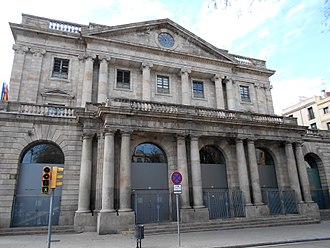
Barcelona’s Llotja de Mar presents one of the most remarkable architectural palimpsests among European exchange buildings: a magnificent Gothic trading hall of the late fourteenth century, entirely encased within a Neoclassical shell erected four centuries later. The original Saló de Contractacions was authorized around 1380 by Peter III the Ceremonious (Pere el Cerimoniós) and constructed between 1384 and 1397 under the direction of architect Pere Arvei, as documented in the building’s institutional records and discussed by Joan Bassegoda i Nonell in his studies of Catalan Gothic civic architecture. The hall rises fourteen meters in height and comprises three naves separated by semicircular arcades resting on four slender stone columns with molded capitals, from which spring six broad arches supporting a polychrome wooden beam ceiling and an upper consular floor. The floor was laid in Montjuïc sandstone, and scallop-shell ornaments alternating with the royal and municipal coats of arms adorn the arch spandrels. As the first mature example in the Crown of Aragon of a purpose-built mercantile hall, the Llotja predates both Guillem Sagrera’s Llotja de Palma de Mallorca (1426–1448) and Pere Compte’s Llotja de la Seda in Valencia (1482–1498), establishing the architectural typology that these later masterworks would elaborate. Between 1774 and 1802, under the patronage of the Royal Barcelona Board of Trade (Junta de Comerç), architects Joan Soler i Faneca, his son Tomàs Soler i Ferrer, and Joan Fàbregas encased the medieval structure within a freestanding quadrangular Neoclassical building—one of the finest of its style in Barcelona—preserving the Gothic interior intact behind monumental facades articulated with four pediments. A fifteenth-century Tarongers courtyard (1456–1459) and chapel additions further enriched the complex.
The decorative program of La Llotja de Mar unfolds across two distinct artistic epochs. Within the Saló de Contractacions, the Gothic interior achieves its effect through structural elegance rather than applied ornament: the proportions of the fourteen-meter-high triple nave, the rhythm of the semicircular arcades, and the polychrome wooden ceiling create what architectural historians recognize as one of the finest civil Gothic interiors in the western Mediterranean. Heraldic devices—scallop shells alternating with the arms of the Crown of Aragon and the city of Barcelona—mark the arch spandrels, connecting the trading space to its royal and municipal patrons. During the Neoclassical renovation of 1774–1802, the building acquired a distinguished sculptural collection that ranks among the most important assemblages of Neoclassical sculpture in Spain. Damià Campeny (1771–1855), whom scholars regard as one of the leading exponents of Spanish and European Neoclassical sculpture, contributed works in Italian marble including the celebrated Dying Lucretia, the allegorical Hymen, and Conjugal Fidelity. His teacher Salvador Gurri (1749–1819), a transitional figure between Baroque and Neoclassical sensibilities, also contributed works. Nicolau Travé created the Fountain of Neptune for the courtyard, flanked by two nereids by Antoni Solà (1780–1861), while Josep Bover carved allegorical representations of the continents for the staircase niches. The building’s artistic significance deepened after 1775, when the Junta de Comerç established the Escola gratuïta de disseny within its walls, evolving into the Escola de Belles Arts de la Llotja where Pablo Picasso, Joan Miró, Antoni Gaudí, and Maria Fortuny all studied. Today the Reial Acadèmia Catalana de Belles Arts de Sant Jordi maintains a collection of over seven hundred paintings and two hundred fifty sculptures within the building.
La Llotja de Mar stands on the Passeig d’Isabel II in Barcelona’s La Ribera neighborhood, the historic maritime and commercial quarter that was the economic heart of medieval Barcelona. As Stephen P. Bensch demonstrates in Barcelona and Its Rulers, 1096–1291 (Cambridge University Press, 1995), the Ribera district—literally “the shore”—grew as a mercantile precinct precisely because it fronted the waterline before the later construction of the Barceloneta quarter. In the thirteenth through fifteenth centuries, when Barcelona commanded a Mediterranean trading empire, the Ribera bustled with goods ferried from ships anchored in the harbor, and the surrounding streets bore the names of their resident trades: Carrer dels Sombrerers (hatmakers), dels Mirallers (glaziers), dels Argenters (silversmiths), and dels Mercaders (merchants). The Llotja occupied a pivotal position between the port and the dense commercial fabric of the Barri Gòtic, adjacent to the Pla de Palau, the principal civic square. When the Via Laietana was cut through the old city in 1907–1913, demolishing many medieval structures, it severed La Ribera from the Gothic Quarter but left the Llotja’s position on the waterfront intact. The nearby Drassanes Reials (Royal Shipyards), now the Maritime Museum, and the church of Santa Maria del Mar—the so-called “cathedral of the sea” built by the merchants and stevedores of the Ribera—together constitute an urban ensemble that maps the spatial organization of medieval Mediterranean commerce onto Barcelona’s streetscape.
The institutional origins of the Llotja de Mar reach back to 1258, when King Jaume I of Aragon granted the Carta Consular to Barcelona, establishing the Universitas Proborum Hominum Riparie—the corporation of notables from the shore district—with authority to adjudicate commercial disputes independently of the royal courts. By 1282 these magistrates were formally titled consols de mar, creating the Consolat de Mar that would become the model for similar tribunals across the Mediterranean. The merchants initially transacted business in open-air porticoes; as Damien Coulon argues in Barcelone et le grand commerce d’Orient au Moyen Âge (Casa de Velázquez, 2004), the expansion of Barcelona’s long-distance trade with Egypt and the Levant created demand for an enclosed trading space. The enclosed hall authorized by Peter III around 1380 and completed by 1397 formalized this need. Barcelona’s Llotja was the first of three great exchange halls built within the Crown of Aragon: the Llotja de Palma de Mallorca by Guillem Sagrera (1426–1448) and the Llotja de la Seda in Valencia by Pere Compte (1482–1498) followed, the latter now a UNESCO World Heritage Site. The Llibre del Consolat de Mar, the foundational compilation of Mediterranean maritime law whose origins scholars trace to fourteenth-century Barcelona, codified the customs governing trade conducted within these halls. After the siege of 1714, Philip V converted the Llotja to military barracks, but Catalonia’s economic recovery in the mid-eighteenth century prompted the Royal Board of Trade to reclaim and rebuild the structure. Mario del Treppo’s Els mercaders catalans and Claude Carrère’s work on Barcelona have demonstrated that the city’s merchant class sustained commercial vitality across centuries.
The Saló de Contractacions functioned as Barcelona’s primary venue for negotiating the commodity trades and financial instruments that sustained the Crown of Aragon’s Mediterranean commercial network. As Maria Teresa Ferrer i Mallol documents in her study “Catalan Commerce in the Late Middle Ages” (Catalan Historical Review, 2008), the products exchanged at the Llotja reflected Barcelona’s position at the nexus of multiple trading spheres: from Occitania and northern Europe came woolen cloth and manufactured goods; from the Maghreb and the Levant arrived spices, silk, cotton, and dyes. Local Catalan exports included saffron, dried fruits, coral, leather, ceramics from Valencia, and fine woolen textiles. The Llotja was also the seat of Barcelona’s money changers, who operated within the hall conducting currency exchange essential to Mediterranean multilateral trade. Among the most significant financial innovations transacted at the Llotja were maritime insurance contracts. As Guido Rossi demonstrates in “The Beauty of Uncertainty: The Rise of Insurance Contracts and Markets in Medieval Europe” (Journal of the European Economic Association, 2023), Barcelona was among the earliest centers—alongside Genoa, Florence, and Palermo—where notaries drew up insurance contracts protecting merchants against the perils of sea transport, with Catalan notarial registers from the late fourteenth century preserving thousands of such documents. Bills of exchange (lletres de canvi) facilitated credit transfers between Barcelona and its correspondents in Italian, North African, and Levantine ports. The lleuda of Barcelona, a tariff schedule dating to 1160–1180, already taxed spices, fine silks, purple cloth, and cotton arriving from al-Andalus and the Orient, establishing the commodity categories that would define Llotja commerce for centuries.