Stock Exchange of Thailand (SET)
Bangkok, Thailand · Established 1975
This site requires authorization to access.
To request access, contact
william.goetzmann@yale.edu
The Stock Exchange of Thailand has occupied three successive homes since its founding, each reflecting a distinct phase of Bangkok’s financial modernization. When official trading commenced on 30 April 1975, the exchange operated from offices in central Bangkok; in 1983 it relocated to the Sindhorn Building on Wireless Road—a three-tower commercial complex built in 1980 in the Lumpini district, the heart of what was then the city’s premier financial corridor. As the exchange outgrew that space, it moved in 1998 to a purpose-built tower on Ratchadaphisek Road in the Khlong Toei district, signaling the emergence of a new business node east of the traditional Silom–Sathorn core. The current and most architecturally ambitious home is the SET Headquarters completed in 2016 on Ratchadaphisek Road in the Din Daeng district. Designed by Plan Architect—with a team led by Nitisak Chobdamrongtham, Jaturon Buranajade, Wara Jithpratugs, and Korkiat Kittisoponpong—the nineteen-storey structure (74 meters, approximately 26,000 square meters of floor area) was built by Thai Obayashi Corporation and occupies a larger 58,630-square-meter campus. The design concept, as described by Plan Architect, centers on “linking and blending the building to the urban context,” organizing three functional zones: elevated office floors that serve as a landmark visible from a distance, a prominent trading hall accessible to staff and public alike, and a ground-level public zone housing a museum and educational center connected to the streetscape through landscape design. The building’s massing is “twisted to conform to its own alignment with the context,” creating a dynamic silhouette along the boulevard. Her Royal Highness Princess Maha Chakri Sirindhorn presided over the inaugural ceremony on 31 May 2016. The building achieved LEED certification through an energy model comparing proposed and baseline performance, as documented in Green Design Consulting’s case study, and became the first project in Asia to earn Fitwel 3 Star certification alongside a 2020 Best in Building Health Award, as noted by the Fitwel certification body.
The decorative program of the Stock Exchange of Thailand’s headquarters is more restrained than the ornamental exuberance typical of Thai royal or temple architecture, yet it deliberately incorporates cultural symbolism into a contemporary commercial idiom. The building’s logo—two fish arranged on an antique Chinese plate evoking yin and yang—reportedly inspired key elements of the facade and interior spatial organization, as noted in a Bangkok Post profile of Bangkok’s distinctive office buildings. Within the public zone at ground level, the museum and education center employ exhibition design to narrate the history of Thai capital markets, functioning as a didactic decorative program in the manner of European exchange museums. The surrounding landscape design integrates the building with its urban context through gardens that also serve as recreational space for staff, blurring the boundary between commercial architecture and public amenity. Thai commercial architecture of the late twentieth and early twenty-first centuries has generally pursued what scholars of Southeast Asian built environments describe as a negotiation between modernist internationalism and local identity: slanted wall profiles recalling traditional Thai roof forms, curved elements echoing the silhouettes of classical structures, and narrow window slits reinterpreted as contemporary patterns. While the SET building does not employ the gold leaf, mother-of-pearl inlay, or colored glass mosaics characteristic of Thai temple decoration, its approach to site-responsive massing and its integration of public educational space within a financial institution reflect a specifically Thai aspiration to connect commercial architecture with civic purpose. Compared with the more overtly decorative programs of exchanges in Mumbai or Shanghai, the SET headquarters exemplifies a regional tendency in Southeast Asian financial architecture toward clean-lined modernism tempered by contextual sensitivity.
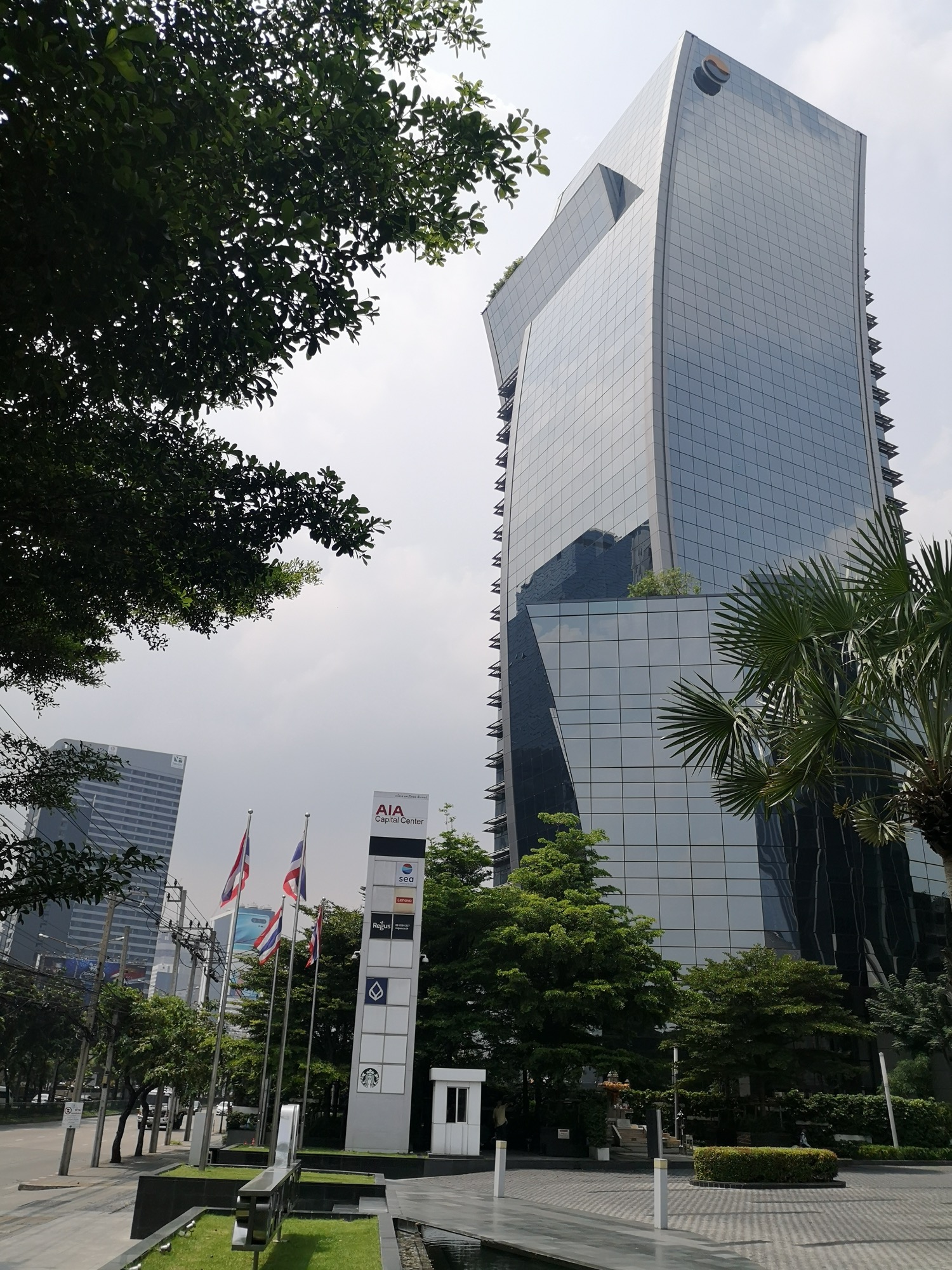
Bangkok’s emergence as a financial center is inseparable from its geography as a riverine and canal city. Founded as the Siamese capital in 1782 on the banks of the Chao Phraya River, the city developed around an extensive network of canals (khlongs) that served as the primary arteries of trade, transport, and dense settlement—earning Bangkok the nineteenth-century epithet “Venice of the East,” as Chris Baker and Pasuk Phongpaichit describe in A History of Thailand (Cambridge University Press, 4th ed., 2022). Chinese, Indian, Middle Eastern, and Southeast Asian merchants settled along the riverbanks from the early nineteenth century, trading in teak, rice, cloth, gems, and spices. The Chao Phraya connected the northern rice lands to maritime trade routes extending to China, India, and beyond, making Bangkok a critical node in the regional commodity economy long before the advent of securities trading. From the 1950s onward, as Marc Askew documents in Bangkok: Place, Practice and Representation (Routledge, 2002), the pressure to modernize propelled commercial development along Silom Road and the parallel Sathorn Road—a southwest–northeast corridor running between Charoen Krung and Rama IV roads in the Bang Rak district. Silom became known as the “Wall Street of Thailand,” hosting major banks, the headquarters of conglomerates like Charoen Pokphand, and the original offices of the Securities Exchange of Thailand. Meanwhile, the old khlong network was progressively filled in to create roads, transforming the linear canal-based urbanism into the automobile-dominated grid that defines modern Bangkok. The Stock Exchange’s 1998 relocation to Ratchadaphisek Road, and then to its new 2016 headquarters further along that boulevard in the Din Daeng district, mirrors the broader eastward shift of Bangkok’s central business district—a shift catalyzed by the opening of the BTS Skytrain in 1999 and the MRT underground system, which created new transit-oriented commercial nodes. The Rama IX–Ratchadaphisek area is now often described as Bangkok’s “New CBD,” with Grade A office towers such as AIA Capital Center and G-Land Tower clustering around the exchange. Thailand’s position as a commercial crossroads—linking the rice economies of mainland Southeast Asia with the maritime trading networks of the South China Sea and the Indian Ocean—has shaped Bangkok’s role as the financial capital of a nation whose economy, by the 1990s, was one of the world’s fastest growing.
The origins of organized securities trading in Thailand trace to the Bangkok Stock Exchange (BSE), established in July 1962 as a limited partnership and reregistered in 1963 as the Bangkok Stock Exchange Co., Ltd. As John Fagan recounts in “The Role of Securities Regulation in the Development of the Thai Stock Market” (Columbia Journal of Asian Law, vol. 16, 2003), the BSE was a private venture that attracted little public attention: annual turnover declined from 160 million baht in 1968 to barely 26 million by 1972, and it ceased operations in the early 1970s, defeated by thin liquidity and the absence of government support. In 1969, at the recommendation of the World Bank, the Thai government engaged Professor Sidney M. Robbins of Columbia University—formerly Chief Economist of the U.S. Securities and Exchange Commission—to study the feasibility of a regulated capital market. Robbins’s 1970 report, A Capital Market in Thailand, provided the intellectual blueprint for what would follow. Alek A. Rozental’s Finance and Development in Thailand (Praeger, 1970) offered a complementary analysis of the broader financial landscape. The Securities Exchange of Thailand Act was enacted in May 1974, and on 30 April 1975 the Securities Exchange of Thailand officially commenced trading, beginning with eight listed companies. On 1 January 1991 the exchange was formally renamed the Stock Exchange of Thailand (SET). The Securities and Exchange Act of 1992 (B.E. 2535) created the Thai Securities and Exchange Commission (SEC) as an independent regulator, separating supervisory authority from the exchange itself and prompting a surge of foreign portfolio investment—as the University of Chicago Law School’s “Evolution of Securities Law in Thailand” working paper documents, overseas investment in the SET jumped to more than ten times its previous average in apparent response to the new regulatory framework. By 1993 the SET Index had surged to a record 1,682.85, fueled by capital inflows and an asset-price bubble. The catastrophe came on 2 July 1997, when the Bank of Thailand was forced to float the baht after exhausting its foreign reserves defending a dollar peg. The Thai baht lost more than half its value, plunging to 56 to the dollar by January 1998; the SET Index collapsed from its 1996 level of roughly 1,300 to 527 by mid-1997, and continued falling. The crisis—known in Thai as the “Tom Yum Kung” crisis—devastated the Thai economy: GDP contracted sharply, fifty-six finance companies were closed, and unemployment soared. On 11 August 1997 the International Monetary Fund assembled a $17.2 billion rescue package, imposing conditions including bankruptcy law reform and financial-sector restructuring. Joseph Stiglitz, in Globalization and Its Discontents (W. W. Norton, 2002), offered a searing critique of the IMF’s austerity prescriptions, arguing that they deepened the recession unnecessarily. Peter Warr’s edited volume Thailand Beyond the Crisis (RoutledgeCurzon, 2005) assessed the policy errors of both the Thai government and the IMF and traced the subsequent recovery. Thailand ultimately repaid its IMF debt in full by 2003, four years ahead of schedule. Post-crisis reforms transformed the exchange: corporate governance standards were tightened, minority shareholder protections enhanced, and accounting standards aligned with international norms—reforms documented in Limpaphayom and Connelly’s “Corporate Governance in Thailand” (International Journal of Disclosure and Governance, 2006). Political turbulence has periodically rattled the market—the 2006 military coup, the 2008–10 Red Shirt–Yellow Shirt protests, and the 2014 coup each triggered sharp sell-offs—yet the exchange has demonstrated institutional resilience, reaching over 800 listed companies by the 2020s. In 2025 the SET celebrated its fiftieth anniversary with social-impact initiatives focused on healthcare infrastructure and financial literacy.
When the Securities Exchange of Thailand opened on 30 April 1975, trading was limited to shares of eight listed companies; five of those original listings remained active as of 2025, a testament to the durability of Thailand’s founding corporate cohort. The exchange grew to encompass more than 800 listed companies spanning the sectors that define the Thai economy. Among the heavyweight constituents of the SET Index—a market-capitalization-weighted benchmark established at 100 on its 1975 base date—are conglomerates and state enterprises that represent the pillars of Thai commerce: PTT Public Company Limited, the state petroleum and energy giant; Siam Cement Group (SCC), the crown-property-linked industrial conglomerate founded in 1913 by royal decree; Bangkok Bank (BBL), Thailand’s largest commercial bank by assets; and Charoen Pokphand Foods (CPF), the agribusiness arm of the Charoen Pokphand empire that traces its roots to a seed store opened on Song Sawat Road in Bangkok’s Chinatown in 1921. The OECD Capital Market Review of Thailand (2025) notes that family-owned businesses constitute 57 percent of SET-listed firms, with founding families retaining more than 20 percent of shares and management control—a distinctive feature of Thai corporate capitalism. Beyond equities, the exchange offers warrants, derivative warrants, depositary receipts, exchange-traded funds (ETFs), real estate investment trusts (REITs), and infrastructure funds. The Thailand Futures Exchange (TFEX), established as a SET subsidiary on 17 May 2004 under the Derivatives Act of 2003, launched SET50 Index Futures on 28 April 2006 as its inaugural product; Lars L. Norden’s SSRN working paper “Liquidity and Trading Activity on a New Futures Market: The Thailand Futures Exchange (TFEX)” documents the considerable improvement in liquidity and order-book depth during TFEX’s first years. Single Stock Futures followed on 24 November 2008, and the product suite expanded to include gold futures, oil futures, agricultural commodity futures, interest-rate instruments, and currency options. Foreign investor participation has been facilitated since 2001 through Non-Voting Depository Receipts (NVDRs), an innovative mechanism that allows overseas investors to receive all financial benefits of equity ownership—dividends, capital gains, and rights issues—without voting rights, thereby circumventing the foreign ownership ceilings that apply to many Thai companies. As of the mid-2020s, NVDRs represent approximately 28 percent of total SET market value and roughly 30 percent of trading volume, with foreign investors from 124 countries holding some 20 percent of market capitalization, placing Thailand third among Asian peers for foreign ownership after Singapore and Indonesia. The exchange’s transition from open-outcry to fully electronic trading, and its subsequent investments in algorithmic trading infrastructure, reflect the broader trajectory described in the CFA Institute Research Foundation’s monograph on Thailand’s capital markets (2021).
Images will be added as the project develops. Photographs by Larry Ng and from research sources.