Baltimore Merchants Exchange
Baltimore, USA · Established 1820
This site requires authorization to access.
To request access, contact
william.goetzmann@yale.edu
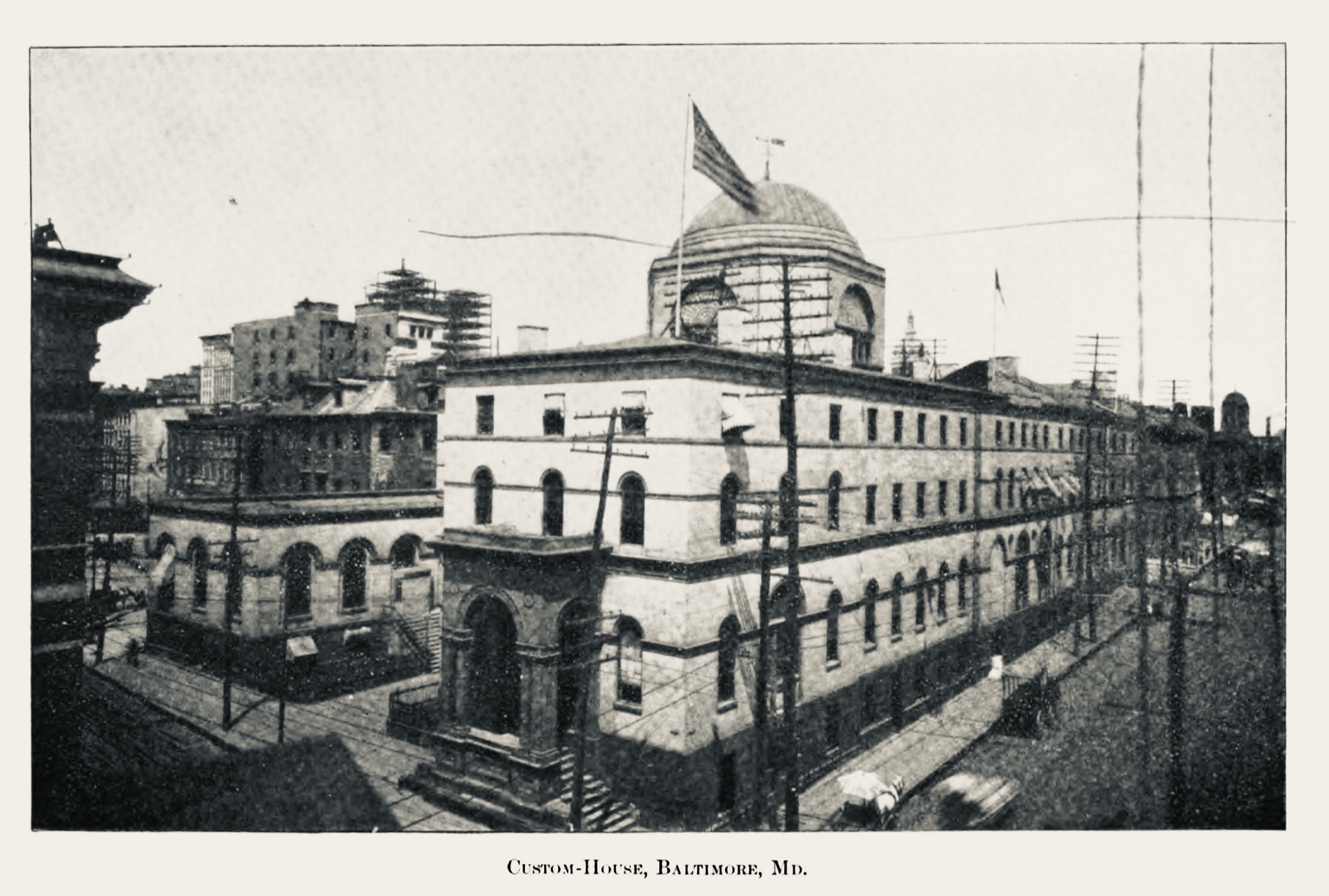
The Baltimore Merchants’ Exchange, completed in 1820, stands as one of the most ambitious neoclassical commercial structures erected in the early American republic. Designed by Benjamin Henry Latrobe—widely recognized as America’s first professionally trained architect, as documented in Talbot Hamlin’s Pulitzer Prize–winning biography Benjamin Henry Latrobe (1955)—the H-shaped building was constructed under the supervision of builder Jacob Small beginning in 1815. Latrobe conceived the Exchange in collaboration with the French-born architect Maximilien Godefroy, though as Jean H. Baker recounts in Building America: The Life of Benjamin Henry Latrobe (Oxford University Press, 2020), the partnership dissolved in a bitter professional dispute. The U.S. government funded the erection of the custom-house wing in 1817, and the building opened to the public in 1820, the year of Latrobe’s death. Mark Edward Reinberger’s doctoral dissertation, The Baltimore Exchange and Its Place in the Career of Benjamin Henry Latrobe (Cornell University, 1988), provides the most thorough architectural analysis of the structure. The great trading hall measured eighty-six by fifty-three feet and was lit from above by a monumental dome whose summit rose ninety feet from the floor. Twelve Ionic marble columns, quarried, cut, and polished in Italy, supported the dome’s drum. As described in Mary Ellen Hayward and Frank R. Shivers Jr., eds., The Architecture of Baltimore: An Illustrated History (Johns Hopkins University Press, 2004), catwalk promenades encircling the dome offered panoramic views of Baltimore’s harbor. At its peak the Exchange was the largest domed commercial building in America, serving simultaneously as stock exchange, reading room, customs house, bank, hotel, and post office. The building was demolished circa 1901–1902, and the cornerstone of the present U.S. Custom House was laid on its former site in 1903.
The decorative program of the Baltimore Merchants’ Exchange reflected Latrobe’s commitment to a neoclassical visual vocabulary that linked American commerce to the civic ideals of the ancient world. The great dome above the trading hall was adorned with allegorical paintings depicting the Maryland coat of arms and seals, alongside representations of “Commerce” and the “Dignity of the United States,” as contemporary descriptions recorded and as noted in the Maryland Center for History and Culture’s archival holdings on the Exchange. These allegorical panels transformed the rotunda into a symbolic space where mercantile activity was elevated to a matter of national purpose. The twelve Ionic marble columns supporting the dome were quarried, cut, and polished in Italy, their importation itself a testament to the transatlantic trade networks that the building served. Latrobe, who had trained in England under Samuel Pepys Cockerell and absorbed the neoclassical principles of Continental design, brought to the Exchange the same refined sense of ornamental proportion evident in his work on the U.S. Capitol, as analyzed in Hamlin’s Benjamin Henry Latrobe (1955). The carved stonework of the entrance porticos and the coffered treatment of the dome’s interior surfaces followed Greco-Roman precedents that Latrobe had studied in engravings of the Pantheon and the Baths of Caracalla. Richard Longstreth’s historiographic survey of Baltimore’s built environment situates the Exchange’s decorative ambition within the broader Federal-era project of fashioning American civic architecture worthy of republican aspirations.
The Merchants’ Exchange occupied a commanding position at the intersection of Gay, Water, and Lombard Streets, two blocks north of Baltimore’s Inner Harbor, anchoring the city’s mercantile quarter at the heart of its commercial waterfront. Gay Street, as documented in the National Register nomination for the Gay Street Historic District, served as Baltimore’s principal commercial corridor from the late eighteenth century through the post–Civil War era, lined with banks, insurance offices, counting houses, and the cast-iron-fronted commercial buildings characteristic of the Victorian period. The Exchange stood within easy walking distance of the wharves along the Basin, where tobacco hogsheads, flour barrels, and coffee sacks were loaded and unloaded from the Baltimore clipper schooners that made the city famous, as discussed in Howard I. Chapelle’s The Baltimore Clipper: Its Origin and Development (1930; Dover reprint, 1988). Nearby, the Phoenix Shot Tower, completed in 1828 and at 234 feet the tallest structure in the United States at the time, testified to the district’s industrial vitality. The Exchange building’s dome, visible from the harbor, functioned as a visual landmark orienting arriving ships and merchants alike toward the center of commercial life. This waterfront district—bounded by the wharves to the south and the warehouses of Jonestown to the east—constituted the original commercial nucleus from which Baltimore’s nineteenth-century expansion radiated outward along the arteries of the B&O Railroad and the National Road.
Baltimore’s rise as a major Atlantic port began with the colonial tobacco trade. The Maryland General Assembly established the Port of Baltimore in 1706 as an official port of entry for tobacco inspection, and the Maryland Tobacco Inspection Act of 1747, analyzed by Ronald Hoffman in the Journal of Economic History (1973), drove diversification toward grain production. By the 1790s Baltimore merchants were profiting from the interruption of European shipping during the Napoleonic Wars, exporting flour at premium prices to the Caribbean and Europe. The founding of Alexander Brown & Sons in 1800—the nation’s first investment bank—cemented Baltimore’s role as a financial center, with the Browns financing trade in coffee from Brazil, copper from Chile, sugar from Cuba, and guano from Peru. The Merchants’ Exchange, opened in 1820, provided the institutional infrastructure for this burgeoning commerce. The arrival of the Baltimore & Ohio Railroad in 1828, the first major railroad in the United States, transformed the city into a transshipment hub linking the interior grain lands of the Ohio Valley to Atlantic shipping, as documented in Herbert H. Harwood Jr.’s studies of the B&O. The Baltimore Corn and Flour Exchange, founded in 1853, formalized grain trading. The Great Baltimore Fire of February 7–8, 1904, destroyed over 1,500 buildings across 150 acres of the original commercial core, leaving 35,000 unemployed and devastating the financial district the Exchange had anchored for eighty years. The Burnt District Commission oversaw a rapid rebuilding that modernized the city’s commercial infrastructure.
The trading floor of the Baltimore Merchants’ Exchange facilitated the exchange of a diverse array of commodities reflecting the city’s position at the nexus of Chesapeake agriculture, Atlantic maritime commerce, and the emerging railroad network. Tobacco, Maryland’s original staple export, remained a significant commodity, traded in hogsheads graded under the state inspection system. Wheat, corn, and especially flour dominated the Exchange’s business: Baltimore was by 1810 the leading flour-milling center in America, harnessing the waterpower of the Fall Line to process grain from Western Maryland and Pennsylvania into barrel flour for European and Caribbean markets. The Baltimore Corn and Flour Exchange, established in 1853, regularized grading and pricing for these staples. Coffee imported from Brazil via the Brown brothers’ Latin American network was a major commodity, alongside sugar from Cuba and cotton shipped coastwise from Southern ports. Pete Lesher, in “A Load of Guano: Baltimore and the Fertilizer Trade in the Nineteenth Century” (The Northern Mariner, Vol. 18, 2008), documents how Peruvian guano imports reached nearly 100,000 tons annually by 1860, with Baltimore’s twenty-seven fertilizer factories processing the raw material by 1880. Maritime insurance policies, underwritten by firms such as the Baltimore Equitable Society (founded 1794), were transacted alongside bills of lading and shipping shares. Government bonds and municipal securities circulated through the exchange, and by 1838 the first Baltimore Stock Board had formed to trade corporate and government securities.
Images will be added as the project develops. Photographs by Larry Ng and from research sources.