Augusta Cotton Exchange Building
Augusta, United States · Established 1872 (exchange organized); 1886 (building)
This site requires authorization to access.
To request access, contact
william.goetzmann@yale.edu
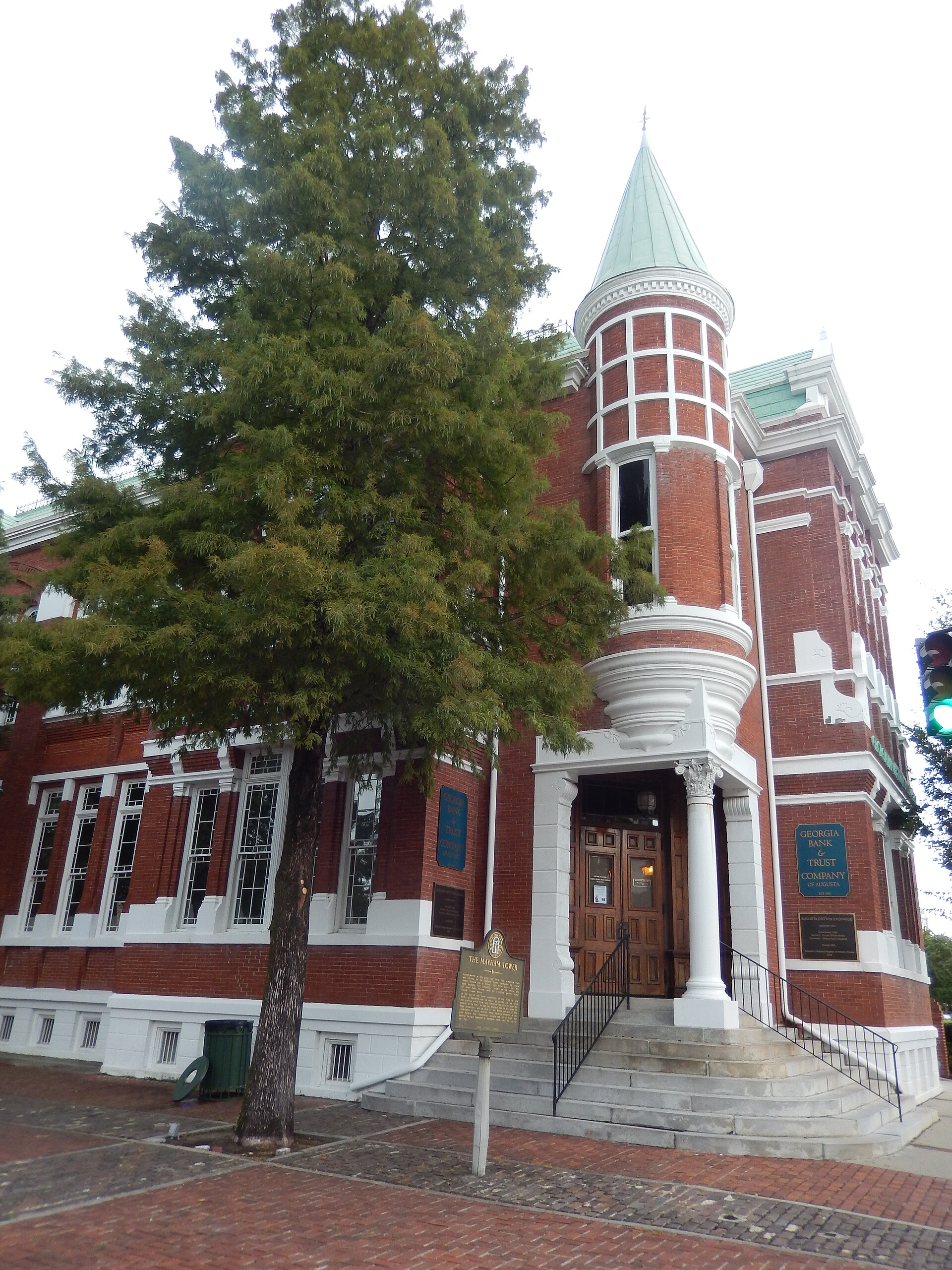
The Augusta Cotton Exchange Building, completed in 1886 and standing on 'Old Cotton Row' along Reynolds Street, is described in its National Register of Historic Places nomination (Elizabeth A. Lyon, Suzanne Turner and John Compton, Georgia Department of Natural Resources, 1977; listed 20 July 1978, ref. 78001003) as 'a massive two-story brick building raised on a rusticated daylight basement.' Designed by the local architect Enoch William Brown and erected by the contractor William Henry Goodrich, it is a rectangular mass sculpted into three ornate units, the front dominated by a square block crowned by a projecting round corner turret. The focal point is a cast-iron Corinthian column that creates two portals to a pentagonal porch; quoins, cast-iron scrolls and segmental lintels frame the entrance, and the turret rises through 'an intricate series of mouldings' to a conical roof set on a dentilled cornice and topped with a finial. The NRHP form characterises the design as 'a blending of French Second Empire and Queen Anne styles in a commercial building,' calling the surviving structure 'an architectural gem' even though, as it records, 'the building originally was topped by a mansard roof and contained dormered Paladian [Palladian] windows capping the three projecting bays, all of which has been lost.' The decorative metalwork -- the iron Corinthian columns, scrolls and brackets -- was cast in 1886 by the local foundry of Charles F. Lombard, a detail documented by Historic Augusta, Inc. Bill Moore of Aiken, South Carolina, purchased and restored the building in 1988, and it has since served as a welcome center and a bank branch.
As a working commodity exchange rather than a civic temple, the Cotton Exchange carries little in the way of fine art; its visual interest lies almost entirely in its architecture and ornamental ironwork. The richest decorative element is the locally cast metalwork -- the Corinthian entrance columns, scrolled brackets and console pedestals supplied by Charles F. Lombard's Augusta foundry in 1886 -- which the National Register nomination treats as integral to the building's High Victorian character. The interior's most celebrated artifact is a long hand-lettered cotton 'blackboard' or quotation board on which clerks chalked daily prices and receipts, now interpreted within the building's later use as a heritage and visitor space. Beyond these, ornamentation is confined to the vigorous brick corbelling, stone sill courses, quoins and the finialed turret described in the NRHP documentation, rather than to painting or sculpture.
The building sits at the corner of Eighth (Center) and Reynolds Streets in downtown Augusta, on the strip historically known as Cotton Row, a few blocks from the Savannah River wharves that made the city a transshipment point for upcountry cotton. Its riverfront position was the source of its wealth: the NRHP statement of significance notes that 'the city's location on the Savannah River with excellent inland transportation available, together with the proximity of good agricultural land, helped establish the city as a center for cotton trade and manufacture.' The Exchange is a contributing property to the Augusta Downtown Historic District and lies within the Augusta Canal National Heritage Area, whose canal (begun 1845) powered the cotton mills that grew up alongside the trade. A 1938 guidebook quoted in the nomination boasted that 'on Cotton Row one could walk a mile on cotton bales, and that the Cotton Exchange ruled the activity of the block,' a measure of how completely this single building dominated its district.
Augusta's cotton economy long predated the Exchange: as the NRHP nomination records, cotton 'had been an important crop early in the city's history and by 1811 had superceded tobacco as the principal commodity,' Eli Whitney having invented the cotton gin nearby in 1793, and 'by 1820, Augusta had become second only to Memphis as the largest inland cotton market in the world.' In 1872 a group of prominent merchants organized the Augusta Cotton Exchange to regulate and standardize the trade; according to the nomination, by 1878 'some 200,000 bales of cotton, representing an annual income of $10,000 to $12,000, were received and processed through its facilities.' The purpose-built Exchange Building followed in 1886, during the boom of the 1880s, a decade the form describes as witnessing 'the most rapid growth with a 580% increase in production, the highest in the South.' The cotton trade flourished into the first half of the twentieth century before the boll weevil and the broader collapse of the cotton South eroded it; the city, the nomination notes, 'by 1964 no longer operated an exchange,' though the merchant group continued to coordinate cotton activity and keep an office in the building. The structure was added to the National Register on 20 July 1978 and restored in 1988.
The Exchange was a spot and forward market in raw upcountry cotton. Brokers and factors gathered on the trading floor to buy and sell ginned and baled cotton brought in by wagon, rail and river from the surrounding plantation belt, grading the staple to international standards and negotiating prices that were posted on a quotation board and transmitted by telegraph to mills in New England and to Manchester and Liverpool. Annual turnover was enormous: contemporary accounts cited by Historic Augusta and the city's own histories describe Augusta in the late nineteenth century as the second-largest inland cotton market in the world, with roughly 400,000 to 500,000 bales changing hands in an average year, and the 1912 receipt of half a million bales celebrated in a photograph noted in the NRHP file. The market dealt almost exclusively in this one commodity -- the 'White Gold' on which, as the nomination puts it, 'the economy of the City of Augusta was to a great extent founded' -- linking local growers and ginners to the global textile supply chain until cotton's mid-twentieth-century decline ended exchange trading in 1964.
Images will be added as the project develops. Photographs by Larry Ng and from research sources.