Athens Stock Exchange (Χρηματιστήριο Αθηνών)
Athens, Greece · Established 1876
This site requires authorization to access.
To request access, contact
william.goetzmann@yale.edu
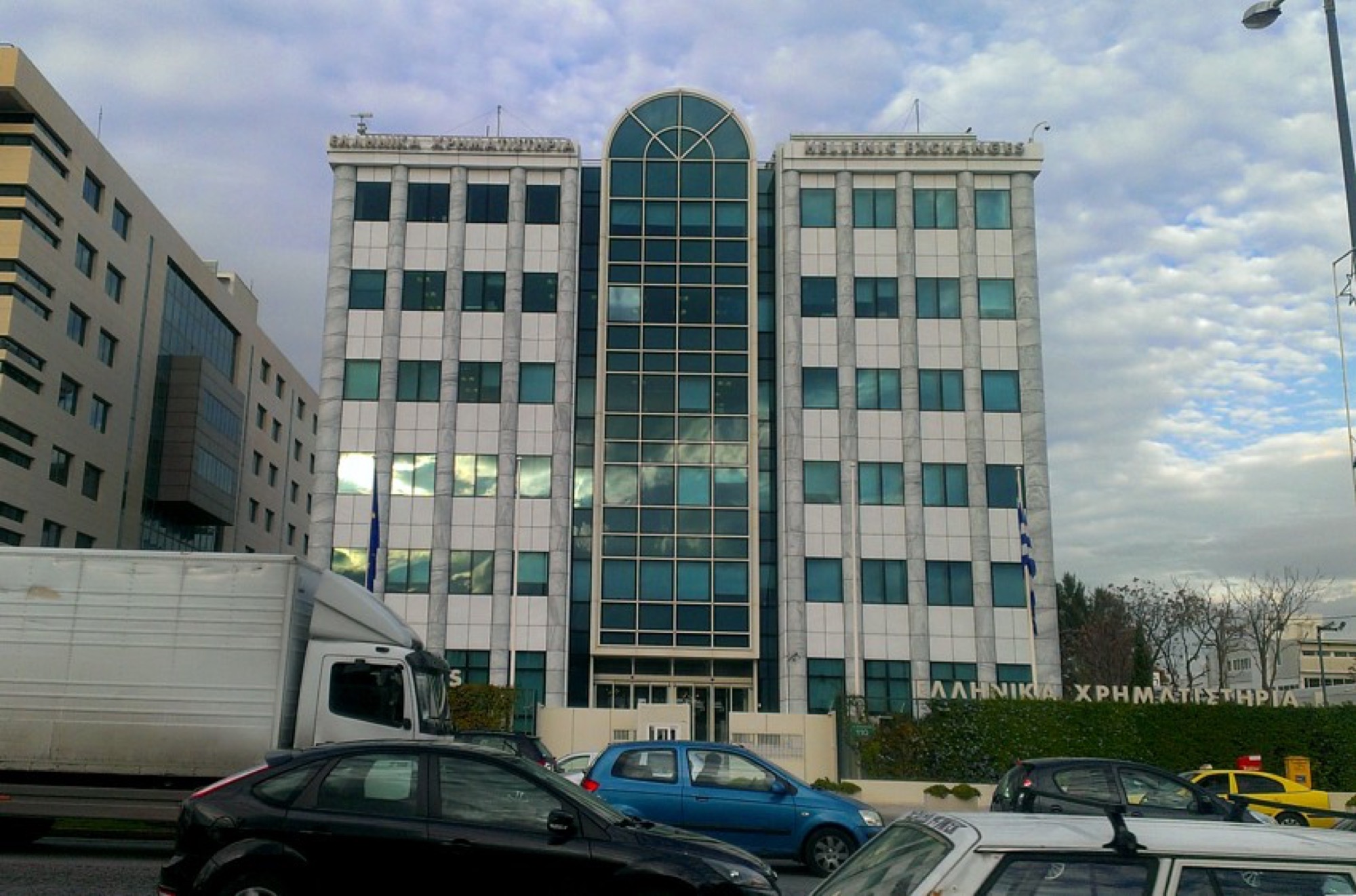
The Athens Stock Exchange occupied five successive buildings before settling at its iconic Sofokleous Street address. Chartered by royal decree on September 30, 1876, under Prime Minister Alexandros Koumoundouros, the exchange first convened in the Melas Mansion, an imposing structure designed by the Saxon architect Ernst Ziller in 1874 for the merchant Vasilios Melas, which had served as the Grand Hotel d’Athènes. After relocations to the corner of Aiolou and Sofokleous streets (1881), 11 Sofokleous Street (1885), and 1 Pesmazoglou Street (1891), the exchange moved in November 1934 into a purpose-built headquarters at 8–10 Sofokleous Street, inaugurated with ceremony on December 19 of that year. This building, designed by the architect Nikolaos Zoumboulidis and constructed beginning in 1931, was previously owned by the National Bank of Greece. As Helen Fessas-Emmanouil documents in her study “Twelve Greek Architects of the Interwar Period” (2005), Zoumboulidis coordinated the great interwar building program of the National Bank, drawing on studies in Constantinople and Berlin. His design for the exchange employed a late neoclassical idiom tempered by interwar rationalism—what scholars characterize as eclectic in its principles, combining imposing exterior decoration with monumental interior volumes suited to the bustle of open-outcry trading. The building was vertically expanded between 1965 and 1968 to accommodate growing market activity. In July 2007, the Hellenic Exchanges group relocated to modern headquarters at 110 Leoforos Athinon, and the historic Sofokleous Street building closed its doors in December 2007.
The decorative program of the Athens Stock Exchange building at 8–10 Sofokleous Street reflected the eclectic neoclassical tradition that defined Athenian institutional architecture from independence through the interwar period. As documented in the Open House Athens architectural surveys (2024–2025), the building stands out for its imposing architectural decoration on both exterior and interior, following principles of eclecticism that blended classical motifs with modernist materials. Zoumboulidis, influenced by discoveries of Aegean prehistory and trained in the monumental traditions of Berlin, integrated ceramic tiles with archaic and folk motifs into his private commissions, and a comparable sensitivity to historical ornament informed his institutional designs. The exchange’s facade presented symmetrical massing and decorative stonework characteristic of Athenian financial buildings, situated within a streetscape of bank headquarters along Sofokleous Street that constituted an ensemble of commercial neoclassicism. The trading hall, the building’s central space, served as the dramatic setting for 116 years of open-outcry trading until electronic systems replaced the practice in 1991. Broader artistic representations of Greek commercial life appear in genre paintings of market scenes and lithographs of the Athenian commercial district, while numismatic artifacts—drachma coins, government bond certificates, and share instruments issued by the National Bank of Greece—constitute a material culture of financial exchange preserved in the National Bank’s Historical Archives in Athens.
The Athens Stock Exchange anchored the commercial heart of the modern Greek capital along Sofokleous Street, which became known colloquially as Greece’s Wall Street. When Athens was designated the capital of the newly independent Greek state in 1834, King Otto commissioned the architects Stamatios Kleanthis and Eduard Schaubert to design an urban plan replacing the Ottoman town’s winding lanes with orthogonal grids and neoclassical public buildings expressing continuity with the ancient city. The exchange grew within the “Commercial Triangle” (Emporiko Trigono), the area bounded by Stadiou, Athinas, and Ermou streets connecting Syntagma and Omonia squares, which from the mid-nineteenth century through the late twentieth century hosted Athens’s most concentrated commercial activity. As documented in studies of urban regeneration by Mela and Patelida in “Abandoned or Degraded Areas in Historic Cities” (Land, 2022), this district evolved from its transformation as a new capital into a dense center of banking houses, brokerage firms, and commercial warehouses. The National Bank of Greece, founded in 1841, established its headquarters nearby, while insurance companies and smaller banks clustered along Sofokleous and the adjacent Aiolou Street. Greek diaspora merchants from Constantinople, Chios, Smyrna, and Alexandria channeled capital into the Athenian market; as Ioanna Pepelasis Minoglou has shown in studies published in Business History Review and Financial History Review, diaspora networks were instrumental in financing Greek enterprise.
The Athens Stock Exchange was established by government decree on September 30, 1876, under Prime Minister Alexandros Koumoundouros, shortly after Greece regained access to international capital markets following a forty-five-year embargo. Trading commenced on May 2, 1880, with seventeen securities—six government bonds, one corporate bond, and ten equities—as Stavros Thomadakis, Dimitrios Gounopoulos, Christos Panagiotis Nounis, and Michalis Riginos document in their study “Innovation and Upheaval” (Economic History Review, 2017). The exchange’s early decades coincided with Prime Minister Charilaos Trikoupis’s ambitious modernization program of railroads, harbors, and the Corinth Canal, financed by 730 million francs in foreign borrowing. When France closed its market to Greek currants—which constituted roughly seventy percent of national exports—the economy collapsed; in 1893, Trikoupis famously declared before parliament, “Regretfully, gentlemen, we are bankrupt.” As Carmen Reinhart and Christoph Trebesch analyze in “The Pitfalls of External Dependence: Greece, 1829–2015” (NBER Working Paper 21664, 2015), this was Greece’s third sovereign default, leading to the imposition of the International Financial Commission in 1898. The exchange weathered further crises: closure during the Great Depression (1931–1932), World War II (1941–1945), and the aftermath of Turkey’s 1974 Cyprus invasion. The most spectacular modern episode was the bubble of the late 1990s, when the General Index soared from 933 points in December 1996 to an all-time high of 6,355 on September 17, 1999—a 579 percent increase—before crashing through 2003. In 2015, capital controls forced the exchange’s longest modern closure, from June 29 to August 3.
From its inception, the Athens Stock Exchange listed both government debt and private equities, reflecting Greece’s dual dependence on foreign borrowing and domestic enterprise. The first bulletin of May 12, 1880, recorded seventeen securities including six government bonds—instruments of a state that had defaulted in 1827 and only restructured its obligations in 1878—alongside ten company stocks. Banking stocks dominated from the earliest years, with the National Bank of Greece, founded in 1841 under Georgios Stavros and listed on the exchange in 1880, anchoring market capitalization. As George Alogoskoufis demonstrates in “Historical Cycles of the Economy of Modern Greece from 1821 to the Present” (GreeSE Paper No. 158, 2021), banking has represented over half of Greek market capitalization since the 1890s, a pattern reinforced by the listings of the Bank of Greece (established 1927), the Commercial Bank of Greece, and later the Agricultural Bank. Currant-related enterprises and the Privileged Company to Protect Production and Trade in Currants (1905) reflected the agricultural economy’s centrality. Railroad and mining companies—including those tied to the Lavreotika silver mining speculation of the 1870s—constituted significant early listings. Sophia Lazaretou’s Bank of Greece working papers on monetary history document how financial intermediation remained shallow, with broad money to GDP at barely 32 percent in 1881. Maritime shipping, Greece’s signature industry, has been represented through firms like Attica Holdings, though many major Greek shipping companies chose to list on the New York Stock Exchange or London markets. Trading was conducted by open outcry from 1880 until 1991, when the ASIS electronic system ended 116 years of floor trading.
Images will be added as the project develops. Photographs by Larry Ng and from research sources.