Antwerp Stock Exchange (Antwerpse Beurs)
Antwerp, Belgium · Established 1531

This site requires authorization to access.
To request access, contact
william.goetzmann@yale.edu
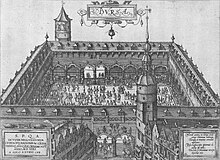
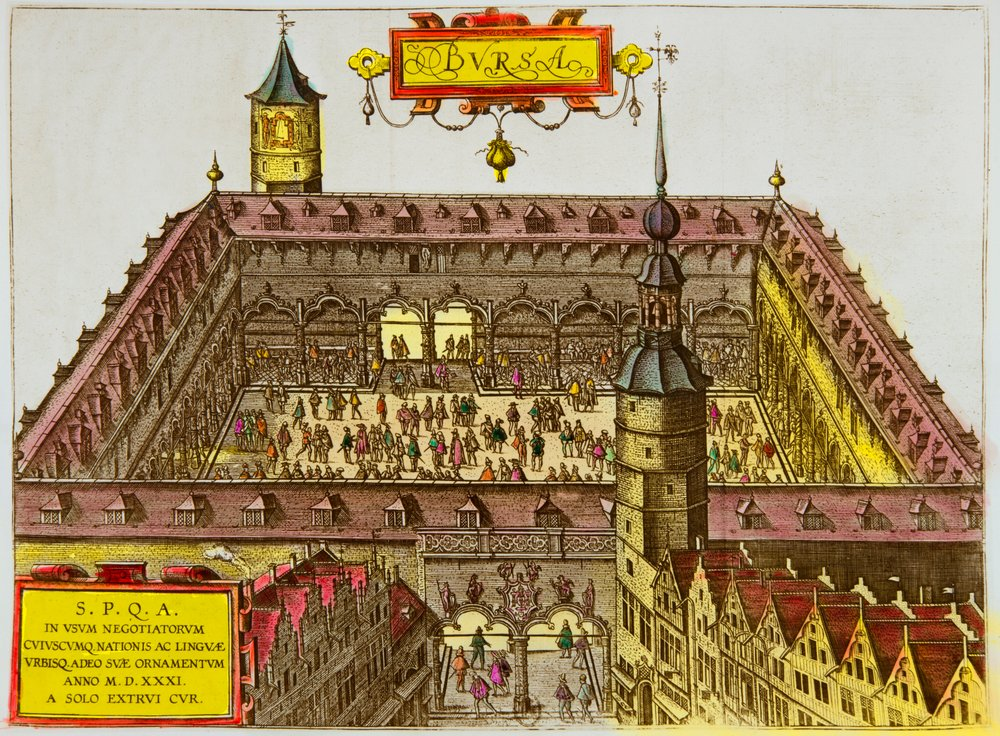
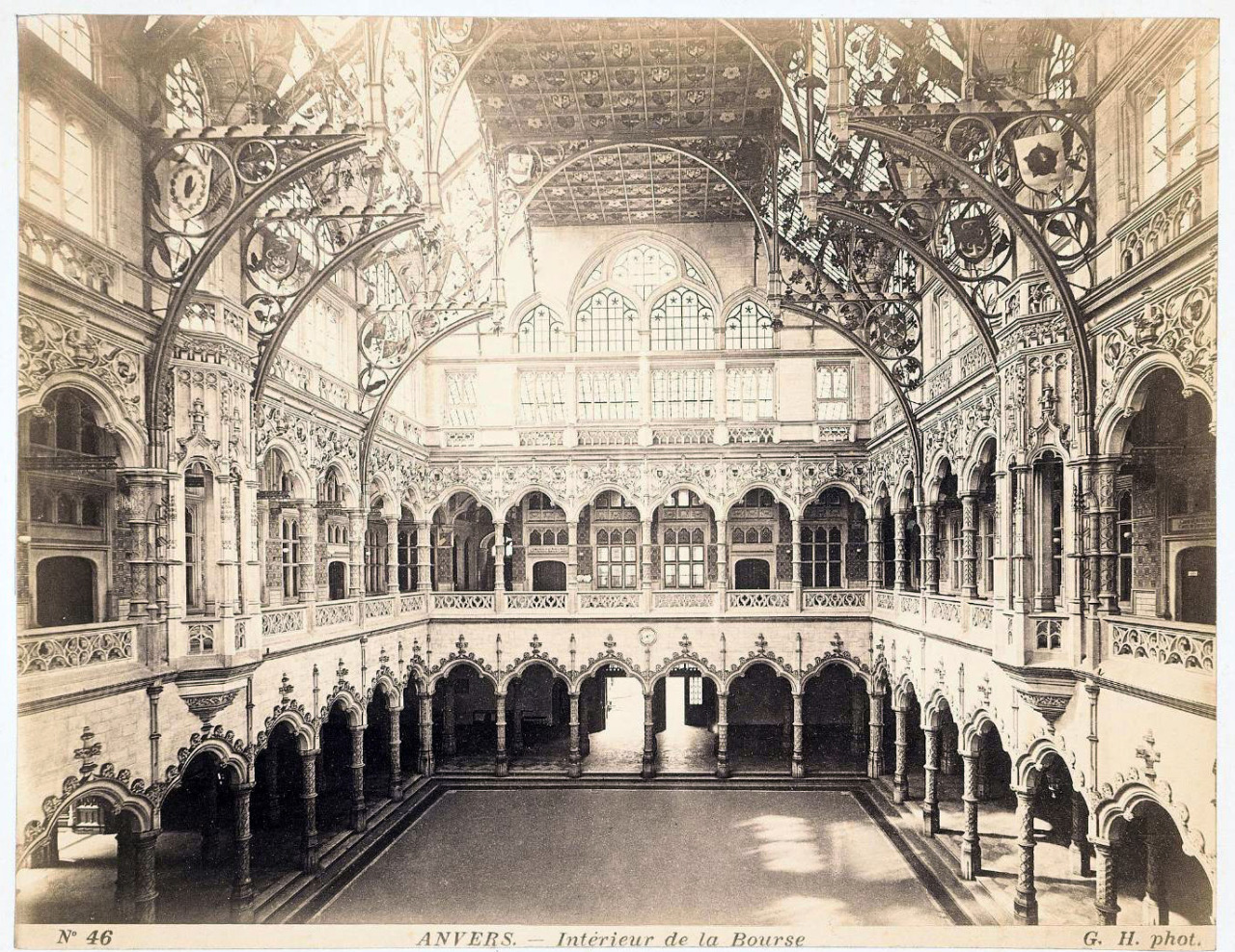
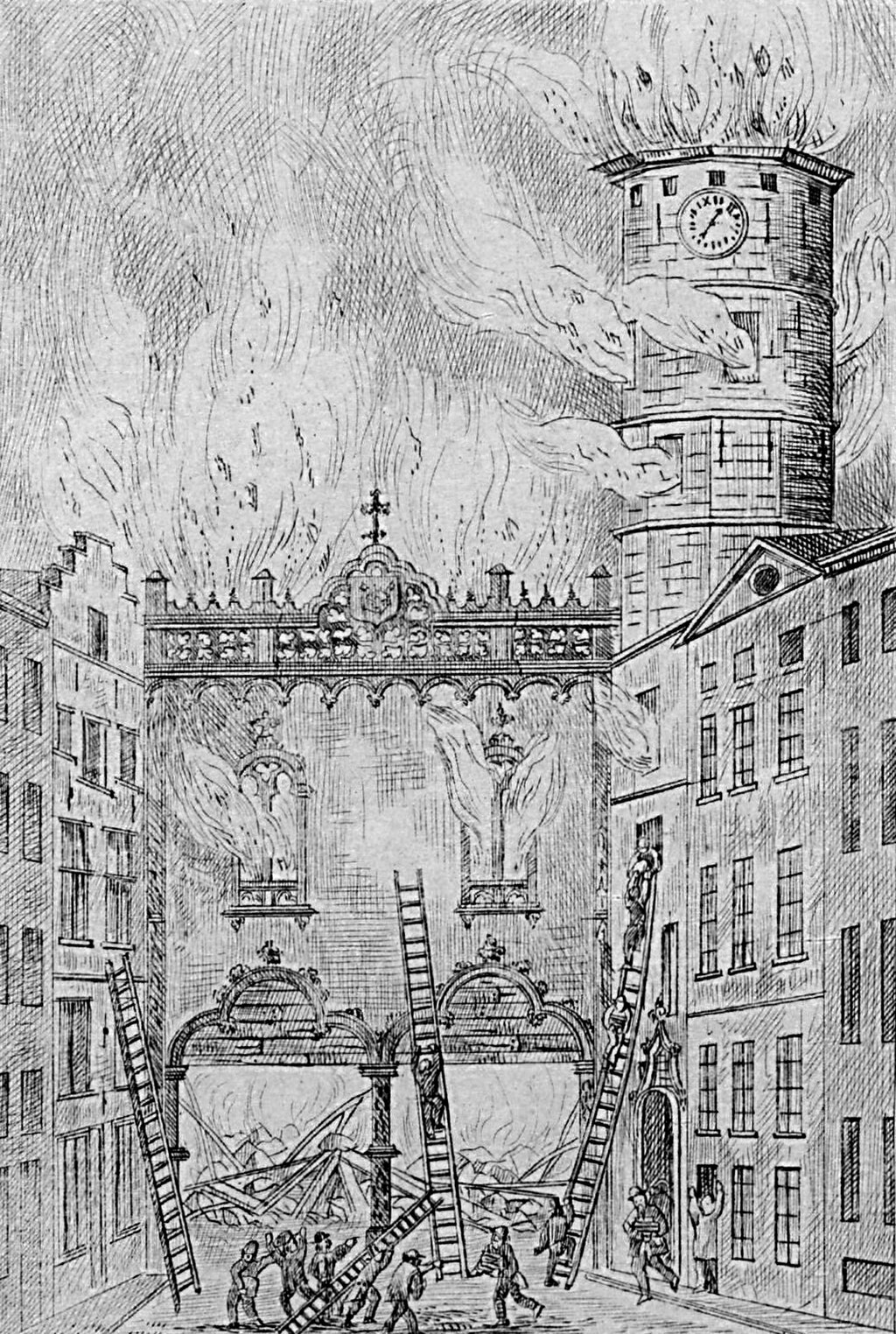
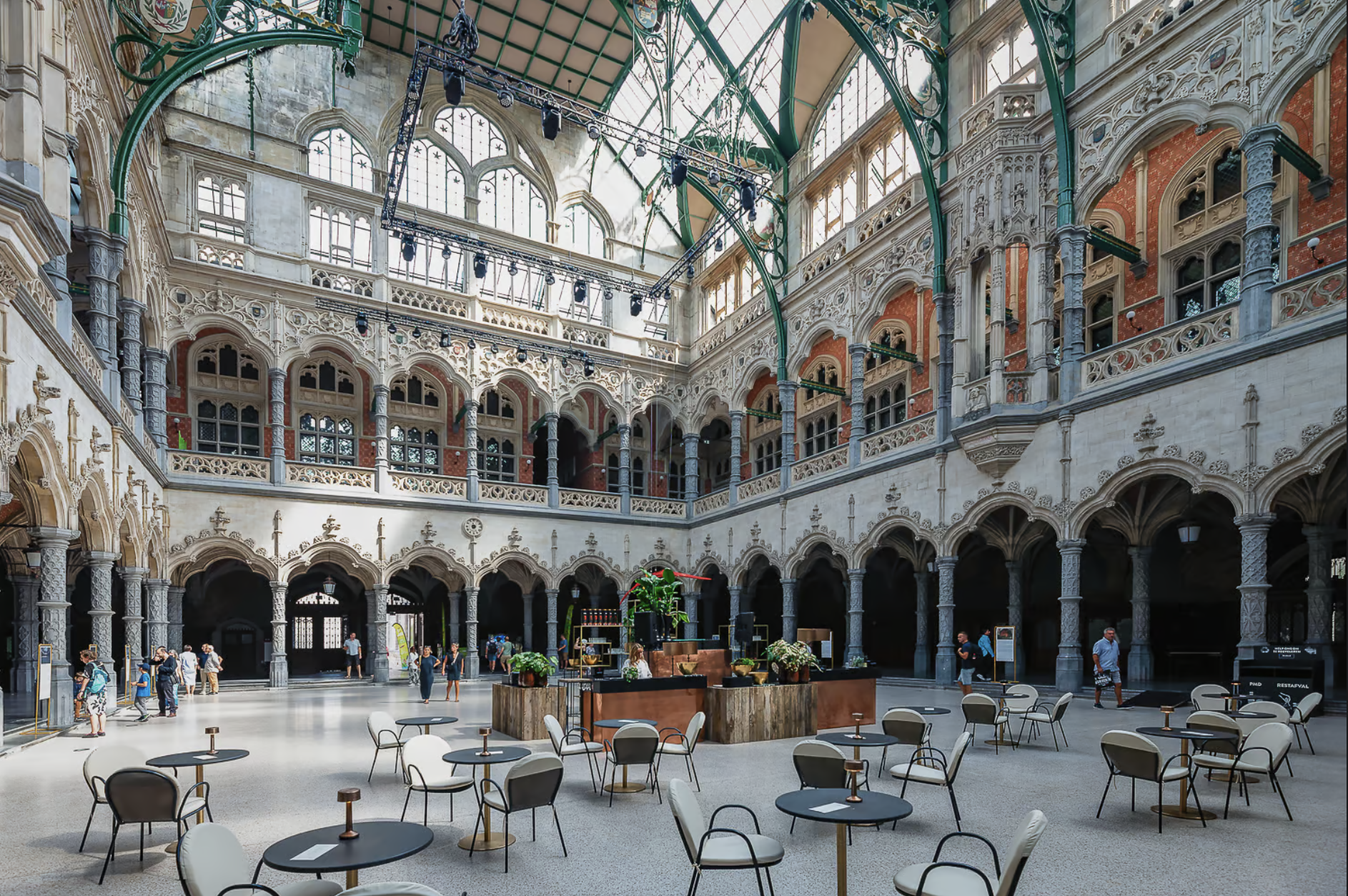
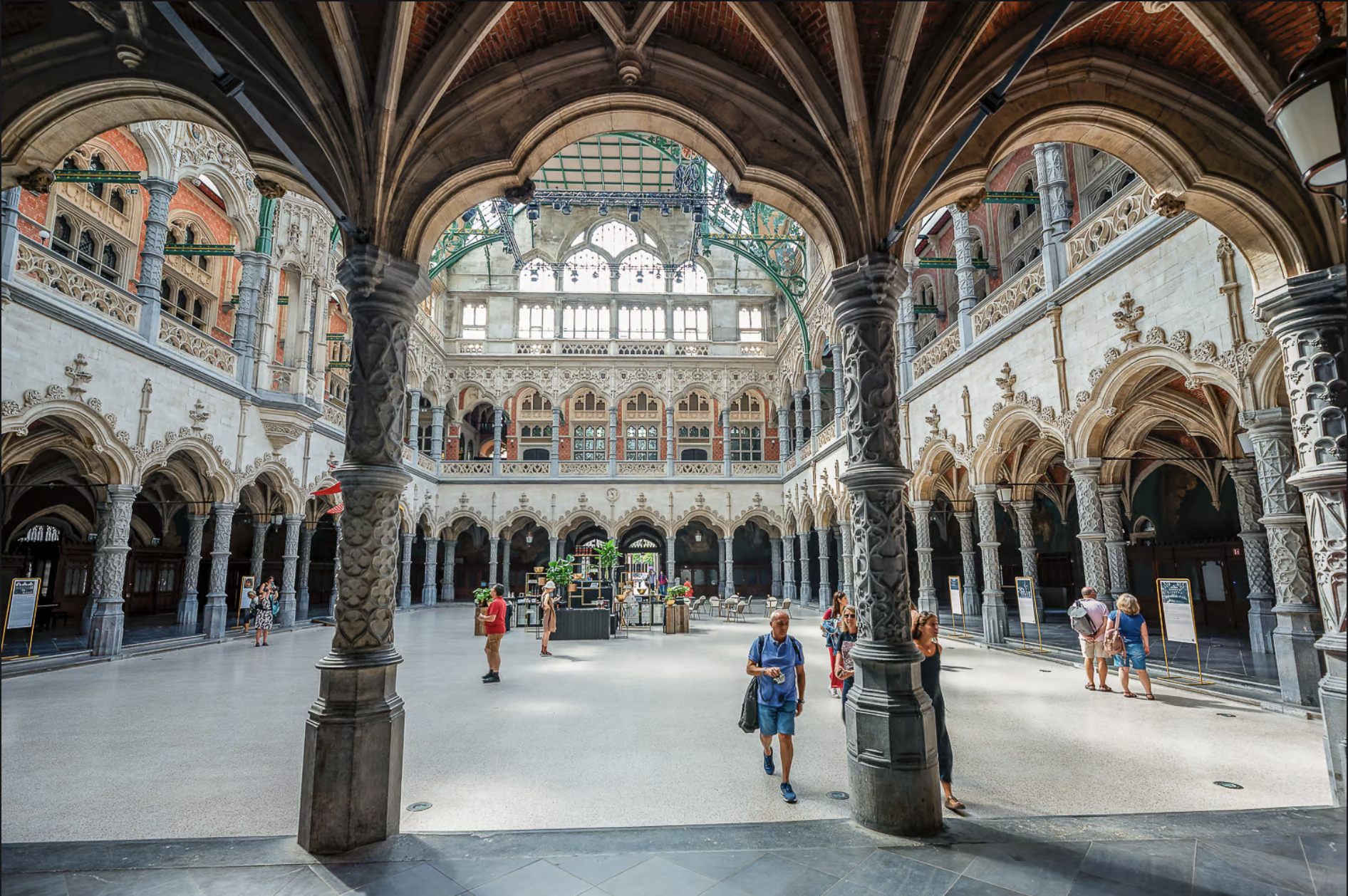
In 1531, the city of Antwerp opened the Nieuwe Beurs — the world’s first purpose-built commodity exchange — replacing the cramped Oude Beurs on the Hofstraat, which had served merchants since at least 1460 and been rebuilt in 1515. The architect was Domien de Waghemakere (c. 1460–1542), master builder of Antwerp Cathedral’s northwestern tower and co-designer, with Rombout Keldermans, of the Maison du Roi in Brussels and the Town Hall in Ghent. De Waghemakere conceived the exchange in the Flamboyant Brabantine late-Gothic style as a rectangular open courtyard measuring approximately 40 by 51 meters, enclosed on four sides by arcades whose slender columns supported star-and-net vaults. Above the principal entrance, a Latin inscription proclaimed the building open “in usum negotiatorum cuiuscumque nationis et linguae” — for the use of merchants of every nation and tongue. The courtyard was left open to the sky, a feature contemporaries explained by saying that God should observe the transactions. Fifty-six wooden offices for brokers lined the perimeter galleries, and world maps with trade routes decorated the gallery walls. Corner towers with octagonal and cylindrical profiles may have served as harbor lookouts. Access came from four narrow streets — Borzestraat, Twaalfmaandenstraat, Korte Klarenstraat, and Israëlietenstraat — threading between the Meir and the Lange Nieuwstraat. The building was destroyed by fire in 1583 during the Eighty Years’ War but was immediately rebuilt to the same plan. A second catastrophic fire on 2 August 1858 razed the structure entirely. The Antwerp city authorities twice organized a design competition stipulating that the old concept be preserved; the commission was won by Joseph Schadde (1818–1894), an architect trained at the Antwerp Academy who had taught there for thirty-eight years. Schadde laid the cornerstone on 24 August 1869 and inaugurated the building on 19 October 1872, with finishing work continuing to 1877. His reconstruction married neo-Gothic forms to revolutionary iron-and-glass engineering: the central hall is spanned by four curved transverse spants of riveted sheet iron, designed by engineer Joseph Pâris-Isaac and built by the firm Lalmand, Focketyn & Cie, supporting a glazed saddle roof that floods the trading floor with daylight. The exterior is clad in white Liais de Brauvilliers limestone, while interior columns rise in blue Ecaussines hardstone. In 1894–1896, city architect Gustave Royers added the adjacent Schippersbeurs annex, designed for the Fondsenbeurs (Funds Exchange) and later used as an inland-shipping freight market until the late 1990s. The complex was listed as a protected monument in 1983. After the Antwerp Stock Exchange merged into the Brussels Exchange (now Euronext) in 1997, the building fell into disrepair; the fire department ordered its closure in 2003 for structural instability. A comprehensive restoration, approved in 2014 and completed in October 2019, reopened the Handelsbeurs as an events venue, preserving Schadde’s architectural achievement for public access.
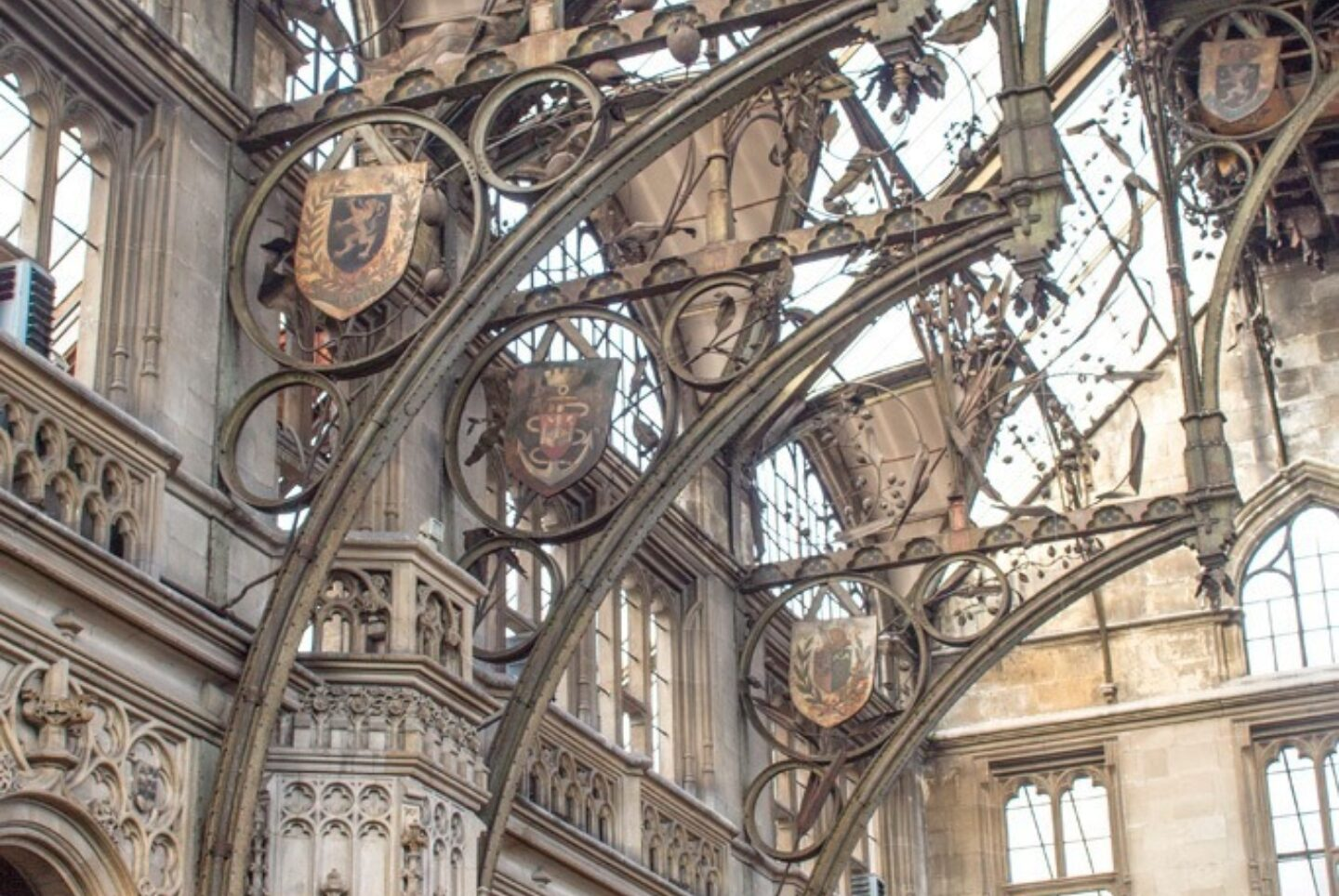
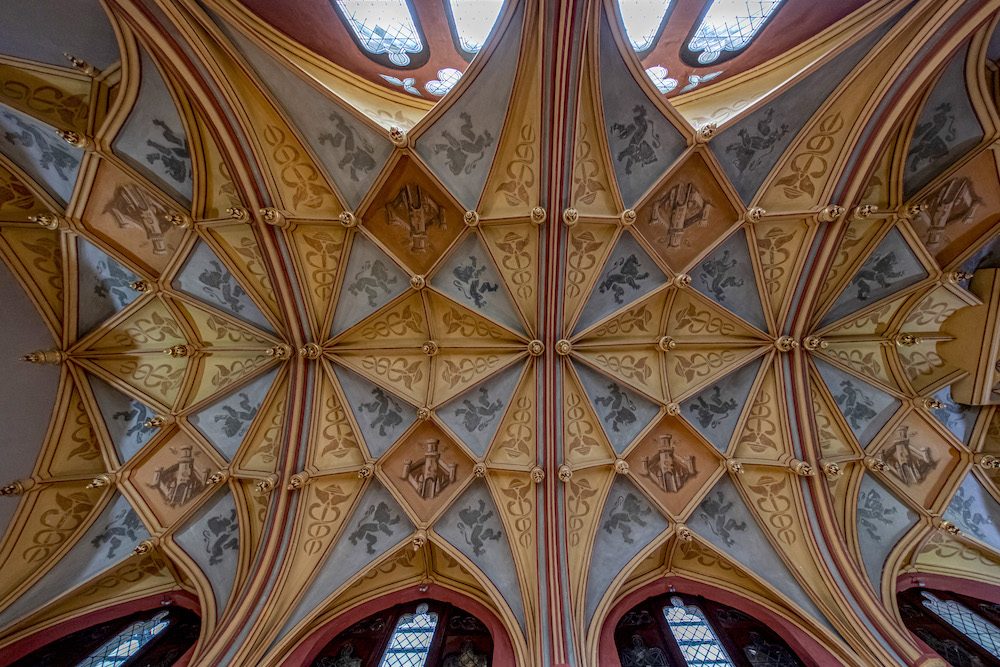
The decorative program of the Antwerp Bourse was conceived as a systematic visual language of international commerce. In the original 1531 building, de Waghemakere’s galleries featured world maps with painted trade routes — cartographic murals that made the spatial reach of Antwerp’s mercantile networks legible on the walls of the exchange itself. Each foreign trading nation occupied a designated section of the courtyard, and the building’s inscription “in usum negotiatorum cuiuscumque nationis et linguae” served as both a welcome and a monumental declaration of cosmopolitan purpose, carved in stone above the entrance. When Joseph Schadde reconstructed the exchange after the 1858 fire, he created an elaborate neo-Gothic ornamental program that transformed the trading hall into a cathedral of commerce. The 243 heraldic coat-of-arms shields, designed by city archivist Pierre Génard, constitute the building’s most distinctive decorative feature: suspended from ironwork near the ceiling and set into blind tracery in the spandrels of the arcades, these polychrome blazons represent the nations, provinces, and trading cities whose merchants had historically frequented the exchange. The gallery ceilings are decorated with flat coffered panels painted with miniature heraldic shields and rosettes. The iron roof spants themselves carry ajour (openwork) ironwork adorned with acanthus spirals and heraldic medallions, fusing structural engineering with ornamental display. Below, the pointed arches spring from clustered columns of blue Ecaussines hardstone, their capitals carved with koolblad (cabbage-leaf) motifs and crowned with cross-flowers — characteristic Brabantine Gothic decorative vocabulary reinterpreted in a nineteenth-century idiom. The gallery offices retain painted world maps with trade routes by the artist Ghesquière, echoing the sixteenth-century cartographic tradition of the original building. Oak entrance doors, transoms, and interior paneling (completed 1875–1877) add warmth to the stone-and-iron interior. The Schippersbeurs annex by Gustave Royers contributes maritime-themed cast-iron structural ornament appropriate to its function as a shipping exchange. Together, these elements constitute a decorative program in which heraldry, cartography, and architectural ornament converge to articulate the Bourse’s identity as a space where the world’s commerce was physically enacted.
The Handelsbeurs occupies a pivotal block between the Meir — Antwerp’s principal commercial boulevard — and the parallel Lange Nieuwstraat, connected by four narrow passage streets that thread merchants from the city’s main artery directly into the trading hall. This through-block permeability, with entrances on Borzestraat and Twaalfmaandenstraat, made the exchange a porous node in the urban fabric rather than a walled enclosure. In the sixteenth century, when Antwerp superseded Bruges as the commercial capital of the Burgundian and then Habsburg Netherlands, the city’s population surged past 100,000, making it one of the largest cities in northern Europe. The Italian merchant and humanist Lodovico Guicciardini, in his influential Descrittione di tutti i Paesi Bassi (1567), described Antwerp as “the warehouse of the world,” a characterization analyzed by Arjan van Dixhoorn in his study of the values and prosperity embedded in Guicciardini’s text. The Scheldt estuary gave the city deep-water access, and by mid-century some 2,500 ships entered its port annually, supported by ten jetties along the river and seven inland ports (vlieten). Approximately 1,500 to 2,000 merchants operated internationally, with each nation maintaining its own merchant house: the Hanseatic Oosterlingenhuis, the Portuguese Feitoria de Flandres (the crown’s spice-trading headquarters established after the first Portuguese spice ships arrived in 1502), the English Merchant Adventurers’ quarter, and substantial colonies of southern German, Italian, and Spanish traders. As Oscar Gelderblom demonstrates in Cities of Commerce: The Institutional Foundations of International Trade in the Low Countries, 1250–1650 (Princeton, 2013), this multinational community drove the competitive institutional innovation that distinguished Antwerp from its rivals. The Fall of Antwerp to Spanish forces under Alessandro Farnese on 17 August 1585, following a siege of over a year, and the subsequent Dutch blockade of the Scheldt, devastated this mercantile world. The population collapsed from 100,000 to roughly 42,000 as all Protestants were given four years to leave. Over 500 southern merchants migrated north to Amsterdam between 1578 and 1609, carrying the commercial networks, capital, and institutional expertise that would build Amsterdam’s exchange (opened 1611, modeled directly on the Antwerp plan) and fuel the Dutch Golden Age.
The Antwerp Bourse was the institutional prototype for all European exchange buildings, and its influence extended far beyond architecture to the fundamental mechanisms of modern finance. The exchange’s predecessor, the Oude Beurs on the Hofstraat, had served merchants informally since at least 1460, but the purpose-built Nieuwe Beurs of 1531 represented something genuinely new: a dedicated, publicly sanctioned space designed to concentrate commercial negotiation and price discovery under one roof. Thomas Gresham, the English crown’s financial agent in Antwerp from the 1550s, witnessed this institution firsthand and commissioned the Flemish master builder Hendrik van Paesschen to design London’s Royal Exchange, opened by Elizabeth I on 23 January 1571. The courtyard-and-gallery model subsequently traveled to Amsterdam (Hendrik de Keyser’s exchange, 1611), Rotterdam, Lille, and beyond. Hermann Van der Wee’s monumental three-volume study The Growth of the Antwerp Market and the European Economy, Fourteenth–Sixteenth Centuries (Nijhoff, 1963) remains the foundational analysis of how Antwerp’s market dynamics shaped European economic history. The exchange was the site of transformative financial innovation. Jeroen Puttevils, in “Tweaking Financial Instruments: Bills Obligatory in Sixteenth-Century Antwerp” (Financial History Review, 2015), shows how private promissory notes (bills obligatory) were incrementally adapted to meet the needs of a changing market — a process of piecemeal institutional adaptation rather than sudden invention. Letters of exchange circulated between Antwerp, Augsburg, Venice, Lyon, Frankfurt, and Seville, combining currency conversion with credit. The practice of endorsing bills of exchange — making them negotiable instruments by signing the reverse — developed here. Southern German banking houses, above all the Fugger, Welser, and Hochstätter, arranged massive sovereign loans to Charles V and Philip II on the exchange floor. It was this lending that precipitated the crisis of 1557, when Philip II’s suspension of payments to creditors sent shockwaves through the European financial system — an event analyzed in detail by Mauricio Drelichman and Hans-Joachim Voth. Fernand Braudel, in the third volume of Civilisation matérielle, économie et capitalisme (1979), identified Antwerp’s mid-sixteenth-century primacy as a pivotal phase in the long history of capitalism, calling it “a world capital created by outside agency.” Between 1661 and 1810, with commercial activity having migrated to Amsterdam, the exchange building served as the seat of the Guild of Saint Luke and as a drawing academy, a remarkable interlude in which the spaces of commerce were reoccupied by the institutions of art. The Antwerp Academy, founded in 1663 when the Guild merged with the chambers of rhetoric, used the former trading floor for artistic instruction.
The Antwerp Bourse was, in Fernand Braudel’s formulation, a market whose breadth made it a true “world economy.” Portuguese colonial spices formed the exchange’s most celebrated commodity stream: pepper, cinnamon, cloves, and nutmeg arrived via Lisbon and were distributed through the Portuguese crown’s Feitoria de Flandres, established after the first spice ships reached Antwerp in 1502. As scholars of the spice trade have shown, the pepper market alone was remarkably heterogeneous, with up to seven-fold price divergences between different grades and species. English and Flemish textiles constituted the second pillar: unfinished English broadcloth was imported, dyed, and finished for re-export to German and southern European markets, a trade analyzed in detail by Gelderblom and others. American silver and gold flowed through the exchange alongside Baltic grain, French wine and salt, and the copper and silver from southern German mines that the Portuguese required as exchange commodities for the purchase of Asian spices. Bills of exchange circulated between Europe’s major financial centers, while promissory notes (bills obligatory) developed the legal sophistication documented by Puttevils (2015). Sovereign loans to Charles V and Philip II were arranged on the exchange floor: by 1569, the city carried 4.6 million guilders in annuity debt, nearly ten times the levels of Bruges, Ghent, or Brussels. Marine premium insurance, introduced by Portuguese, Spanish, and Italian traders who had relocated from Bruges, became established in Antwerp between approximately 1520 and 1560 — a development explored by Dave De ruysscher in “Marketing and Pricing Risk in Marine Insurance in Sixteenth-Century Antwerp” (Journal of Economic History, 2018). The exchange also pioneered speculative “to arrive” contracts on cargoes still at sea, particularly in grain, whale oil, herring, and salt. As Geoffrey Poitras demonstrates in “From Antwerp to Chicago: The History of Exchange Traded Derivative Security Contracts” (Revue d’histoire des sciences humaines, 2009), these forward sales of cargoes whose quality and quantity could not be known prior to the fleet’s arrival were inherently speculative, and a key step in the evolution of standardized exchange-traded contracts came when trading involved fictitious goods settled by payment of differences.