Ancona Merchants' Loggia (Loggia dei Mercanti)
Ancona, Italy · Established Begun 1442; facade 1451-1459
This site requires authorization to access.
To request access, contact
william.goetzmann@yale.edu
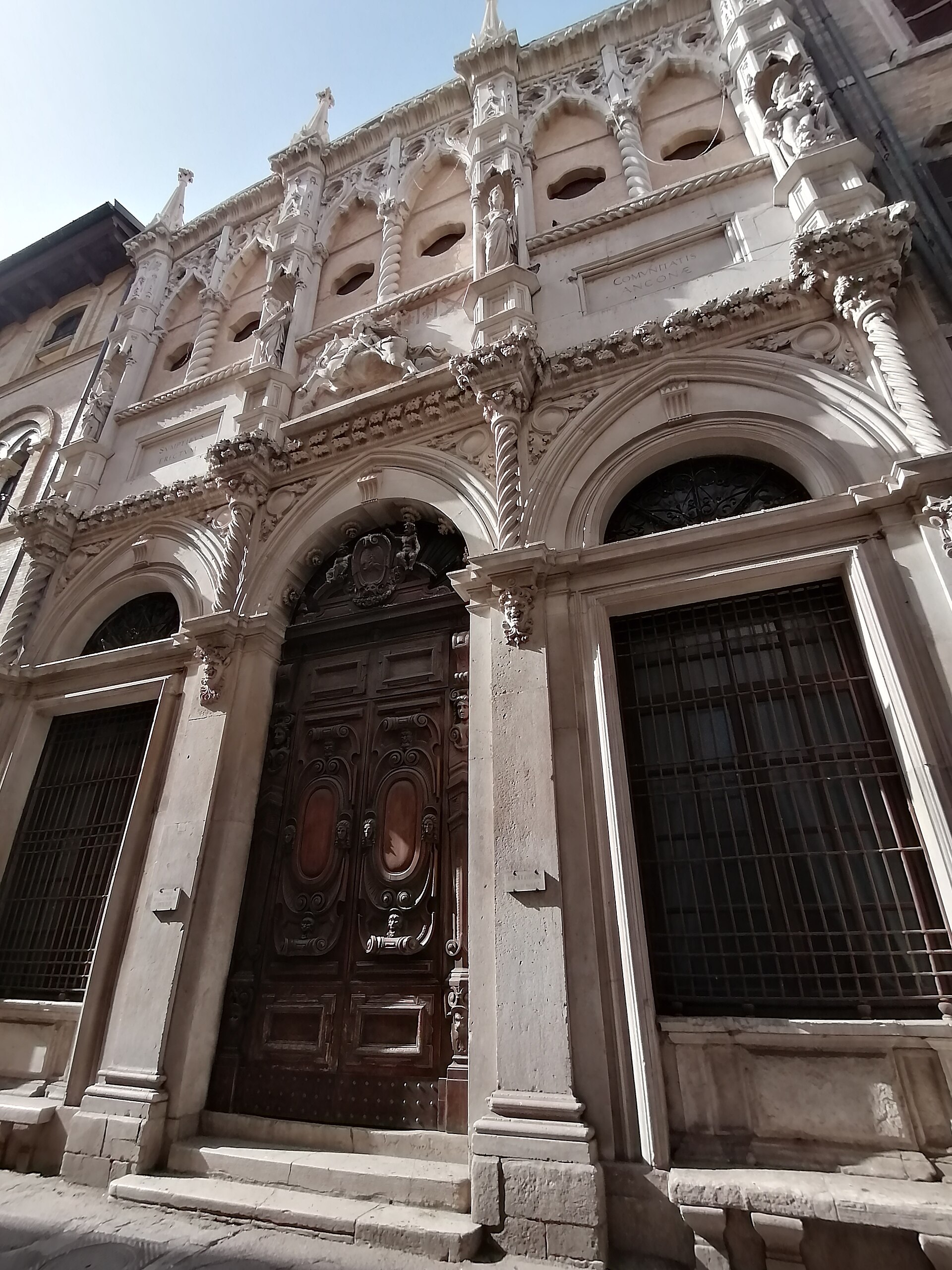
The Loggia dei Mercanti rises along Via della Loggia in Ancona's old harbour quarter, its construction begun in 1442 under the local master Giovanni Pace, called 'il Sodo,' during the commercial heyday of the late medieval maritime republic. Its fame, however, rests on the sumptuous west facade designed and carved between 1451 and 1459 by the Dalmatian sculptor-architect Giorgio da Sebenico (Giorgio di Matteo, Juraj Dalmatinac), one of the leading figures of what Fabio Mariano, in 'La Loggia dei Mercanti in Ancona e l'opera di Giorgio di Matteo da Sebenico' (Il Lavoro Editoriale, Ancona, 2003), characterizes as the 'Adriatic Renaissance' -- an idiom in which classicizing sculptural figures are set within the structural envelope of late Venetian Florid Gothic. The facade was executed in costly Dalmatian marble quarried on the island of Brazza (Brac), as the Camera di Commercio delle Marche brochure 'La Loggia dei Mercanti' records; four vertical bays, each crowned by a pinnacle and a statue, frame blind mullioned windows above three pointed ground-floor arches. After fire gutted the interior in 1556, the Bolognese Mannerist Pellegrino Tibaldi was engaged in 1558-1561 to rebuild and remodel the hall, inserting round-arched openings beneath the Gothic arches and frescoing the vault of the great chamber. The building was damaged by Allied bombing in 1943 and restored, reopening to the public on 21 November 1952, with a further major conservation campaign in 2000-2002.
The Loggia's principal artistic interest is the facade sculpture itself: Giorgio da Sebenico's pinnacled figures of the four virtues of the good Christian merchant -- Hope, Fortitude, Justice and Charity (read left to right) -- together with an equestrian relief of the Roman emperor Trajan, Ancona's imperial patron and the builder of its harbour, set at the centre of the front, as described on the Italian Wikipedia entry 'Loggia dei Mercanti (Ancona)' and the city's own culture portal (comuneancona.it). These statues, knitted into the Gothic membrane of the wall, are among the most studied works of fifteenth-century Adriatic sculpture, treated at length in Mariano's 2003 monograph and in the entry on Giorgio da Sebenico in the Dizionario Biografico degli Italiani (Treccani). Inside, the chief surviving decoration is the frescoed vault of the main hall executed under Pellegrino Tibaldi's 1558-1561 reconstruction; the interior is otherwise comparatively plain, its grandeur concentrated outward, toward the port and the street, where the merchants and their cargoes passed.
The Loggia stands in the San Pietro district of Ancona's lower town, only a few steps from the curving quay of the natural harbour that gave the city its name (from the Greek ankon, 'elbow'). It was deliberately sited by the waterfront so that merchants meeting under its arcade could watch vessels enter the port and inspect incoming cargoes, as the city's tourism and culture pages emphasize. Conceived originally as a true open loggia -- without fixtures on the ground floor toward either street or harbour, as Giorgio da Sebenico designed it -- the building belonged to a string of mercantile and maritime monuments strung along the Adriatic shore, near the medieval merchants' warehouses, the cathedral of San Ciriaco on the Guasco hill above, and Trajan's Arch at the mole. Its position at the meeting point of land routes from Florence and Lucca and sea routes to the Levant made it the institutional heart of the trading town.
Ancona was an independent maritime republic on the central Adriatic, retaining its autonomy under nominal papal overlordship until its forcible absorption into the Papal States in 1532, and Pope Eugenius IV had formally acknowledged it as a republic in 1447, just as the Loggia was being built (see 'Republic of Ancona,' Wikipedia, and the broader literature on the Italian maritime republics). The Loggia was raised by and for the city's merchant community as a covered hall in which to gather, negotiate and conclude bargains -- the counterpart of the bourses and merchant lodges of other Mediterranean ports. After the republic's incorporation into the papal dominion, the building continued in commercial use; at the end of the eighteenth century the French administration transferred its ownership to the Chamber of Commerce, which retained it after Italian unification. It survived fire, wartime bombardment and successive restorations, and today houses and is administered by the Camera di Commercio delle Marche, which uses its frescoed hall for conferences and civic events.
Under the Loggia's arches merchants dealt in the goods that made Ancona one of the cradles of Adriatic commerce. The republic's warehouses were active in Constantinople, Alexandria and other eastern ports, and from the Levant came Egyptian and Syrian cotton, raw silk, spices and drugs, while westward flowed the wool and finished textiles of Florence and Lucca, whose merchants used Ancona as their outlet to the eastern Mediterranean (see 'Republic of Ancona' and the 'Maritime republics' surveys on Wikipedia). Ancona and Ragusa together developed an overland-and-sea axis carrying goods from the Levant through Ancona to Florence and on to Flanders. Business here was conducted face to face, by negotiation and the auction of wares, ships and shares in ships, with the harbour in plain view -- a place where the arrival of a cargo and its sale could be settled within sight of the same quay, rather than through the standardized securities trading of a later age.
Images will be added as the project develops. Photographs by Larry Ng and from research sources.