Amsterdam Exchange (Beurs van Hendrick de Keyser)
Amsterdam, Netherlands · Established 1611 (decided 1607; built 1608-1611 over the Rokin; enlarged 1668; closed 1835, demolished 1836-37)
Amsterdam's first purpose-built exchange was a municipal commission of 1607. According to the Dutch Wikipedia article on the building (drawing on R. Meischke's study of the Amsterdam fabrieksambt in the Bulletin KNOB, 1994, and on Frijhoff and Prak, eds., Geschiedenis van Amsterdam 1578-1650, 2004), the city council approved a merchants' exchange in April 1607 on the model of Antwerp and London, and adopted the building plan on 1 September 1607. Lodewijk Petram (The World's First Stock Exchange, Columbia University Press, 2014) writes that the city ordered it "after the example of the Antwerp Exchange"; the Exchange History project of Euronext Amsterdam (beursgeschiedenis.nl) adds that Hendrick de Keyser, appointed city stonemason and architect in 1594, was sent to London to study Thomas Gresham's Royal Exchange (itself built 1566-1571 on the pattern of Antwerp's Nieuwe Beurs of 1531). The visit is a commonplace of the secondary literature, but its date and the document behind it are seldom given, and it should be repeated with that reserve. Salomon de Bray's biographical preface to Architectura Moderna (1631) lists "de Beurs" among de Keyser's principal Amsterdam works, alongside the Zuiderkerk, Noorderkerk and Westerkerk.
The site was unusual: the building stood over the water of the Rokin, the Amstel just south of the Dam. Its foundations rested partly on existing sluice vaults and partly on piles of fifty to sixty feet; the first stone was laid on 28 May 1608 by Hendrick Hooft, son of burgomaster Cornelis Hooft, and the work was executed with the master carpenter Hendrick Staets and the master mason Cornelis Dankertsz. de Rij. Petram, citing J.G. van Dillen, gives the official opening as 1 August 1611. Small vessels could pass under the building through its arches with masts lowered; after an arson plot of 1622 the passage was closed during exchange hours, later fitted with heavy doors, and finally bricked up in 1672.
The Exchange was a rectangular brick block enclosing an open courtyard ringed by a covered stone arcade. The Exchange History site gives overall dimensions of about 60 metres by more than 35 metres. Without a measured survey of the demolished building, the figures are best taken as approximate. The arcade, with stone cross-vaults, ran twelve by six bays in alternating narrow and wide intervals derived from Hans Vredeman de Vries; niches intended for thirty-six statues of the counts of Holland and Zeeland were never filled. A tower with a clock and bells rose beside the entrance on the Rokin side, flanked by two blocks of shops; in 1655 the Hemony brothers supplied a carillon for it. Sources disagree on the number of numbered pillars: 42 (Exchange History), 46 (Amsterdam Museum), and 41 (the caption to Hermann Kellenbenz's 1957 translation of de la Vega), a spread that may reflect the building before and after its enlargement.
In 1668 the courtyard was lengthened from twelve to seventeen bays, a gallery was built over the bridge on the Rokin side, and the city architect Daniel Stalpaert gave the building a new pilastered outer facade crowned by a statue of Mercury; the tower and the shops were removed, the carillon going to the Munttoren and the clock to the Oosterkerk (Dutch Wikipedia, after A. Lehr and H.B. van der Weel on the Hemony bells). Two centuries of subsidence finally made the building unusable. It was closed in 1835 and demolished in 1836-37; trading moved to a temporary Hulpbeurs on the Dam until J.D. Zocher's new exchange on the Damrak opened in 1845.
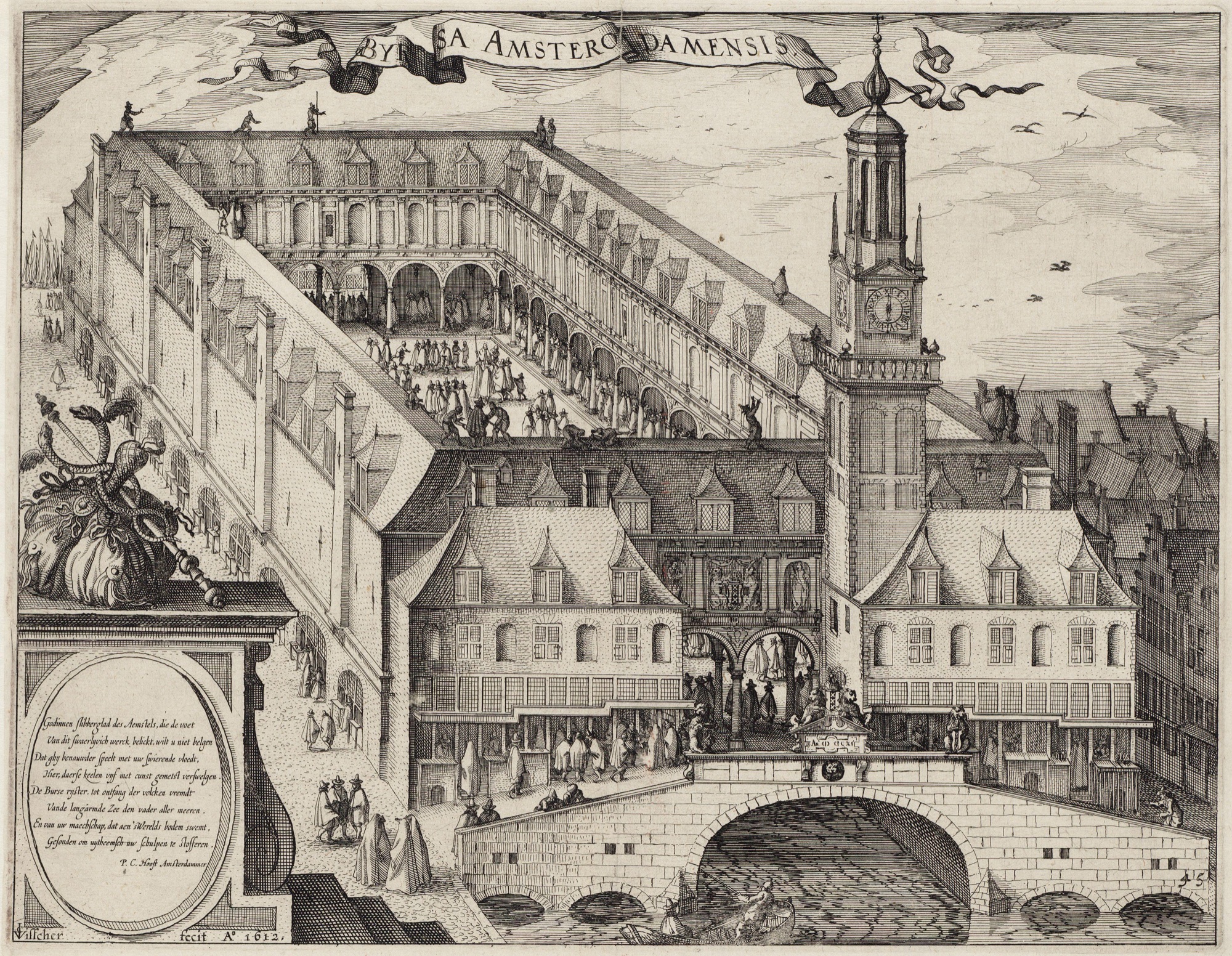
The Exchange was among the most frequently depicted buildings of seventeenth-century Amsterdam. The foundational image is Claes Jansz. Visscher's bird's-eye etching Byrsa Amsterodamensis, dated 1612, which shows the building straddling the Rokin with crowds in and around the courtyard and carries an eight-line Dutch verse by P.C. Hooft beneath a purse and caduceus. The Rijksmuseum's catalogue entry (RP-P-AO-25-1) notes that this state of the plate first appeared in Willem Jansz. Blaeu's 1612 Dutch edition of Guicciardini's description of the Low Countries and was reused in later editions until 1648. A perspective print by Boetius Adamsz. Bolswert is dated 1609, before the building was finished, and commemorative plaquettes and medals for its completion and inauguration (1612-1613) survive in Dutch collections; Petram reproduces Visscher's etching as his principal image of the building in The World's First Stock Exchange.
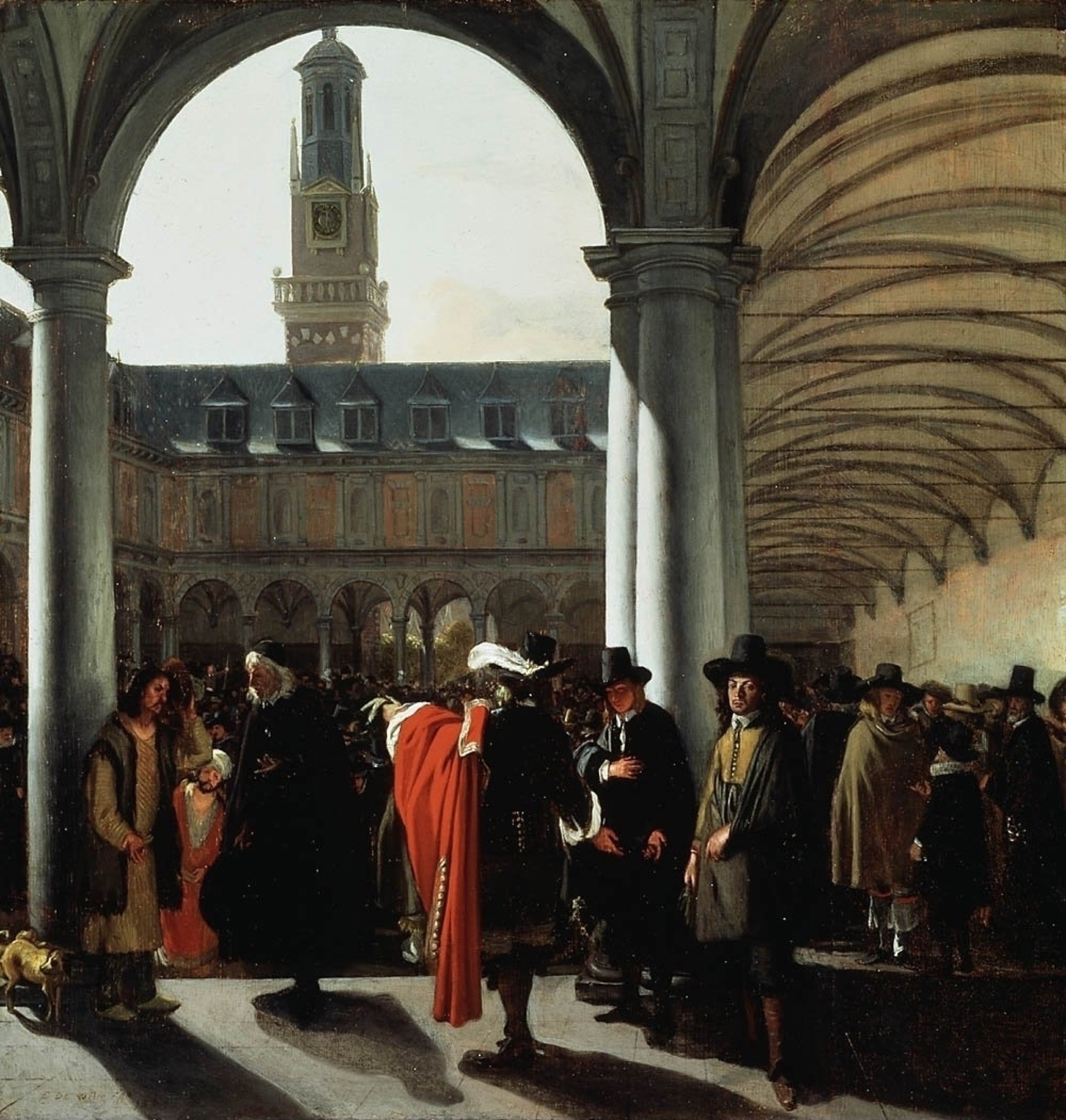
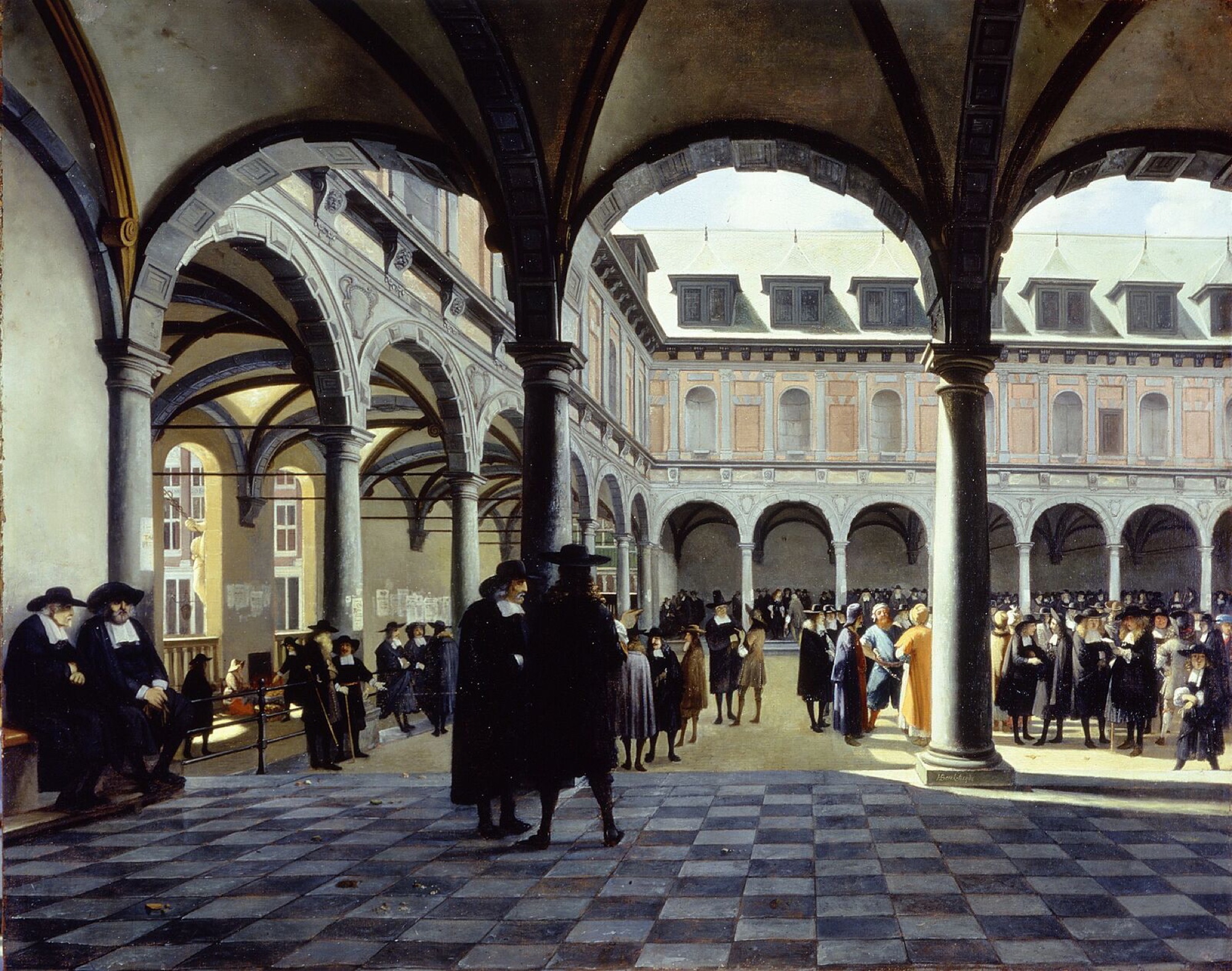
The painted record begins with Emanuel de Witte, otherwise best known for church interiors. His Courtyard of the Exchange in Amsterdam (1653, oil on panel, 49 x 47.5 cm; Museum Boijmans Van Beuningen, Rotterdam, inv. VdV 91, on loan from the Stichting Willem van der Vorm since 1972) places the merchants in the foreground and the architecture behind; the museum notes that the emphasis on the figures has led specialists to suppose that one of the traders commissioned it. Job Adriaensz. Berckheyde painted the courtyard and its facade several times after the 1668 enlargement: a courtyard view of about 1670 in the Boijmans (inv. 1043 OK); a large courtyard canvas of 1670-1690 (89 x 116 cm) in the Amsterdam Museum (SA 3025), bequeathed to the city by Adriaan van der Hoop in 1854; and The Stock Exchange in Amsterdam (c. 1675-1680, 62.2 x 52.8 cm) in the Stadel Museum, Frankfurt (inv. 536), which shows the north facade with the city arms and street vendors selling oranges and newspapers outside. Jan van der Heyden's painting of the rear of the Exchange (1667, Staatsgalerie Stuttgart) is a topographical capriccio: as the museum's description notes, it combines the building with a patrician house and omits the canal behind it.
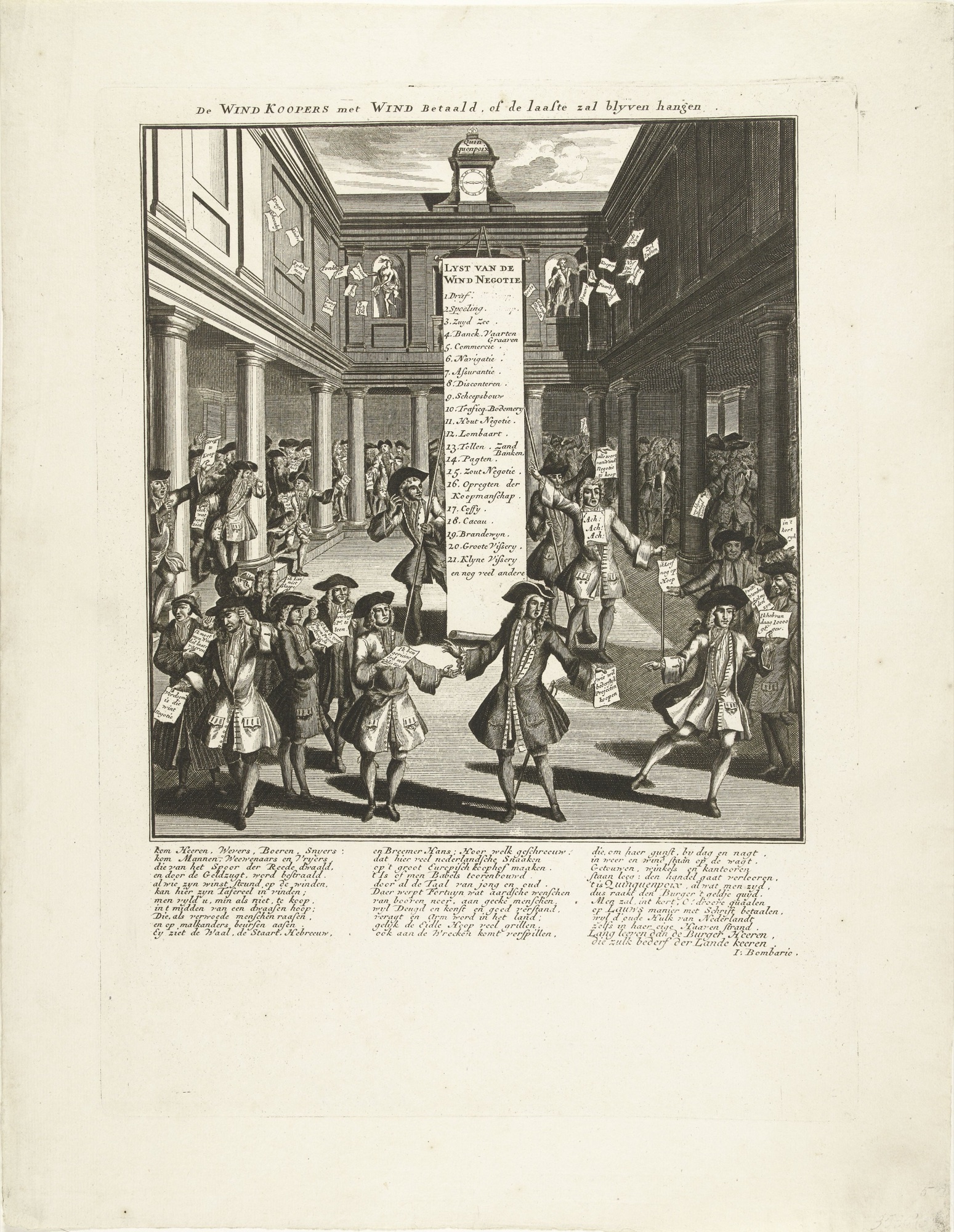
Prints followed the building's later life. A series of plates of about 1670-1680 shows the annual demonstration of fire-hose pumps in the courtyard. Het Groote Tafereel der Dwaasheid (1720), the satirical compilation on the Dutch share bubble, set its third plate, De Wind Koopers met Wind betaald, in the Exchange courtyard, with ruined speculators beneath a board listing the products of the "wind trade" (Rijksmuseum RP-P-OB-83.504); allegorical prints on the bankruptcies of 1763 return to the same setting. Abraham van der Hart's survey drawings (1802) record the water beneath the building, and Gerrit Lamberts drew the empty site after demolition. Pieter Saenredam, sometimes associated with these views, painted Amsterdam's Old Town Hall on the Dam (1657, Rijksmuseum) but no Saenredam view of the Exchange was found.
The Exchange gathered into one building a trade that had previously wandered around the harbour end of the city. Petram, drawing on Clé Lesger (Handel in Amsterdam ten tijde van de Opstand, 2001; English translation The Rise of the Amsterdam Market and Information Exchange, Ashgate, 2006), reconstructs the earlier geography. Merchants met first in the Warmoesstraat, the main street of the medieval town, until they blocked the shopfronts; in 1561 the city directed them to the Nieuwe Brug, the bridge across the Damrak by the harbour, where ships delivered overseas mail at the Paalhuisje on its west side and news arrived first. In bad weather they sheltered under the Warmoesstraat porches until 1586, when the magistrates allowed them into the nearby St. Olofskapel and occasionally the Oude Kerk; Petram cites a share deal negotiated in the Oude Kerk in April 1610. Kellenbenz's introduction to de la Vega summarises the same sequence: Warmoesstraat, the Nieuwe Brug, the "church square" by the Oude Kerk, then the Exchange of 1611.
The new building moved the centre of gravity about six hundred metres south (Petram), to the hinge between the Damrak, the harbour inlet running north to the IJ, and the Rokin, the Amstel running south. It stood on the south side of the Dam, the city's original dam and market square. Across the square were the medieval town hall, where the Exchange Bank (Wisselbank) founded in 1609 kept its accounts, and from 1655 Jacob van Campen's new town hall on the same site; the Nieuwe Kerk stood on the square's north side and served as a fallback trading place when the Exchange was under repair (Exchange History). A financial quarter formed around these institutions: notaries specialising in commercial deeds kept offices in Beurssteeg, the lane along the Exchange, and in Kromelleboogsteeg; the printer of standard forward contracts, Aart Dirksz. Oossaan, had his shop at the corner of the Dam and Beurssteeg; and share traders met at night in the Kalverstraat inns, notably De Plaetse Royael, halfway between the Exchange and the Dam (Petram).
Regulation tried, and failed, to confine dealing to the building. Petram shows that trade continued on the Dam outside hours, and de la Vega (1688) describes business on the Dam from ten to twelve before the crowd hurried into the Exchange. The building also exposed the city to risk: the 1622 plot to burn Amsterdam named the Exchange among its targets. After demolition the stretch of the Rokin beside the Dam was later filled in (1933, according to the Dutch Wikipedia account), and nothing of de Keyser's building survives above ground.
The Exchange belongs to the short span of years that Oscar Gelderblom and Joost Jonker ("Completing a Financial Revolution: The Finance of the Dutch East India Trade and the Rise of the Amsterdam Capital Market, 1595-1612", Journal of Economic History 64, 2004) treat as decisive for Amsterdam's capital market: the VOC's permanent capital of 1602, the Exchange Bank of 1609, and the exchange building of 1611. Jan de Vries and Ad van der Woude (The First Modern Economy, Cambridge, 1997) set these institutions within the wider expansion of the Dutch economy. Euronext dates the first municipal regulation of the merchants' meeting, with fixed hours and an exchange clerk who rang a bell, to 1592, while trade was still on the Nieuwe Brug.
The building's early years coincided with the first contests over the share market. Isaac le Maire's syndicate sold VOC shares forward from 1609, and on 27 February 1610 the States General banned short selling, requiring forward share transactions to be registered with the company within a month; Petram records that the ban was reissued in 1623, 1624, 1630, 1636 and 1677. Five days before the Exchange opened, a municipal bye-law of 26 July 1611 required trade to take place only in the building, every day except Sunday from 11 a.m. to noon, and in summer (May-August) also from 6.30 to 7.30 p.m. (Petram, citing M.F.J. Smith, Tijd-affaires, 1919). In 1613 contracts concluded outside the Exchange during exchange hours were declared void, and from 1619 brokers were barred from lingering around the Exchange and the Dam after hours. Hours changed over time: by 1688 de la Vega reports dealing on the Exchange from twelve to two in the afternoon, with fines for latecomers. The figure of noon to 1 p.m. given by the Amsterdam Museum presumably reflects yet another period; no single schedule applied across the building's life.
The Exchange witnessed the seventeenth-century share booms and busts studied by Petram, including the sharp fall of August 1688 analysed by Jonathan Israel ("Jews and the Stock Exchange: The Amsterdam Financial Crash of 1688", in Diasporas within a Diaspora, 2002). That year the Sephardic merchant Joseph Penso de la Vega published Confusión de confusiones, a set of dialogues describing the market; In the epilogue to his 2011 dissertation Petram argues that de la Vega wrote chiefly to entertain educated Sephardic readers, dramatising the market and exaggerating price movements, so the book should not be read as a trading manual. In 1720 the Dutch share bubble followed those in Paris and London. Frehen, Goetzmann and Rouwenhorst ("New Evidence on the First Financial Bubble", Journal of Financial Economics, 2013) show that it was driven by new insurance and trading companies floated from July 1720 in Rotterdam, Gouda, Delft, Schiedam, Middelburg and other towns, together with a run-up in West India Company shares, and that it collapsed with the British crash; Het Groote Tafereel der Dwaasheid commemorated it, setting one plate in the Exchange courtyard. Later crises, notably 1763, played out in the same building until its closure in 1835.
The Exchange was primarily a commodity and bill market in which securities occupied one corner. Petram writes that each commodity had its own designated place by one of the arcade pillars, with securities dealt at a pillar toward the back of the building; the Exchange History site instead places the share trade just behind the main entrance on the Rokin side. Either may be right for a different moment in the building's two centuries of use, and the sources do not settle which. According to the Amsterdam Museum, boards on the pillars named the goods traded or the ports in which the dealers there specialised, and the weekly official price list named some six hundred goods. Printed commodity price currents (prijscouranten) predate the building: John McCusker and Cora Gravesteijn (The Beginnings of Commercial and Financial Journalism, NEHA, 1991) list an Amsterdam price current of 1585 among the earliest to survive, and N.W. Posthumus's Inquiry into the History of Prices in Holland (1946) draws heavily on the Amsterdam series. Payments for goods and bills of exchange were settled by transfer at the Wisselbank across the Dam.
The securities trade centred on VOC shares, later joined by those of the West India Company (1621) and by public debt. There were no share certificates: ownership was a balance in the company's capital books, and prices were quoted as a percentage of nominal value, with a ƒ3,000 share becoming the standard unit (Petram). Forward contracts appear in notarial protocols from 1607, building on forward dealing in the Amsterdam grain trade since the mid-sixteenth century (Petram, after Milja van Tielhof); options and repos followed, and in the 1660s forwards were standardised to settle on the first of the month, which made possible the periodic rescontre clearing meetings. De la Vega describes deals struck by handslaps and shouted bids among the pillars.
Intermediation was regulated by the city. Sworn brokers (gezworen makelaars) belonged to the municipal brokers' guild and were not allowed to trade on their own account; dealings through unsworn interlopers (bijlopers) were legally void and the parties liable to fines. Petram finds that brokers handled only a handful of share deals in 1609-1612 but became important in the 1640s, a change he links to the arrival of Portuguese Jewish traders; the commission was fixed at 10 stuivers per ƒ100 nominal from 1 January 1613 and cut to 4 stuivers in 1647, and a brokers' ordinance of 1693 required brokers to report to clients within twenty-four hours. Petram also notes that, unlike the later Paris Bourse or London Stock Exchange, the Amsterdam Exchange imposed no formal membership requirement on those who traded in it.