Al-Mahdiyya Fatimid Port
Mahdia, Tunisia · Established 916 CE
This site requires authorization to access.
To request access, contact
william.goetzmann@yale.edu
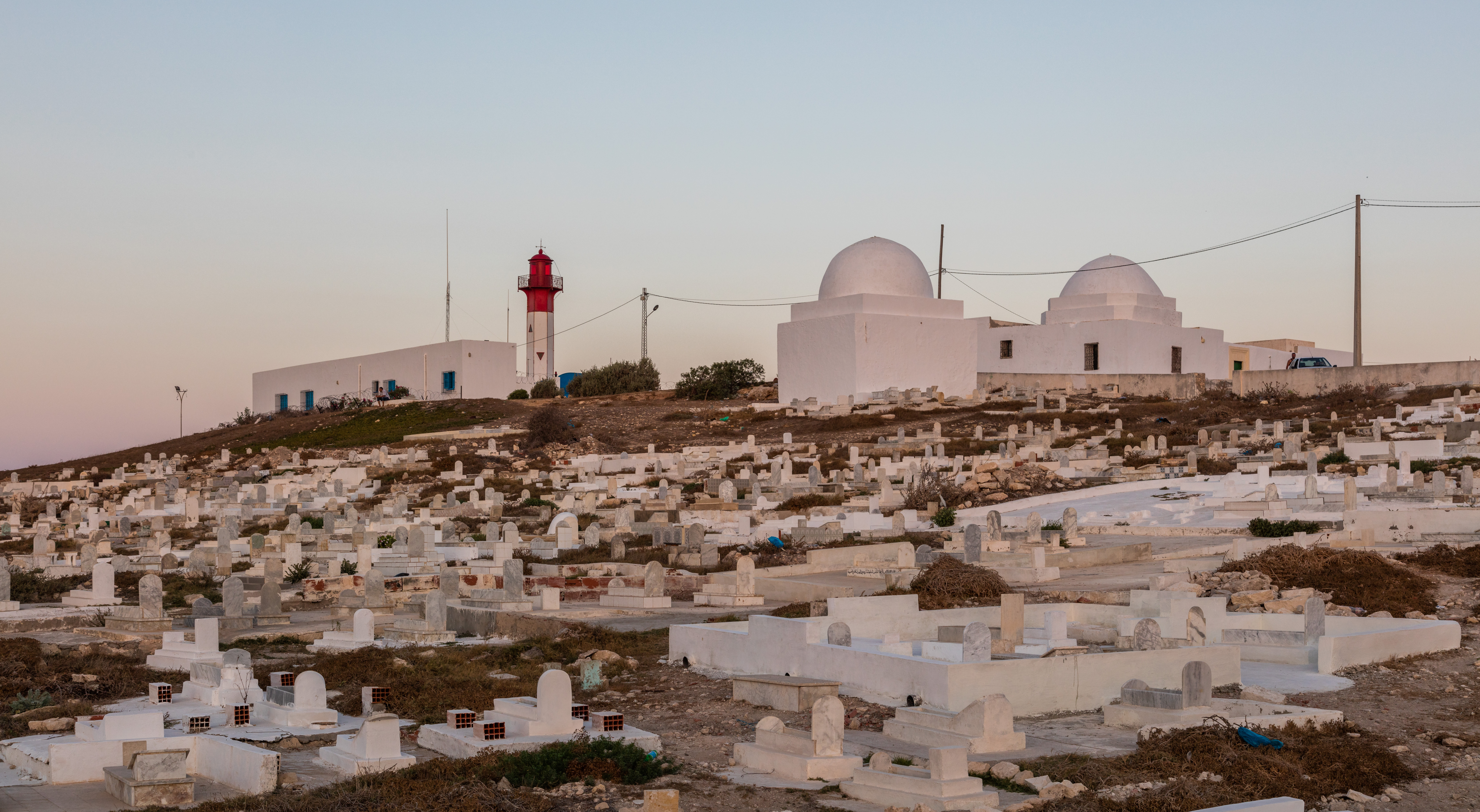
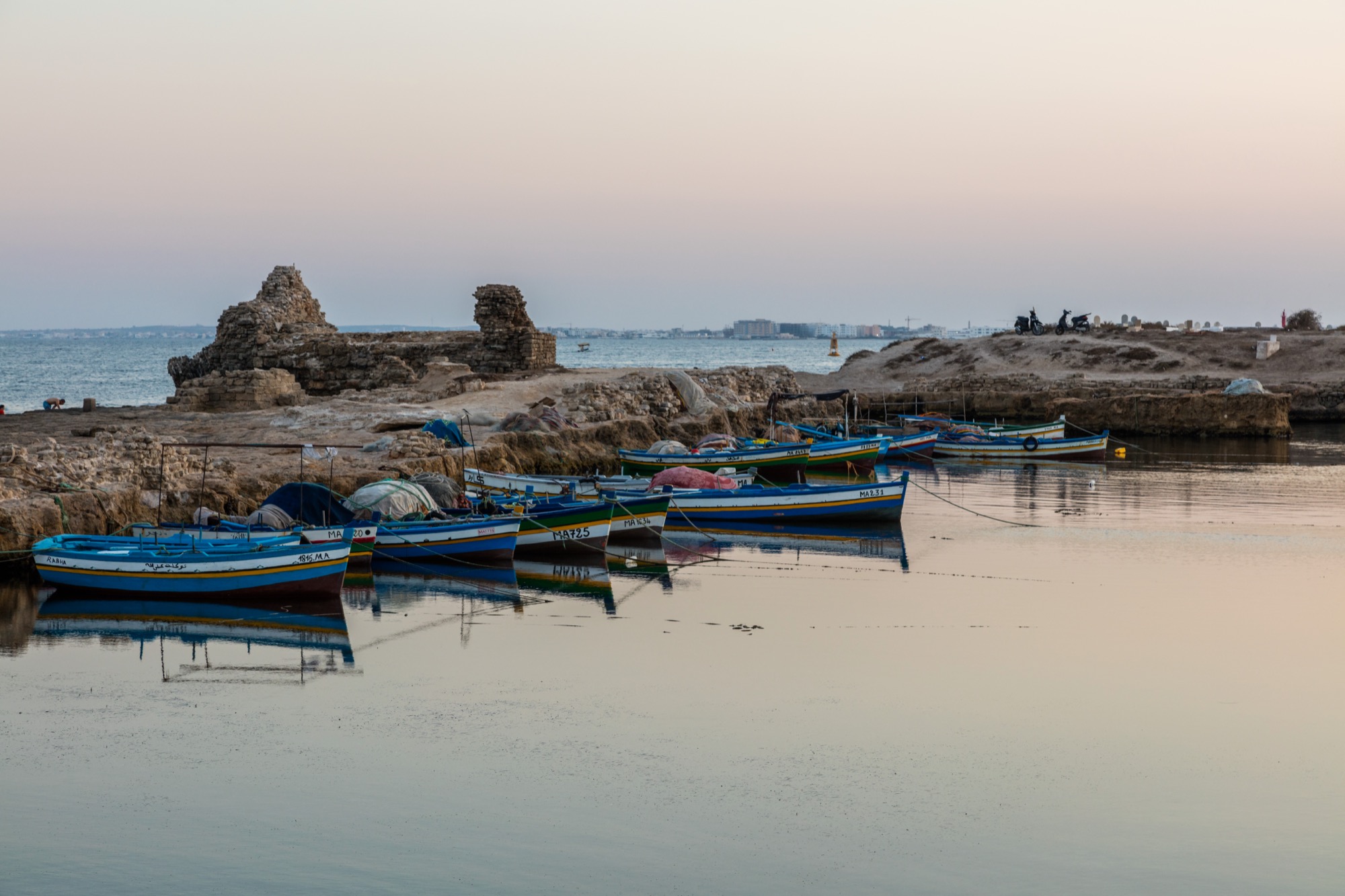
The city of al-Mahdiyya was founded in 916 CE by the Fatimid Caliph ‘Ubayd Allah al-Mahdi bi’llah, who selected a narrow, easily defensible peninsula on the Ifriqiyan coast as the seat of his new dynasty. As Heinz Halm details in “The Empire of the Mahdi: The Rise of the Fatimids” (Brill, 1996), the caliph ordered the construction of an entirely artificial harbor—a basin carved directly from the coastal rock, capable of sheltering up to thirty warships behind a chain that could be drawn across the entrance. This engineering feat, described also by the medieval geographer al-Bakri in his “Kitāb al-Masālik wa’l-Mamālik” (1068), made al-Mahdiyya one of the most formidable naval installations in the medieval Mediterranean. The city was formally inaugurated in 921 CE. Access to the peninsula was controlled through the Skifa el-Kahla (“the dark vestibule”), a massive fortified gateway tunneled through walls reportedly forty feet thick, which Paul Sebag described in “L’Architecture musulmane en Tunisie” as among the most imposing defensive structures of the Fatimid period. Beyond the gateway, the urban plan included a congregational mosque whose austere, fortress-like façade deliberately omitted the minaret—an architectural choice that Jonathan Bloom analyzes in “Arts of the City Victorious: Islamic Art and Architecture in Fatimid North Africa and Egypt” (Yale University Press, 2007) as a statement of Ismaili doctrinal identity. The caliph’s palace complex occupied the tip of the peninsula, while the suburb of Zwaila, laid out beyond the walls, housed the commercial markets, caravanserais, and public baths that served the port’s trading community.
The decorative arts of Fatimid al-Mahdiyya reflected the dynasty’s ambition to rival Abbasid Baghdad in cultural sophistication. Jonathan Bloom’s “Arts of the City Victorious” (Yale University Press, 2007) documents carved stone panels, luster-painted ceramics, and worked ivory that survive from the early Fatimid capitals of al-Mahdiyya and nearby Sabra al-Mansuriyya. The congregational mosque’s entrance portal, with its monumental arched gateway framed by sculptural niches, represents what Bloom calls “the earliest surviving example of a monumental façade in Islamic architecture.” In 1907, Greek sponge divers discovered a Roman-era shipwreck in the waters off Mahdia, yielding one of the most significant underwater archaeological finds of the twentieth century. The vessel, a Greek cargo ship dating to the first century BCE, carried an extraordinary collection of bronze sculptures, marble columns, and decorative furnishings—evidently plundered or traded art objects bound for Rome. Alfred Merlin published the initial excavation reports in “Les fouilles sous-marines de Mahdia” (Comptes rendus de l’Académie des Inscriptions, 1909), and a joint Tunisian-German expedition led further systematic recovery campaigns from 1907 through 1913. The comprehensive exhibition catalog “Das Wrack: Der antike Schiffsfund von Mahdia” (Rheinisches Landesmuseum Bonn, 1994), edited by Gisela Hellenkemper Salies, remains the definitive scholarly treatment of the shipwreck’s cargo. The Bardo National Museum in Tunis today houses major pieces from the find, including bronze Eros figures and marble kraters that testify to the Mediterranean’s long history as a corridor for the movement of luxury art objects.
Al-Mahdiyya’s urban geography was dictated by its extraordinary site: a rocky peninsula roughly 1,400 meters long and only 500 meters wide, connected to the African mainland by a narrow isthmus. This natural formation, described by the tenth-century geographer Ibn Hawqal in “Kitāb Sūrat al-Ard”, gave the city a defensive advantage comparable to Constantinople’s Golden Horn. The peninsula commanded the sea lanes of the Strait of Sicily, the critical maritime chokepoint connecting the eastern and western Mediterranean basins. As S.D. Goitein demonstrated through his monumental analysis of Cairo Geniza documents in “A Mediterranean Society” (University of California Press, 1967–1993), al-Mahdiyya occupied a pivotal position on the trunk route linking Ifriqiya to Palermo, Sicily—a commercial corridor that sustained regular merchant shipping across the central Mediterranean. The city’s relationship to Kairouan, the traditional inland capital of Ifriqiya located roughly 200 kilometers to the northwest, was complementary: Kairouan served as the overland caravan terminus connecting to trans-Saharan trade networks, while al-Mahdiyya provided the maritime outlet. This dual-node arrangement, which Jessica Goldberg examines in “Trade and Institutions in the Medieval Mediterranean: The Geniza Merchants and Their Business World” (Cambridge University Press, 2012), allowed Fatimid Ifriqiya to function as a transshipment zone bridging sub-Saharan African commerce with Mediterranean sea trade. The harbor’s carved-rock basin and the sheltered anchorage along the peninsula’s southern shore gave al-Mahdiyya advantages over rival ports along the Tunisian coast, including Sousse and Sfax.
The Fatimid choice of al-Mahdiyya as a dynastic capital was, as Heinz Halm argues in “The Empire of the Mahdi” (Brill, 1996), fundamentally strategic: the peninsula site offered natural defenses against the Sunni populations of Ifriqiya who had fiercely resisted Ismaili rule. From this fortified base, the Fatimids built the naval fleet that would project their power across the central Mediterranean, raiding the Italian coast and contesting Byzantine control of Sicily. When the Fatimids conquered Egypt in 969 and transferred their capital to the newly founded city of Cairo in 973, al-Mahdiyya lost its status as the seat of the caliphate but retained its commercial importance. The Cairo Geniza letters, systematically analyzed by S.D. Goitein in “A Mediterranean Society” (University of California Press, 1967–1993), reveal that the al-Mahdiyya–Palermo trunk route remained one of the busiest commercial corridors in the eleventh-century Mediterranean. Jessica Goldberg’s “Trade and Institutions in the Medieval Mediterranean” (Cambridge University Press, 2012) traces how Jewish and Muslim merchants operating between these two ports developed sophisticated instruments of commercial trust, including partnership contracts and letters of credit. Ali Asgar Alibhai’s research on the timber trade, presented in “Timber, Trade, and the Fatimids”, documents how North African ports—al-Mahdiyya chief among them—served as critical nodes in the supply of Sicilian and Calabrian timber to the wood-starved coastlands of Ifriqiya. The mid-eleventh century brought disruption when the Banu Hilal, Arab Bedouin tribes whose westward migration was encouraged by the Fatimid court in Cairo, devastated inland Kairouan around 1057. As Michael Brett describes in “The Rise of the Fatimids” (Brill, 2001), this catastrophe paradoxically increased al-Mahdiyya’s importance as the surviving urban center of Ifriqiya. In 1148, Roger II of Sicily’s Norman forces besieged and captured the city, incorporating it briefly into a Christian-ruled Mediterranean empire—an episode David Abulafia analyzes in “The Great Sea: A Human History of the Mediterranean” (Oxford University Press, 2011).
The commercial life of al-Mahdiyya’s port centered on the trunk route connecting Ifriqiya to Palermo, a corridor whose workings are documented in extraordinary detail through the Cairo Geniza letters analyzed by S.D. Goitein in “A Mediterranean Society” (University of California Press, 1967–1993) and further elaborated by Jessica Goldberg in “Trade and Institutions in the Medieval Mediterranean” (Cambridge University Press, 2012). Timber was among the most strategically important commodities flowing through this route: North Africa’s chronic shortage of shipbuilding wood created sustained demand for Sicilian and Calabrian lumber, a trade that Ali Asgar Alibhai has studied in detail. Egyptian flax and finished linen textiles, transshipped through al-Mahdiyya on their way to western Mediterranean markets, constituted another major category of commerce, as Goitein’s analysis of merchant correspondence reveals. Olive oil from the groves of the Sahel region surrounding Mahdia was both a local export and a bulk commodity in Mediterranean trade. Gold arriving via trans-Saharan caravan routes through Kairouan also passed through al-Mahdiyya’s port, connecting sub-Saharan African bullion supplies to the monetary systems of the Mediterranean world—a flow that Andrew Ehrenkreutz examined in “Monetary Change and Economic History in the Medieval Muslim World” (Variorum, 1992). The port’s customs system operated under the Fatimid state’s centralized fiscal administration, which levied duties on imports and exports as described in the Geniza documents. Goldberg notes that merchants frequently discussed customs payments, delays, and the role of state agents in her reconstruction of the institutional framework governing medieval Mediterranean trade.