Akrotiri: Triangle Square and the West House
Akrotiri (Thera / Santorini), Greece · Established 17th century BCE
This site requires authorization to access.
To request access, contact
william.goetzmann@yale.edu
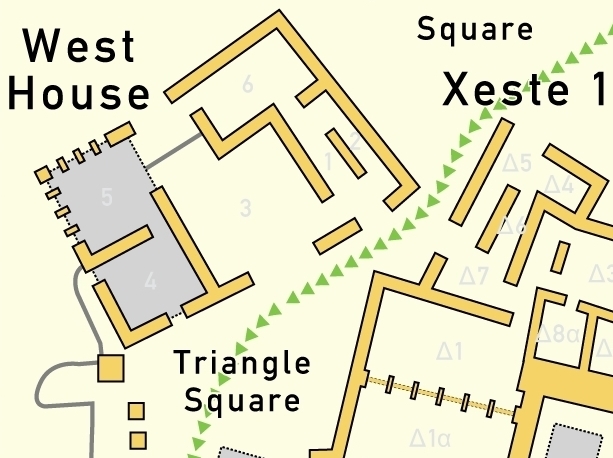
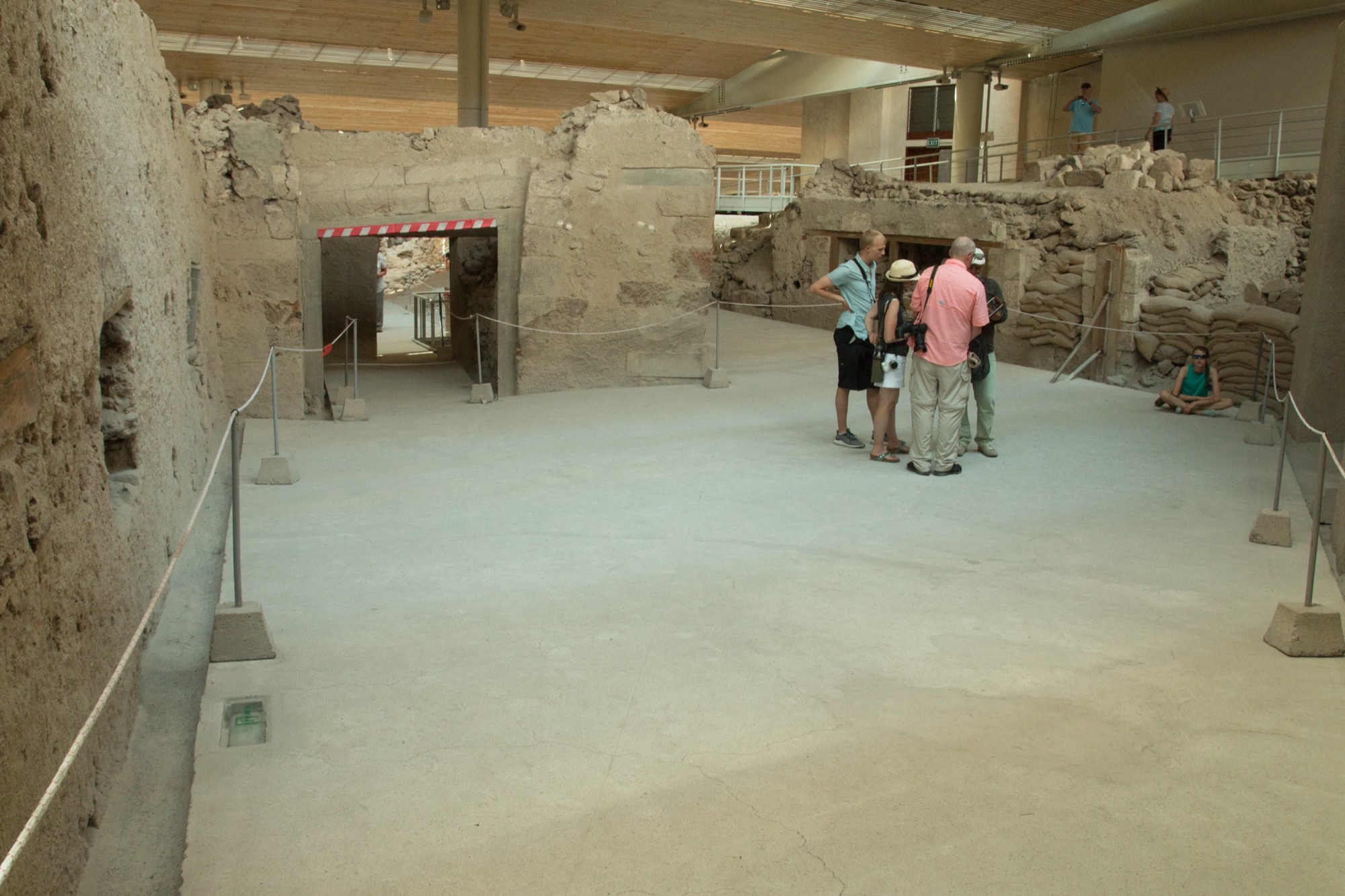
Akrotiri, on the southern shore of the volcanic island of Thera (modern Santorini), preserves one of the most completely surviving towns of the Bronze Age Aegean — a Late Cycladic settlement whose multi-story houses, paved streets, and open plazas were sealed beneath some four meters of volcanic tephra by the Theran eruption dated by radiocarbon to c. 1600 BCE (the conventional archaeological date is c. 1500 BCE). Systematic excavation began in 1967 under Spyridon Marinatos and continued under Christos Doumas, whose Akrotiri: Thera — Thirty Years of Research (Archaeological Society at Athens, 1999) remains the authoritative synthesis. Clairy Palyvou, in Akrotiri Thera: An Architecture of Affluence 3,500 Years Old (INSTAP Academic Press, 2005), documented buildings of two and three stories built in ashlar masonry with timber-reinforced walls, interior staircases, and sophisticated drainage — a domestic architecture more elaborate than anything known at this date from the Greek mainland. Among the most prominent structures is the West House (Doumas's Building 3), a three-story residence of roughly 165 square meters per floor facing the central plaza. Adjacent stand the House of the Ladies, Xeste 3 (a richly frescoed public building interpreted as a venue for rites of passage), Xeste 4, and the Block Delta complex — together delineating the open space that the excavators named Triangle Square. Foundations and in situ pithoi show that ground-floor rooms functioned as workshops and storerooms while living and display rooms occupied the upper stories, an arrangement Palyvou compared to later Mediterranean merchants' houses. The entire excavated area — approximately 13,000 square meters to date — is today enclosed within the bioclimatic shelter designed by Nikos Fintikakis and inaugurated in 2012, which permits continuing excavation under controlled conditions.
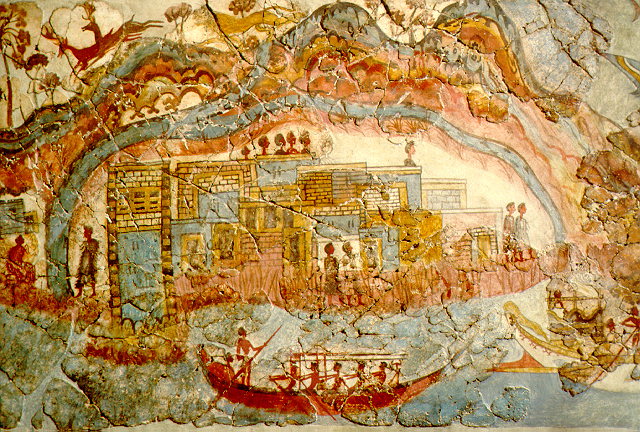
The frescoes of Akrotiri constitute the largest corpus of Bronze Age painting yet recovered and provide unparalleled visual evidence for the commercial world of the Late Cycladic Aegean. In the upper story of the West House, Room 5 preserved on all four walls the so-called Miniature Fresco or Flotilla Fresco, published in definitive form by Lyvia Morgan in The Miniature Wall Paintings of Thera: A Study in Aegean Culture and Iconography (Cambridge University Press, 1988). The south wall depicts a ceremonial fleet of seven oared ships, sail-rigged galleys, and paddled vessels proceeding between two harbor towns — one of the towns widely identified as Akrotiri itself and the other as a foreign port, offering what Morgan described as the earliest known topographic painting in Europe and the closest visual parallel we possess to the mercantile world that the lead weights document materially. Adjacent walls of the same room bore the celebrated Fisherman frescoes and the Priestess holding an incense burner. Nanno Marinatos, in Art and Religion in Thera (1984), analyzed the iconographic programme as a coherent celebration of a maritime household whose identity was bound up with long-distance exchange. Xeste 3 preserves the Saffron Gatherers fresco, in which young women pick crocus stigmas offered to a seated goddess — an image that Ellen N. Davis (American Journal of Archaeology 90, 1986) and Lyvia Morgan have argued depicts an actual saffron trade. Outside the West House, the House of the Ladies fresco and the Spring Fresco of Room Delta 2 demonstrate the extraordinary range of a painters’ tradition that combined Minoan technique with distinctively Cycladic subject matter. Most of the frescoes are now displayed in the Museum of Prehistoric Thera at Fira and in the National Archaeological Museum in Athens.
Thera lies in the southern Cyclades, roughly midway on the sailing route between Minoan Crete and Cyprus, and Akrotiri occupied the most favorable anchorage on the island's southern coast before the eruption reconfigured its topography. The settlement's access to the sea was direct: Telchines Street, the principal thoroughfare of the excavated area, descended from the town center toward the ancient harbor, emptying into Triangle Square, which functioned — as Clairy Palyvou argued in Akrotiri Thera (2005) — as the main circulatory and commercial hub of the town. Imports document the extraordinary reach of Akrotiri's contacts: Egyptian scarabs, Syrian cylinder seals, Melian obsidian, Cypriot copper ingots, and tin from still-unlocated eastern sources have all been recovered in the excavated quarters, confirming the town's position within the exchange network that the Uluburun shipwreck (c. 1300 BCE, some three centuries later) would subsequently materialize in a single cargo. Christos Doumas, in Thera: Pompeii of the Ancient Aegean (Thames & Hudson, 1983), described Akrotiri as a “bridgehead” linking the commercial spheres of the Aegean, the Levant, and Egypt during the Middle and early Late Bronze Age. Within this network, Thera occupied a structurally similar role to that later played by Aegina or Rhodes: an island staging-post whose prosperity derived from service to long-distance commerce rather than from the agricultural resources of its own volcanic soil. The eruption that destroyed Akrotiri — now dated by radiocarbon and by tephra stratigraphy to c. 1600 BCE, as argued by Manning et al. in Science (2014) and in refined form by Pearson et al. (PNAS, 2018) — not only sealed the town for rediscovery but reshaped the island into its present crescent and eliminated Thera's role as a Bronze Age commercial entrepot.
Habitation at Akrotiri reaches back to the fifth millennium BCE, when the site was a small Neolithic fishing and farming settlement, but its commercial prominence developed rapidly in the Middle Cycladic III period (c. 1900–1700 BCE) and reached its apex in the Late Cycladic I (c. 1700–1600 BCE) immediately before the eruption. The town was not rediscovered until 1867, when workers quarrying pumice for the Suez Canal encountered ancient walls; preliminary investigations by the French geologist Ferdinand Fouqué followed, but systematic excavation awaited Spyridon Marinatos, whose campaigns from 1967 to 1974 revealed the scale of the buried settlement. Marinatos famously perished on site in a fall in 1974 and is buried within the excavated area. His successor, Christos Doumas, directed excavations continuously from 1975 and has overseen the long program of conservation and publication; the current director is Nikolaos Papageorgiou, working under the auspices of the Archaeological Society at Athens. Thera's historical importance for the study of money and markets derives from what Anna Michailidou established in a series of fundamental studies — The Lead Weights from Akrotiri (Thera): The Archaeological Record; the synthesis chapter “Measuring by Weight in the Late Bronze Age Aegean: The People Behind the Measuring Tools” in Iain Morley and Colin Renfrew, eds., The Archaeology of Measurement (Cambridge University Press, 2010); and Weight and Value in Pre-Coinage Societies (Athens, 2008). Michailidou catalogued 102 lead balance weights distributed across virtually every excavated building — a concentration roughly three times that known from all of Minoan Crete — with the largest single cluster of 26 weights in the West House alone. Crucially, the weights form a genuine matched balance-set rather than a stray accumulation, and their distribution across private residences rather than centralized palace magazines implies, as Michailidou argued, that weighing at Akrotiri was a household-level practice rather than a palace prerogative. This distributed evidence of commercial activity supports the long-standing archaeological suggestion — associated particularly with Christos Doumas and Clairy Palyvou — that Triangle Square, at the convergence of the town’s main streets and fronted by the weight-rich West House, was Akrotiri’s marketplace: one of the earliest and best-attested candidates for a physical agora anywhere in the Bronze Age world.
Because Akrotiri was sealed so abruptly by volcanic ash, its material record offers a rare snapshot of what actually passed through a Bronze Age marketplace. Textiles are the most plausible local export: Iris Tzachili, in her monograph Yfantiki kai yfantres sto proistoriko Aigaio, 2000–1000 p.Ch. (Weaving and Weavers in the Prehistoric Aegean) and in her chapter “Entangled Threads: Who Owned the West House at Akrotiri” (2016), collated the abundant loom weights and spindle whorls recovered from the West House and argued that its owner was a textile trader whose maritime iconography, concentration of balance weights, and position on Triangle Square together identify a Bronze Age commercial household. Imported commodities document the goods that were bought rather than sold: obsidian from Melos for blade tools, copper ingots and finished bronze objects from Cyprus, tin from sources as yet uncertain but probably reaching the Aegean via Levantine intermediaries, Egyptian scarabs, Syrian cylinder seals, and Canaanite storage jars (see Robert Laffineur and Emanuele Greco, eds., Emporia: Aegeans in the Central and Eastern Mediterranean, Aegaeum 25, 2005). The Akrotiri weights themselves record the interlocking metric systems that made such exchange possible. Most lead discs conform to the Minoan standard of approximately 65.5 grams, but a large stone cone marked with a circle weighs 91 grams — exactly the Egyptian deben — while other pieces reflect the Syrian shekel, indicating that merchants at Akrotiri could convert among the major weight systems of the eastern Mediterranean. As Lorenz Rahmstorf observed in Weights and Marketplaces from the Bronze Age to the Early Iron Age (Oxbow, 2021), the coexistence of multiple metric standards within a single assemblage is the hallmark of a genuine cross-cultural entrepôt. The range of values attested — from roughly 10 grams to 15 kilograms — implies weighing of very different classes of goods, from high-value spices, dyes, and metals at the small end to bulk commodities such as wool, grain, or ingots at the large end. Whether these transactions rose to the institutional threshold that would later define a Greek agora remains debated; but the material record at Akrotiri offers the most convincing physical evidence yet recovered for a distributed, household-scale, cross-cultural market economy in the Bronze Age Mediterranean.