Aihole (Birthplace of the Ayyavole Guild)
Aihole, India · Established c. 5th century CE
This site requires authorization to access.
To request access, contact
william.goetzmann@yale.edu
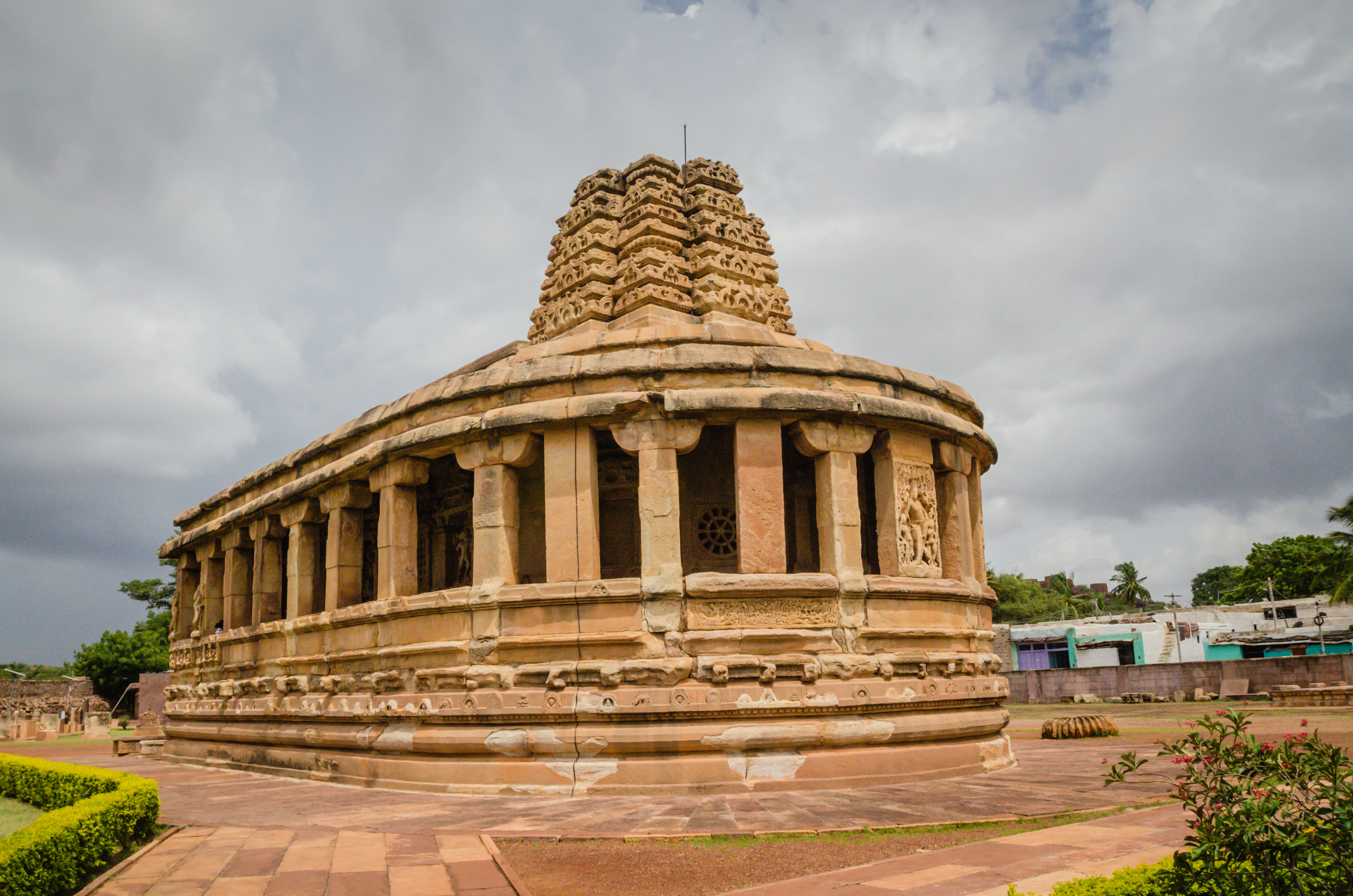
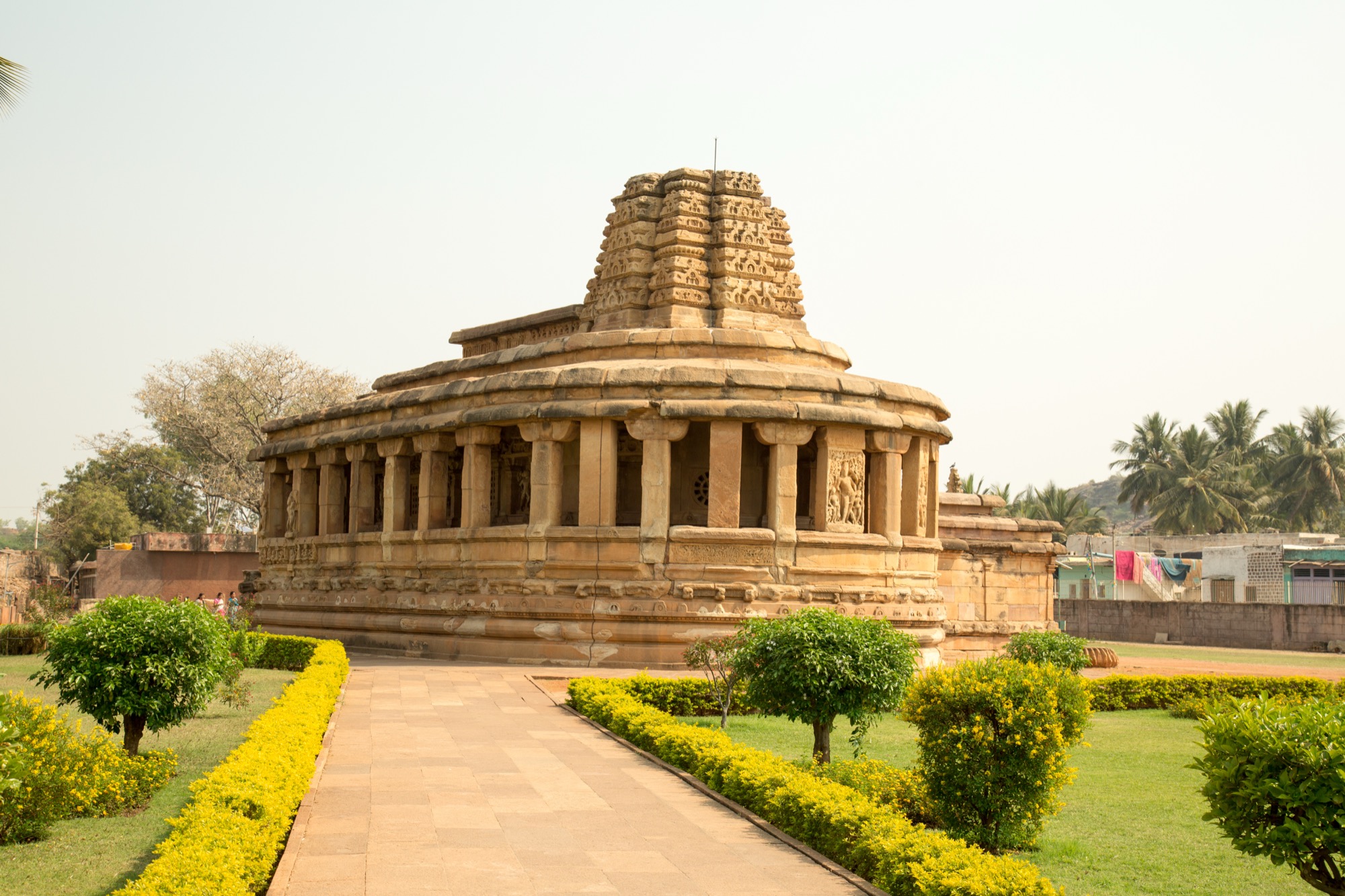
Over 120 stone and cave temples—Hindu, Jain, and one Buddhist—line the Malaprabha River valley at Aihole, dating from the 5th through 10th centuries under the Chalukyas of Badami. The site has long been recognized as what George Michell describes in his study of early Chalukyan architecture as “the cradle of Indian temple architecture,” a vast open-air laboratory of experimental forms including apsidal, circular, and rectangular plans (George Michell, ‘Early Western Chalukya Architecture at Aihole,’ in Temple Architecture and Art of the Early Chalukyas, 2014). The Durga Temple, with its distinctive apsidal layout and elevated plinth encircled by a pillared gallery, remains among the most studied examples of early Dravidian experimentation, as analyzed by Adam Hardy in Indian Temple Architecture: Form and Transformation (1995). The Lad Khan Temple, possibly the oldest surviving structural Hindu temple at the site, employs a flat-roofed mandapa form that prefigures later developments. The Meguti Jain Temple, set atop a hill overlooking the village, bears the celebrated Aihole inscription of 634 CE—a Sanskrit ćampu composed by the court poet Ravikirti praising Pulakeshin II’s victories—studied in detail by D.C. Sircar in Indian Epigraphy (1965). All structures are built from the local Kaladgi sandstone, whose warm ochre tones weather distinctively. The Archaeological Survey of India, which has overseen conservation since the late 19th century, classifies the Aihole complex among the most significant ensembles of early medieval Indian architecture.
The Chalukya sculptural programs at Aihole represent a formative phase of Deccan artistic tradition. Carved panels across the temple complex depict Vishnu in his various avataras, Shiva as Nataraja and Lakulisha, and Jain tirthankaras in meditative postures. Lisa Owen, in Carving Devotion in the Jain Caves at Ellora (2012), situates the Aihole Jain sculptures within the broader trajectory of western Deccan Jain artistic patronage. The experimental temple forms themselves constitute architectural art—the apsidal Durga Temple’s continuous frieze of narrative panels, the Lad Khan Temple’s elaborately carved pillars, and the Hucchimalli Temple’s refined sculptural ornament demonstrate what Carol Radcliffe Bolon terms the “formative experiments” of Chalukya artistic identity (Carol Radcliffe Bolon, Forms of the Goddess Lajja Gauri in Indian Art, 1992). The Aihole inscription of 634 CE is itself a work of calligraphic and literary art: Ravikirti’s nineteen Sanskrit verses in the ćampu style praise Pulakeshin II’s defeat of Harsha and employ elaborate alaṅkāra poetic conventions, as examined by Sheldon Pollock in The Language of the Gods in the World of Men (2006). The inscription’s paleography provides one of the key dating anchors for all early Chalukya monuments. Aihole’s artistic achievements are best understood in relation to the nearby sites of Badami, with its four celebrated cave temples, and Pattadakal, the ceremonial coronation site, together forming what K.V. Soundara Rajan characterizes as a unified Chalukya artistic landscape (K.V. Soundara Rajan, Cave Temples of the Deccan, 1981).
Aihole occupies a strategic position in the Malaprabha River valley of northern Karnataka, approximately 35 kilometers from Badami and 15 kilometers from Pattadakal. Together these three sites form what scholars of the early Chalukya period call the “sacred triangle” of Chalukyan civilization, as described by George Michell and Mark Zebrowski in Architecture and Art of the Deccan Sultanates (1999). The Malaprabha, a tributary of the Krishna, provided both water and a natural corridor for the ancient trade routes crossing the Deccan plateau that connected the western coast ports to interior markets—routes along which the Ayyavole merchant guild would later establish its vast commercial network. The geographer and historian B.R. Grover, in A New Look at Medieval Indian History (1993), emphasizes how Aihole’s location at the intersection of north-south and east-west Deccan trade arteries made it a natural locus for mercantile organization. Today the modern village of Aihole overlays much of the historical site, with residential structures interspersed among the ancient temples. The Archaeological Survey of India has progressively documented and fenced key temple clusters, but the lived character of the site—with agriculture, habitation, and worship continuing alongside the ancient monuments—distinguishes Aihole from more thoroughly excavated sites. The UNESCO World Heritage tentative list includes Aihole as part of the “Evolution of Temple Architecture” nomination alongside Badami and Pattadakal.
The Chalukya dynasty of Badami (c. 543–757 CE) established Aihole as an important cultural and religious center, but the site’s most distinctive historical legacy lies in its identity as Ayyavole—the origin point of the Five Hundred Lords of Ayyavole (Aiṇṇūrruvar), the most powerful and geographically extensive merchant guild in Indian history. Meera Abraham’s foundational study Two Medieval Merchant Guilds of South India (1988) traces the guild’s emergence from the mercantile communities of the Chalukya heartland, documenting how it grew from a regional trading association into a pan-Indian and international commercial organization. The earliest guild inscriptions date from the 9th century, and over 200 Ayyavole inscriptions have been found across present-day Karnataka, Tamil Nadu, Andhra Pradesh, Kerala, and as far afield as Sumatra and mainland Southeast Asia. Y. Subbarayalu, in a series of seminal studies including ‘The State and the Merchant Guilds of South India’ (in South Indian Horizons, 2001), demonstrates that the guild maintained a remarkable degree of autonomy, operating its own system of justice, levying its own taxes on trade, and even maintaining private armies. The guild styled itself as “valiant merchants” (Vīra-Balanjas), and its inscriptions describe members as warriors of commerce who “conquered the six directions.” Kenneth Hall, in A History of Early Southeast Asia: Maritime Trade and Societal Development, 100–1500 (2011), situates the Ayyavole guild within the broader context of Indian Ocean commercial networks, showing how its agents facilitated trade between the Chola and Rashtrakuta empires and the maritime states of Southeast Asia. The guild’s longevity—active from at least the 9th through 14th centuries—and its geographic reach from Karnataka to the Malay Archipelago make it one of the most remarkable commercial institutions of the medieval world.
The Ayyavole guild’s trade network encompassed an extraordinary range of commodities. Guild inscriptions, as catalogued and analyzed by Meera Abraham in Two Medieval Merchant Guilds of South India (1988), enumerate spices (especially pepper, cardamom, and cloves), fine textiles (including cotton cloth and silk), precious and semi-precious stones (rubies, sapphires, pearls), horses imported from Arabia and Central Asia, sandalwood, camphor, and aromatics. The guild’s financial sophistication extended well beyond commodity exchange. Temple endowments functioned as financial instruments: merchants deposited capital with temple authorities, who lent it at interest and used the proceeds for temple maintenance, a practice documented extensively by Burton Stein in Peasant State and Society in Medieval South India (1980). The guild itself acted as a financial intermediary—accepting deposits, making loans to cultivators and artisans, and charging interest rates that inscriptions record at 9 to 12 percent per annum, as analyzed by Y. Subbarayalu in ‘South Indian Merchant Guilds: Their Role in Trade and Urbanization’ (The Indian Economic and Social History Review, 2001). The hundi, or indigenous bill of exchange, was employed by Ayyavole merchants to facilitate long-distance remittances without the physical transfer of specie—a practice that Sanjay Subrahmanyam discusses as part of the broader “commercial revolution” of medieval India (Sanjay Subrahmanyam, The Political Economy of Commerce: Southern India 1500–1650, 1990). Kenneth Hall, in Trade and Statecraft in the Age of the CōḼas (1980), emphasizes how the Ayyavole guild’s international reach connected Deccan markets to the spice trade of the Malay Archipelago, making Aihole’s merchant descendants key intermediaries in the Indian Ocean world system.