Manek Chowk (Sarafa Bazaar and Bullion Market)
Ahmedabad, India · Established 1411
This site requires authorization to access.
To request access, contact
william.goetzmann@yale.edu
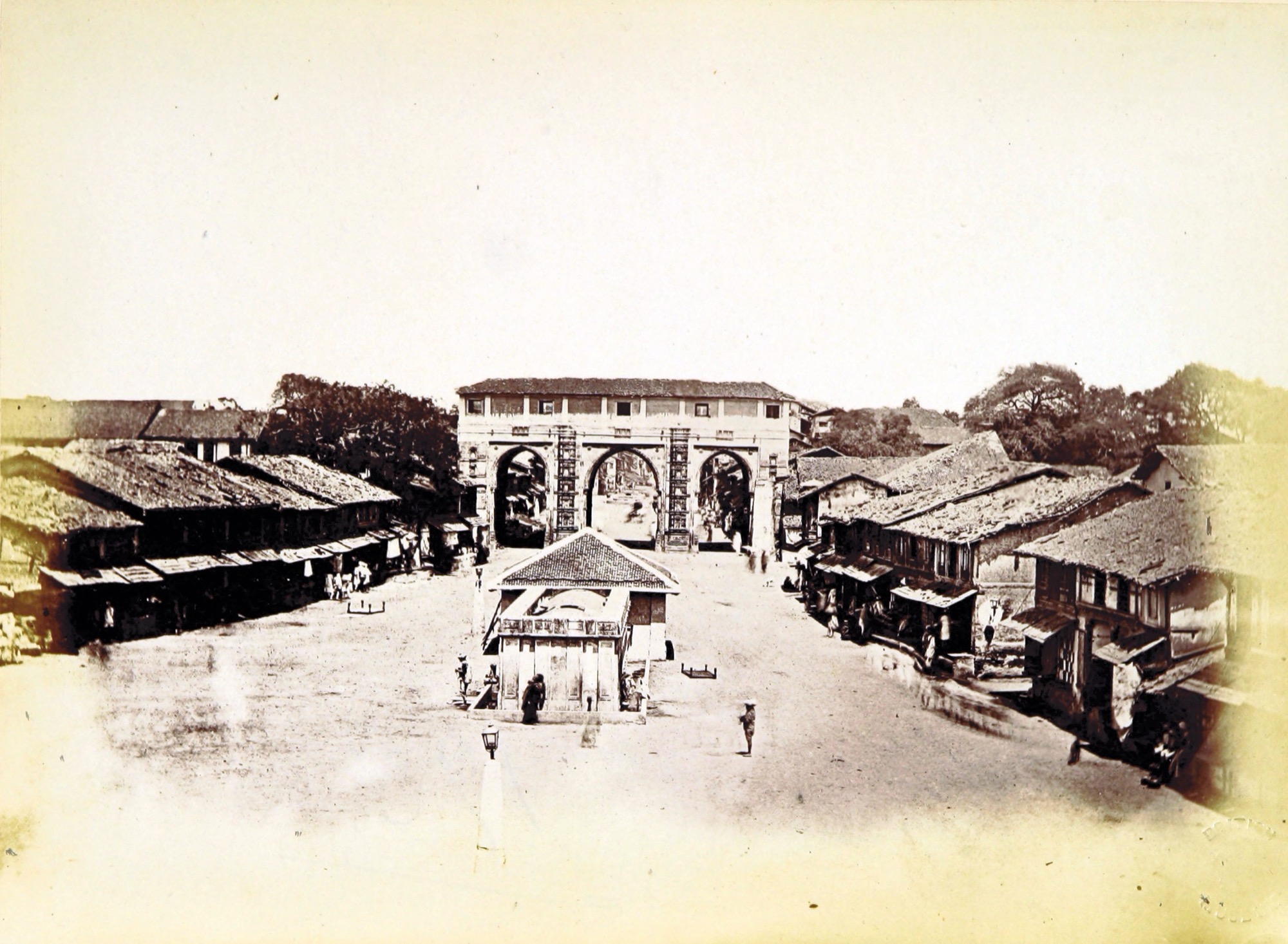
Manek Chowk is an open civic square at the heart of the walled city of Ahmedabad, situated immediately east of the Bhadra Fort citadel built by Sultan Ahmad Shah I in 1411-1413. The square takes its name from Baba Maneknath, a fifteenth-century Hindu ascetic whose shrine still stands at the site. The spatial logic of the marketplace derives from the processional axis that Ahmad Shah established between the Bhadra citadel and the Maidan-i-Shah, the royal square that Teen Darwaza -- the magnificent triple-arched gateway completed in 1415 -- opened onto from the east. As M.S. Commissariat documented in A History of Gujarat (Longmans, 1938), the Sultan conceived this ceremonial corridor as both a seat of sovereignty and a magnet for commerce. The square is flanked by the tombs of Ahmad Shah I (Badshah no Hajiro) and his queens (Rani no Hajiro), whose perforated stone jali screens and domed chambers create an architectural frame of Sultanate-era grandeur. The surrounding bazaar lanes radiate outward through a dense fabric of pols -- gated residential neighborhoods housing between fifty and one hundred closely-packed timber houses, each pol historically organized by caste, profession, or sect. The most notable modern structure on the square is the Old Stock Exchange building, erected in 1919 in British colonial style with a European facade adorned with neo-classical decorations and jharoka-style balconies. This building housed the Ahmedabad Stock Exchange, India's second-oldest after Bombay, until operations relocated in 1996. The building is now listed on the heritage register as part of the UNESCO World Heritage-inscribed Historic City of Ahmadabad (2017), India's first city to receive that distinction.
The decorative environment of Manek Chowk reflects the distinctive Indo-Islamic synthesis that UNESCO recognized as demonstrating Outstanding Universal Value when it inscribed the Historic City of Ahmadabad in 2017. Teen Darwaza, the ceremonial gateway that anchors the western approach to the square, exemplifies this fusion: its three massive pointed arches -- the central span measuring 5.49 meters wide, flanked by two side arches of 4.24 meters each, set in piers 11.28 meters deep -- are ornamented with carved sandstone spandrels depicting elephants, peacocks, and intertwined mythical figures drawn from both Hindu and Islamic iconographic traditions. The tombs surrounding the square display the perforated stone screens (jalis) characteristic of the Gujarat Sultanate style, which the Jama Masjid of Ahmedabad (1424) brought to its fullest expression with over 260 columns and fifteen domes blending lotus motifs from Jain temple architecture with Islamic geometric patterns. V.S. Pramar's study Haveli: Wooden Houses and Mansions of Gujarat (Mapin, 1989) demonstrated how the merchant houses of the surrounding pols developed an elaborate vocabulary of timber carving: massive teak beams supported projecting jharokha balconies festooned with intricate floral and geometric patterns, while carved wooden jali screens filtered the harsh Gujarat sun. The chabutaro -- elevated cylindrical bird feeders found at pol intersections -- represent a distinctively Jain contribution to urban art, embodying the principle of ahimsa (non-violence) in functional architectural sculpture.
Manek Chowk occupies the commercial core of Ahmedabad's walled city, positioned on the eastern bank of the Sabarmati River at the intersection of the city's principal axes of power, worship, and trade. Ahmad Shah I chose this site in 1411 when he transferred his capital from Patan, as the Mirat-i-Ahmadi of Ali Muhammad Khan (completed c. 1750s, translated by M.F. Lokhandwala, 1965) records. The Bhadra Fort, whose forty-three-acre citadel with eight gates anchored the western edge, was complemented in 1487 by Sultan Mahmud Begada's outer wall -- approximately ten kilometers in circumference with twelve principal gates, 189 bastions, and numerous minor entrances. The Jama Masjid (1424), the largest congregational mosque in the Indian subcontinent at the time of its construction, stands north of the processional axis. The square sits at the hub of a dense network of over six hundred pols, whose gated entrances were locked at night for security, creating what the UNESCO inscription described as an exceptional example of multicultural coexistence, with institutions belonging to Hinduism, Islam, Buddhism, Jainism, Christianity, Zoroastrianism, and Judaism coexisting within the walls. As Makrand Mehta argued in Indian Merchants and Entrepreneurs in Historical Perspective (Academic Books International, 1991), this spatial organization enabled the dense networks of trust and credit that sustained Ahmedabad's bullion trade across centuries. The city's commercial geography extended along the Sabarmati, which connected Ahmedabad to the port of Cambay (Khambhat) on the Gulf of Cambay and thence to Indian Ocean trade routes.
Ahmad Shah I of the Muzaffarid dynasty founded Ahmedabad on 26 February 1411 at the site of the older settlement of Asawal. As Sudev Sheth demonstrates in Bankrolling Empire: Family Fortunes and Political Transformation in Mughal India (Cambridge University Press, 2023), the Jhaveri family of Ahmedabad rose to dominate the city's financial life across four generations, beginning with Shantidas Jhaveri (1584-1659), a Jain jeweler and bullion trader (sarraf) who became the wealthiest merchant in seventeenth-century Ahmedabad. Emperor Jahangir conferred on Shantidas the title of Nagarsheth -- chief civic leader and mediator between the merchant guilds (mahajans) and the ruling administration -- an institution that Dwijendra Tripathi analyzed in a seminal IIM Ahmedabad working paper as a unique innovation in urban governance. As court jeweler, Shantidas enjoyed such intimacy with the Mughal household that Shah Jahan reportedly addressed him as mama (maternal uncle). Together with his close associate Virji Vora of Surat, Shantidas supplied most of the capital lent to the Dutch East India Company (VOC) in India, a partnership that Ashin Das Gupta explored in Indian Merchants and the Decline of Surat (Franz Steiner Verlag, 1979). When Akbar conquered Gujarat in 1573, incorporating Ahmedabad into the Mughal empire, the city's mercantile infrastructure remained intact; the nagarsheth institution evolved into a formally sanctioned hereditary office when a Mughal emperor accorded official recognition in 1732. Shantidas's descendant Khushalchand (b. 1680) navigated the turbulent transition to Maratha dominance. British rule arrived in 1818. The establishment of the Ahmedabad Stock Exchange in 1894 -- India's second, after Bombay (1875) -- marked the formalization of securities trading that had begun informally near Manek Chowk, driven by the explosive growth of Ahmedabad's textile mills following Ranchhodlal Chhotalal's founding of the city's first spinning mill in 1861. The exchange moved into its purpose-built colonial building in 1919 and operated from this Manek Chowk location until 1996.
Manek Chowk has functioned as a precious metals and gemstone marketplace since the fifteenth century, and remains one of India's largest bullion bazaars. The sarraf (money-changer and bullion dealer) profession was the foundation of the Manek Chowk economy, as Makrand Mehta documented in Indian Merchants and Entrepreneurs in Historical Perspective (1991). Sarrafs maintained expert knowledge of the purity and relative value of coins circulating across the Mughal empire's numerous mints, and they extended their functions beyond simple money-changing into deposit banking and long-distance funds transfer through the hundi system -- bills of exchange that allowed merchants to move capital between cities without physically transporting coins. As Irfan Habib noted, so brisk was the use of hundis in the Ahmedabad market that merchants settled their obligations almost entirely through these instruments, a practice that made Manek Chowk a de facto clearing house for western Indian commerce. Gold and silver arrived from maritime trade through the port of Cambay and later Surat, where Gujarati merchants like Virji Vora dealt in bullion alongside spices, coral, ivory, opium, and textiles. The gem trade centered on diamonds (from Golconda), rubies, and emeralds. Gujarat's ancient textile industry -- cotton cloth, silk brocades, and the famed patola double-ikat fabrics -- generated the commercial surpluses that fueled the bullion market. The nineteenth-century transformation of Ahmedabad into a modern industrial city, with over eighty cotton mills by independence in 1947, created the securities market that the Ahmedabad Stock Exchange formalized in 1894. Today, Manek Chowk continues its daily metamorphosis -- vegetable market at dawn, India's second-largest jewelry bazaar by midday, street food market by night -- preserving the layered commercial identity of a marketplace that has served as Gujarat's financial heart for over six hundred years.
Images will be added as the project develops. Photographs by Larry Ng and from research sources.