Adelaide Stock Exchange
Adelaide, Australia · Established 1887
This site requires authorization to access.
To request access, contact
william.goetzmann@yale.edu
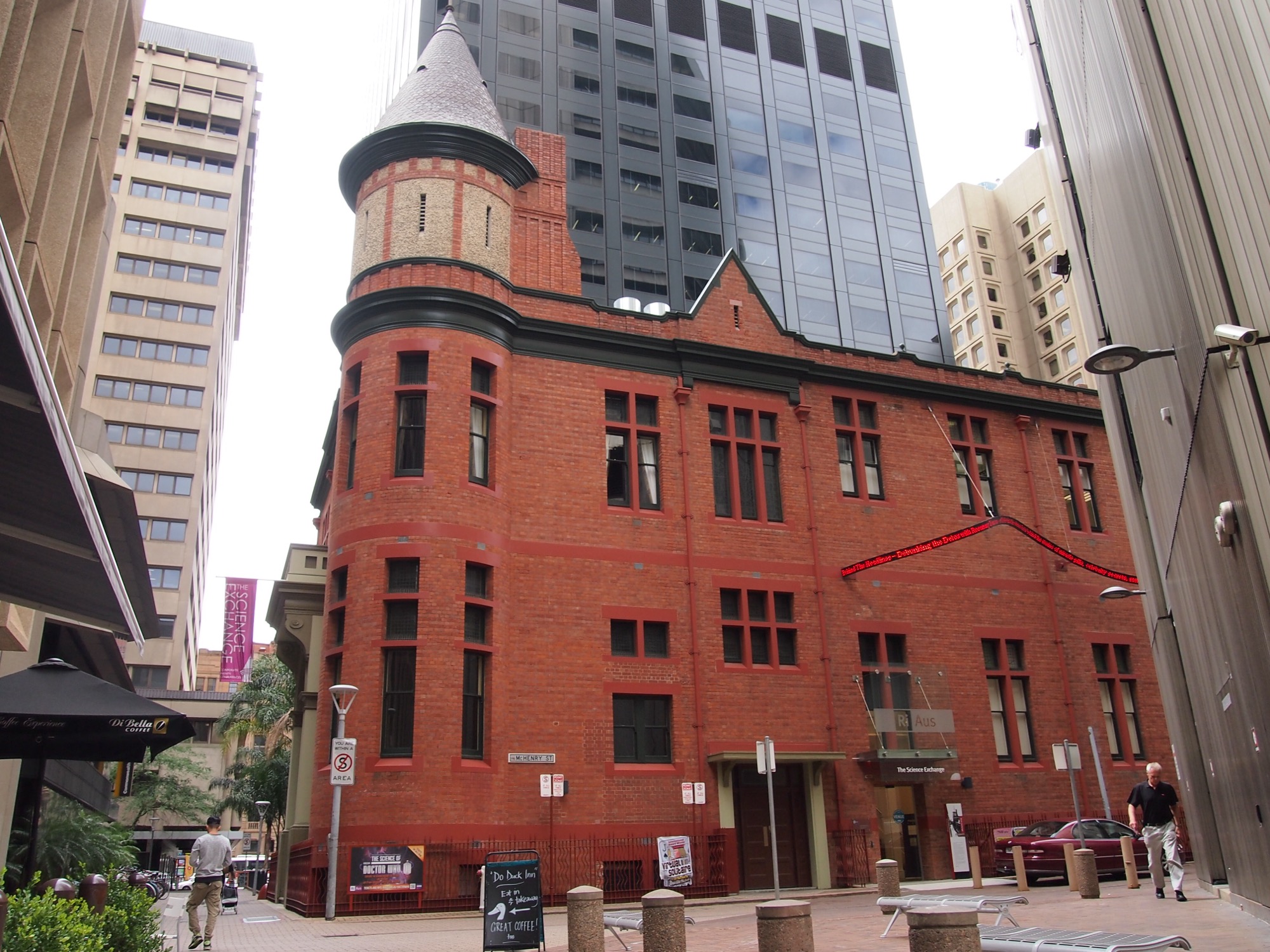
The Stock Exchange of Adelaide occupied several premises before achieving its permanent architectural expression. Founded on 3 October 1887, the exchange first met in Dutton Green’s Pirie Street rooms, moving to the Town Hall Exchange Room in 1888, then to rented space at 86–88 King William Street. The construction of a purpose-built exchange on Exchange Place, between Pirie and Grenfell Streets, marked the institution’s maturation. Architects Henry Ernest Fuller and Hedley Allen Dunn won both first and second prizes in the 1899 design competition, and master builder Walter C. Torode’s tender of £8,380 was accepted in August 1900. South Australian Premier J. G. Jenkins opened the building on 6 September 1901, its completion deliberately coinciding with the inauguration of the Australian Commonwealth. The two-storey red brick structure exemplifies the Federation Free Classical style—one of the few surviving examples in Adelaide’s central district—featuring a prominent corner turret, ornate stonework, and arched window groupings evoking the grand exchanges of Melbourne and Sydney. The building was damaged by fire in 1938 and again in 1982, yet its core fabric survived. Entered on the South Australian Heritage Register on 8 November 1984 (Place No. 11581) and recognized by the Australian Institute of Architects among the 120 nationally significant twentieth-century buildings in South Australia, it was vacated by the exchange in 1991. Purchased by the State Government and sympathetically restored, it reopened in 2009 as the Science Exchange, headquarters of the Royal Institution of Australia (RiAus)—a rare instance of a historic trading hall finding renewed public purpose (Susan Marsden, Paul Stark, and Patricia Sumerling, Heritage of the City of Adelaide, Corporation of the City of Adelaide, 1990).
The decorative program of the Adelaide Stock Exchange achieves its fullest expression in the extraordinary stained-glass window dominating the main stairwell—a work embedding the iconography of empire and federation within the daily passage of colonial finance. Commissioned by the Hon. Sir George Brookman (1850–1927), mining magnate, sharebroker, and exchange member, the window was produced by the renowned London firm Morris & Co., making it the first work by that celebrated workshop brought to South Australia and the only secular Morris & Co. window in Adelaide. Designed by John Henry Dearle (1859–1932), who had succeeded William Morris as chief designer, the window reused cartoons originally drawn by Edward Burne-Jones, blending Pre-Raphaelite figuration with Arts and Crafts ornament. The six-panel work, measuring 301 by 210 centimetres in coloured glass and lead, was installed in 1902 (Art Gallery of South Australia, Accession No. 20072A15). Its lower panels depict allegorical figures representing Britain and her colonies—Australia, Canada, India, New Zealand, and South Africa—accompanied by emblematic fauna: kangaroo, beaver, tiger, and ostrich. Upper panels personify Morning, Sun, and Evening. Though titled “Federation,” the iconographic scheme is more properly an image of imperial commerce, its placement in a stock exchange stairwell framing every broker’s ascent to the trading floor as a passage through the visual rhetoric of global trade. Lesley Baker’s study of Dearle’s contribution to Morris & Co. (William Morris Society Journal, 2002) notes the Adelaide commission as evidence of the firm’s reach into antipodean institutional patronage. Remarkably, the Morris window survived both the 1938 and 1982 fires, preserving one of the most significant decorative art installations in any Australian exchange building.
The Adelaide Stock Exchange occupies a position within one of the most deliberately planned urban grids in the British colonial world. Colonel William Light’s 1837 survey laid out Adelaide’s 1,042 town acres in a precise grid bisected by King William Street, the broad north-south thoroughfare intended as the city’s principal axis. Adelaide was the first city planned using trigonometrical rather than running survey, and Light’s plan—later cited by Ebenezer Howard in Garden Cities of To-morrow (1902)—established a garden-city prototype with its encircling parklands. The exchange’s siting on Exchange Place, a short lane just east of King William Street, placed it within the financial core crystallizing along that axis from the 1840s onward. As the SA History Hub documents, increased economic activity following the development of copper mines at Kapunda (1842) and Burra (1845) generated demand for financial services, drawing banks and insurance companies to King William Street. Between 1851 and 1867 the Bank of Australasia, Bank of New South Wales, Savings Bank of South Australia, English Scottish and Australian Bank, and National Bank of Australasia all constructed imposing premises. Thomas Greaves Waterhouse erected his offices at King William and Rundle Streets in 1848 with profits from the Burra Burra copper mine. By the time the Stock Exchange was established in 1887, the financial district was firmly anchored to Light’s central axis, standing within steps of Parliament House, Government House, and the banking precinct—embedding share trading within a dense institutional landscape of colonial governance and capital.
The Stock Exchange of Adelaide was formally constituted on 3 October 1887, the fifth of Australia’s six colonial capital city exchanges, following Melbourne (1861), Sydney (1871), Hobart (1882), and Brisbane (1884). Its founders organized against the backdrop of the Broken Hill mining boom. Charles Rasp’s 1883 discovery of silver-lead-zinc deposits at Broken Hill, just fifty kilometres east of the South Australian border, had transformed the colonial economy; the Broken Hill Proprietary Company, floated in Melbourne in August 1885, was by 1887 at the centre of speculative frenzy (National Museum of Australia, Defining Moments). Membership grew from the original handful to seventy by 1890, with entrance fees rising from £25 to £1,000. Trading operated on the call system, where an official called out listed companies in sequence while brokers bid or offered. The first interstate conference of Australian exchanges convened in 1903, and in 1937 the Australian Associated Stock Exchanges was formalized with uniform listing rules. The Adelaide exchange gained international notoriety during the Poseidon nickel boom of 1969–1970, when Adelaide stockbroker Norman Shierlaw vended mining claims into the dormant Poseidon NL, listed on the Adelaide board. Following a nickel discovery at Mount Windarra, Poseidon’s shares rose from $1.85 to $280, valuing the company at $700 million. The subsequent crash prompted Senator Peter Rae’s 1974 Senate Select Committee report documenting insider trading and manipulation, leading to national securities legislation (John Simon, “Three Australian Asset-Price Bubbles,” Reserve Bank of Australia Conference, 2003). On 1 April 1987, the Adelaide Stock Exchange merged with the five other state exchanges to form the Australian Stock Exchange (ASX). Trevor Sykes’s The Money Miners (1978) and Salsbury and Sweeney’s The Bull, the Bear and the Kangaroo (1988) remain foundational accounts.
The Adelaide Stock Exchange’s listings mirrored South Australia’s distinctive commodity base. Mining shares dominated from inception, beginning with the Broken Hill silver-lead-zinc companies that precipitated the exchange’s formation in 1887. Although Broken Hill lay across the border in New South Wales, its economic orbit was firmly South Australian: smelting commenced at Port Pirie in 1889, and BHP took over the port smelters in 1892, tying Broken Hill’s industrial chain to Adelaide’s capital markets. Earlier, the colony’s copper mines had established South Australia’s identity as a mining economy. The South Australian Mining Association’s “Monster Mine” at Burra, opened in 1845, paid extraordinary dividends—in some years returning 800 per cent—while the Kapunda copper mine (1842) was among Australia’s earliest mineral ventures. By 1850 copper production value exceeded grazing and agriculture combined, establishing patterns of speculative mining investment persisting through the exchange’s history. The Western Australian gold rush of the 1890s brought a second wave of mining securities as brokers like George Brookman formed syndicates investing in Coolgardie and the Kalgoorlie Golden Mile. Pastoral company stocks reflected the wool, wheat, and livestock economy. Government bonds provided conservative counterweight. The Poseidon nickel boom of 1969–1970 demonstrated the exchange’s continuing centrality to Australian resource speculation: Adelaide-listed Poseidon NL achieved $700 million market capitalization before collapse triggered regulatory reform (Rae Committee Report, 1974). The no-liability share structure, an Australian innovation from 1870s Victorian legislation allowing investors to abandon unprofitable calls, was the essential instrument enabling the speculative mining culture defining Adelaide’s trading floor for a century.
Images will be added as the project develops. Photographs by Larry Ng and from research sources.