Ghana Stock Exchange (GSE)
Accra, Ghana · Established 1989
This site requires authorization to access.
To request access, contact
william.goetzmann@yale.edu
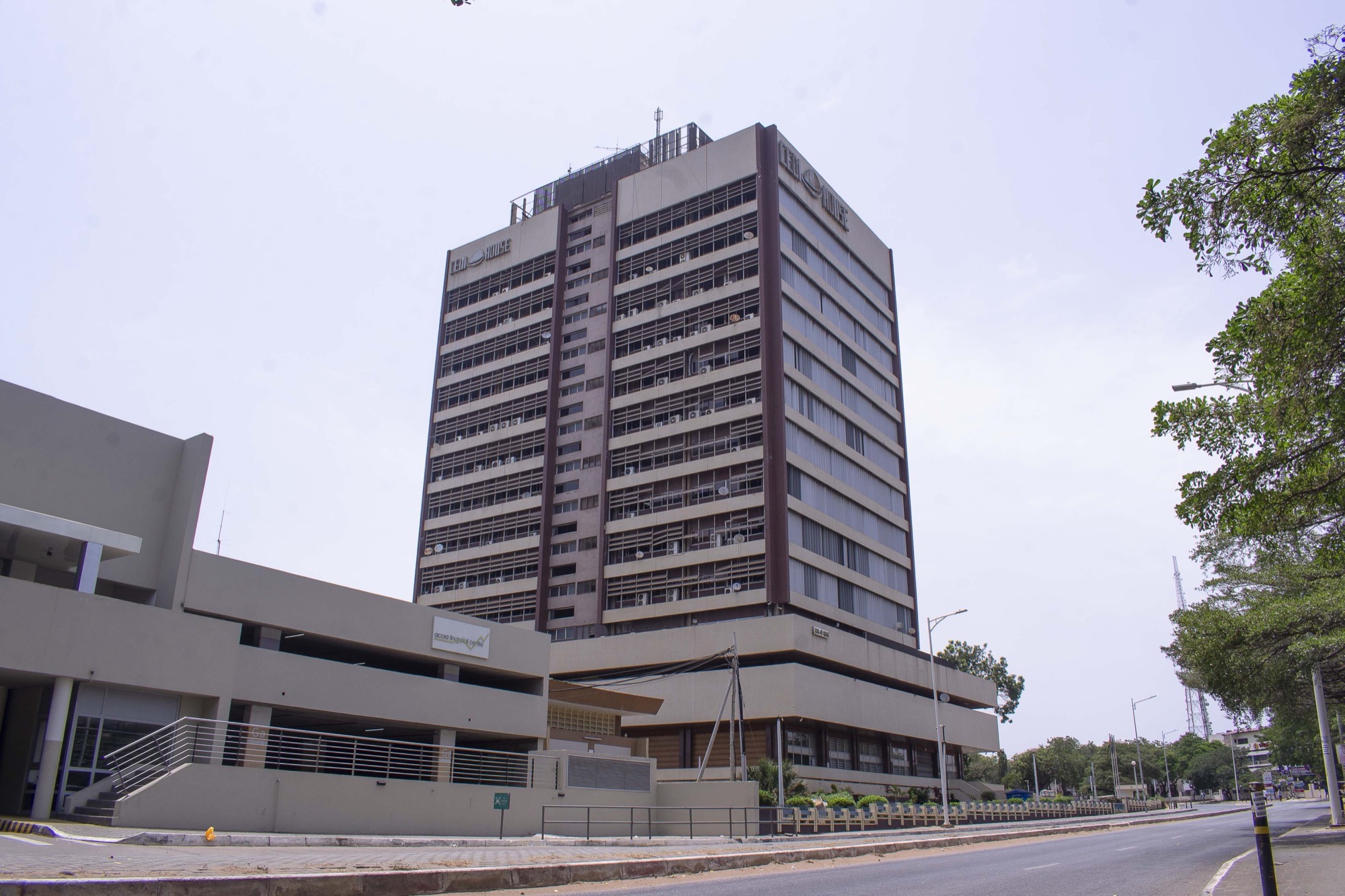
The Ghana Stock Exchange occupies the fifth and sixth floors of Cedi House, a fourteen-storey reinforced-concrete tower on Liberia Road in Accra’s Ridge district. Designed by Professor John Owusu Addo—one of the first indigenous Ghanaian architects to receive major government commissions—the building was constructed between 1970 and 1973 as the headquarters of the Bank of Ghana. Owusu Addo, who trained at the Kwame Nkrumah University of Science and Technology, employed a distinctive tropical modernist vocabulary: each façade responds differently to solar and climatic conditions through horizontal bands of glazing, motorized brise-soleils, perforated breeze-block screens, and deep overhangs that promote cross-ventilation while deflecting equatorial sun. As Hannah le Roux and Ola Uduku note in their study of Ghanaian architects at the 2023 Venice Architecture Biennale, these devices represented a conscious “reappropriation” of tropical modernism as a symbol of postcolonial sovereignty. Inside, marble wall cladding and an exposed ceremonial staircase lend the public floors a monumental quality. The tower was also the first building in Ghana to incorporate a two-level underground car park. A ResearchGate study by Nana Osei Bonsu, “Tropical Modern Architect: Prof. John Owusu Addo” (2023), documents how Cedi House’s east-west orientation and rhythmic façade became a template for subsequent commercial high-rises in Accra.
The decorative programme of Cedi House reflects the symbolic ambitions of post-independence Ghana, where state architecture was enlisted to project economic modernity. The building’s most prominent visual feature is its rhythmic external screen of brise-soleils—horizontal and vertical sun-shading fins whose geometric patterns recall indigenous Adinkra textile motifs, a connection explored in the Victoria and Albert Museum’s 2023 exhibition “Tropical Modernism: Architecture and Independence in Africa and South Asia.” The lobby and banking halls on lower floors are finished in polished marble cladding, a material choice that, as the docomomo Accra chapter has documented, signalled institutional gravitas in the context of newly sovereign African central banks. The exchange floors themselves are more functionally appointed, featuring the electronic display boards of the Ghana Automated Trading System (GATS) installed in 2008, which replaced the original manual call-over boards. Cedi House takes its name from the national currency—the cedi, derived from the Akan word for cowrie shell—and the building’s identity thus encodes Ghana’s deep monetary heritage within its modernist shell. The Transnational Architecture Group’s 2018 field notes from Accra describe the tower’s façade as a “visual metronome” whose alternating opaque and transparent bands establish a civic rhythm along Independence Avenue.
Cedi House stands on Liberia Road at the edge of Accra’s Ridge neighbourhood, the administrative quarter that the British colonial government developed in the early twentieth century as a European residential enclave set apart from the commercial bustle of Jamestown and Usshertown along the coast. After independence in 1957, Kwame Nkrumah’s government repurposed Ridge as the seat of sovereign institutions, and Independence Avenue—running past Cedi House—became the ceremonial spine linking the new state’s political and financial apparatus. Today the immediate surroundings concentrate Ghana’s financial infrastructure: the Bank of Ghana’s main headquarters at 42 Castle Road is nearby, while CalBank, Standard Chartered, Agricultural Development Bank, and Republic Bank Ghana all maintain major offices along Independence Avenue. The Securities and Exchange Commission and the Central Securities Depository also operate from Cedi House itself, creating a vertical financial district within a single tower. This clustering parallels what Kwame Amoah Labi describes in his urban studies of Accra as a shift from the colonial-era commercial waterfront to an inland institutional corridor oriented toward the airport and the expanding northern suburbs. The GSE’s location within the central bank’s own building underscores the close regulatory relationship between monetary authority and capital market that characterized Ghana’s early post-liberalization economy.
The Ghana Stock Exchange was incorporated in July 1989 as a private company limited by guarantee under the Companies Code of 1963, received authorization under the Stock Exchange Act of 1971 (Act 384), and commenced trading on November 12, 1990, with eleven listed equities and one government bond. Its creation was a direct consequence of the Economic Recovery Program (ERP) launched in 1983 under Flight Lieutenant Jerry Rawlings with IMF and World Bank guidance, which mandated the privatization of state-owned enterprises—some 300 of which were divested by 2000—and required a formal securities market to absorb the resulting share offerings. In 1994, the GSE All-Share Index surged 124 percent, and the Fédération Internationale des Bourses de Valeurs declared it the best-performing emerging stock market in the world. A landmark moment came in 1996 when Ashanti Goldfields Corporation, cross-listed on the GSE and the London Stock Exchange, became the first African-operated company to list on the New York Stock Exchange, raising over $450 million and signalling Ghana’s integration into global capital flows. The exchange adopted electronic trading in November 2008 with the Ghana Automated Trading System (GATS), replacing the original manual call-over method. In 2015 the Ghana Fixed Income Market (GFIM) was launched for secondary trading in government and corporate bonds. The 2022 sovereign debt crisis—when Ghana defaulted on external obligations and restructured some 137 billion cedis in domestic debt—severely disrupted the exchange, though it also prompted regulatory modernization under the Securities Industry Act of 2016 (Act 929).
The Ghana Stock Exchange lists equities, corporate bonds, government securities, and exchange-traded funds across several market segments. The main market hosts large-capitalization firms spanning brewing (Guinness Ghana, Accra Brewery), banking (GCB Bank, Ecobank Ghana, CalBank), mining (AngloGold Ashanti, Atlantic Lithium), insurance (Enterprise Group, SIC Insurance), and manufacturing (Unilever Ghana, Fan Milk, PZ Cussons). The Ghana Alternative Market (GAX), introduced in 2015, serves small and medium enterprises with relaxed listing requirements to broaden capital access. The Ghana Fixed Income Market (GFIM), also established in 2015, provides a dedicated electronic platform for secondary trading of Treasury bills, government bonds, and corporate debt instruments, with the Bank of Ghana and the Ghana Association of Bankers as founding stakeholders. A Commercial Paper Market facilitates short-term corporate borrowing, and a Green and Sustainable Bond Market has been added for environmentally linked issuances. Trading is conducted through the Ghana Automated Trading System (GATS), an electronic order-matching platform that replaced the earlier manual call-over system in 2008. The CFA Institute Research Foundation’s country brief on Ghana notes that the exchange lists approximately 42 equities from 37 companies, with manufacturing, brewing, and banking sectors dominating by market capitalization. The GSE Composite Index, introduced in 2011 with a base value of 1,000 points, serves as the principal benchmark, succeeding the earlier All-Share Index.
Images will be added as the project develops. Photographs by Larry Ng and from research sources.