Bourse Régionale des Valeurs Mobilières (BRVM)
Abidjan, Ivory Coast · Established 1998
This site requires authorization to access.
To request access, contact
william.goetzmann@yale.edu
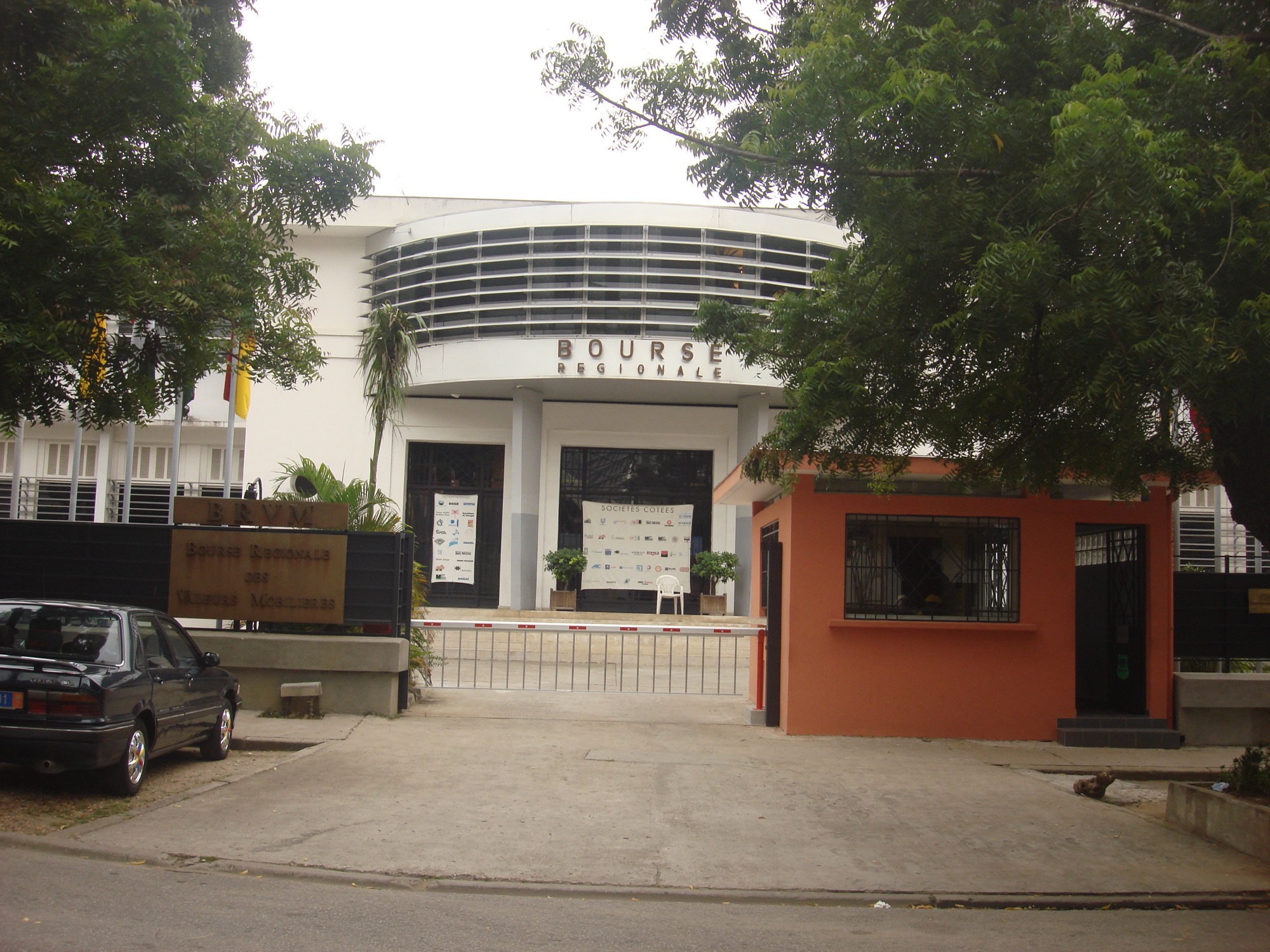
The Bourse Régionale des Valeurs Mobilières occupies offices at 18 Avenue Joseph Anoma—known locally as the Rue des Banques—in the Plateau district of Abidjan, Côte d’Ivoire. Unlike the monumental exchange halls of European tradition, the BRVM was conceived from inception as a fully electronic institution requiring operational headquarters rather than a trading floor. When the exchange commenced operations on 16 September 1998, it inherited no purpose-built bourse; instead, it established itself within the existing commercial fabric of the Plateau, Abidjan’s central business district. The headquarters sits amid the modernist towers and colonial-era administrative buildings that define the Plateau’s skyline, an architectural landscape shaped by decades of ambitious urban planning. As Antonio Lauria documented in “Systemic Shifts: The Case of Abidjan’s Urban Planning, 1945–60” (Journal of Architectural Education, 2014), French architect Daniel Badani arrived in 1947 to draft the city’s first comprehensive plan, approved in 1952, which established the Plateau as the administrative and commercial nerve center. The SETAP plan of 1959 further consolidated this vision. The Rue des Banques corridor where the BRVM stands reflects this planning legacy—a concentrated strip of financial institutions including the regional BCEAO agency, commercial banks, and insurance companies. The exchange’s physical modesty belies its technological ambition: when decentralized electronic trading launched in March 1999, a satellite network connected trading stations across eight West African countries to the central site in Abidjan, making it one of Africa’s first fully electronic exchanges. Brokers need not be present at the headquarters; they engage from workstations in their own offices via the dedicated network, a design choice that rendered the grand trading hall unnecessary. The BRVM thus represents a new paradigm in exchange architecture—the exchange as telecommunications hub rather than monumental gathering place.
The BRVM’s visual identity draws less from the tradition of exchange-hall decorative programs than from the broader visual culture of West African commerce and the architectural heritage of its Plateau neighborhood. No grand allegorical sculptures or painted ceilings adorn its offices in the manner of European bourses. Instead, the exchange’s aesthetic context is shaped by its setting amid Abidjan’s distinctive modernist landmarks. The most celebrated of these is La Pyramide, designed by Italian architect Rinaldo Olivieri and completed in 1973, which the Architectural Review has described as a conscious attempt to translate the spatial energy of an African market into built form. As documented by a 2020 exhibition text at MoMA (“Beyond the Modern Architect: La Pyramide, African Labor, and Rinaldo Olivieri’s Lens in Abidjan”), Olivieri conceived the stepped concrete terraces of this truncated pyramid as an evocation of covered market stalls—a Brutalist interpretation of indigenous commercial space. The BCEAO agency buildings throughout the WAEMU zone, designed by architects including Pierre Goudiaby Atépa, similarly project institutional authority through modernist form, as discussed in the Failed Architecture essay “BCEAO and BEAC Buildings: The Lonely Towers of African Capitals” (2018). The visual culture of the CFA franc itself constitutes a relevant decorative tradition: the banknote series circulating from 2003 to 2019, issued by the BCEAO, featured the stylized sawfish—a symbol of fertility and prosperity in West African mythology—as its central motif. The currency’s iconography of fish, birds, and agricultural scenes reflects the commodity wealth that underlies the region’s financial markets. The BRVM’s own corporate identity, with its distinctive logo and the visual apparatus of its electronic trading platform, represents the contemporary equivalent of exchange decoration—the digital interface as the new public face of the marketplace.
The Plateau district of Abidjan, where the BRVM maintains its headquarters, is the product of a century of deliberate commercial urbanism on the shores of the Ébrié Lagoon. The site’s strategic significance was recognized in the colonial period: French administrators in 1925 designated the elevated peninsula between the lagoon and the ocean as the European administrative quarter, physically separated from the African residential areas of Treichville by the Gallieni Military Barracks. As the United Nations University study “Abidjan: From the Public Making of a Modern City to Urban Management of a Metropolis” documents, the completion of the Vridi Canal in the 1950s—providing deep-water access from the Atlantic to the calm lagoon waters—transformed Abidjan from a secondary colonial outpost into West Africa’s premier port city. The Abidjan-Niger railway terminus at the Plateau’s edge further cemented its role as a commercial hub connecting coastal trade with the Sahelian interior. By the late 1950s, Abidjan had surpassed Dakar as West Africa’s financial capital, a status it retains. Nicknamed “Little Manhattan” for its concentration of towers overlooking the lagoon, the Plateau houses the regional headquarters of major banks, the BCEAO agency, government ministries, and the principal commercial courts. The Rue des Banques, where the BRVM is located, forms a financial axis that concentrates institutional power within a few city blocks. The district’s compact geography—constrained by lagoon waters on multiple sides—drove vertical development, producing an impressive skyline dominated by the Cité Administrative towers (the tallest at 120 meters), La Pyramide, and numerous bank headquarters. As the Global Business Districts Innovation Club noted when admitting the Plateau in 2022, it functions as one of Africa’s most concentrated financial districts, housing institutions that serve not only Côte d’Ivoire but the entire WAEMU region. The exchange’s placement here, rather than in Dakar where the BCEAO maintains its headquarters, reflected Abidjan’s established primacy as West Africa’s commercial gateway.
The BRVM’s origins lie in the postcolonial ambition to create indigenous capital markets in francophone West Africa. The Bourse des Valeurs d’Abidjan (BVA), established by presidential decree in 1974 and operational from 1976, was the first stock exchange in the CFA franc zone, created to encourage domestic investment and provide Ivorian industries with access to capital markets. As documented in the Country Data economic profile of Côte d’Ivoire, the BVA remained a modest institution—thinly traded, with limited listings drawn primarily from Ivorian subsidiaries of French firms. The transformative step came on 17 December 1993, when the WAMU Council of Ministers decided to create a Regional Financial Market and mandated the Central Bank of West African States (BCEAO) to lead the project. The institutional design was unprecedented: rather than linking separate national exchanges, the eight WAEMU member states—Benin, Burkina Faso, Côte d’Ivoire, Guinea-Bissau, Mali, Niger, Senegal, and Togo—would share a single exchange under common regulation. On 18 December 1996, the BRVM and the Central Depository/Securities Settlement Bank (DC/BR) were formally incorporated in Cotonou, Benin. The Regional Council for Public Saving and Financial Markets (CREPMF, now AMF-UMOA) was established as the supranational regulator in November 1997. The BVA closed at the end of December 1997, and the BRVM commenced trading on 16 September 1998, absorbing all BVA listings. As the Oxford Business Group’s report on Côte d’Ivoire (2020) details, the exchange’s early years coincided with the political crisis that engulfed its host country: the 1999 coup d’état, the contested 2000 elections, and the devastating civil war that erupted in September 2002 split the country and paralyzed economic activity. The BRVM Composite Index fell to a record low of 65.2 points in August 2003. Despite the turmoil, the exchange’s regional structure provided resilience—Senegalese and other non-Ivorian listings continued to anchor the market. Recovery began in earnest after 2011, when the end of the post-election crisis under President Ouattara unleashed a period of rapid economic growth. The BRVM Composite rose 39.3 percent in 2013, its best annual performance. In 2017, the exchange created a Third Compartment for small and medium enterprises, and in 2013 the West African Capital Markets Integration Council (WACMIC) was inaugurated to explore broader integration with anglophone exchanges in Nigeria and Ghana. As Kalu Emenike demonstrated in “Interdependence among West African Stock Markets” (African Development Review, 2021), the BRVM’s relationship with the Nigerian and Ghanaian markets reveals patterns of emerging but still limited regional financial integration. By 2024, market capitalization had reached a record 10,200 billion CFA francs (approximately $17 billion), confirming the BRVM’s status as Africa’s fifth-largest exchange.
The BRVM trades equities and bonds denominated in the West African CFA franc (XOF), the common currency of the eight WAEMU member states maintained at a fixed parity with the euro by the BCEAO. As of 2025, the exchange lists approximately 46 equities organized into three compartments and over 150 bond lines. As the MarketVector research note “Hidden Gems: West Africa’s Capital Market Pioneer” (2024) details, the equity market is dominated by telecommunications and banking: Sonatel of Senegal, the regional telecommunications giant majority-owned by Orange, and Orange Côte d’Ivoire together account for approximately half of the exchange’s free-float market capitalization. Banking groups—including Société Générale Côte d’Ivoire, Ecobank, and the Bank of Africa network operating across multiple WAEMU states—form the second-largest sector. Industrial listings include SODECI (water utility), SOLIBRA and Société des Brasseries (breweries), and agricultural firms processing palm oil, rubber, and sugar—reflecting Côte d’Ivoire’s commodity-based economy. The bond market has grown dramatically: in 2025, a record 4,204.7 billion CFA francs ($7.5 billion) was raised on the primary market, with sovereign borrowers accounting for over 95 percent of issuance, as WAEMU member states increasingly tap the regional market for deficit financing. Senegal alone registered four bond issues for a record 405 billion CFA francs in 2025, as reported by Financial Afrik. Trading is conducted entirely electronically through a centralized system at the Abidjan headquarters, with broker-dealers in each of the eight member states connected via satellite and internet links. The exchange operates a continuous auction system. As the African Development Bank’s African Securities Markets Competitiveness Study (2022) documented, the BRVM’s unique cross-border structure—combining countries with a collective GDP of approximately $160 billion under a single market infrastructure—avoids the competitive barriers that have stymied other African exchange integration efforts. The exchange’s role extends beyond trading to regional economic governance: by providing a common platform for sovereign debt issuance, it reinforces the fiscal discipline framework of the WAEMU monetary union and channels regional savings toward public investment across the zone.
Images will be added as the project develops. Photographs by Larry Ng and from research sources.